
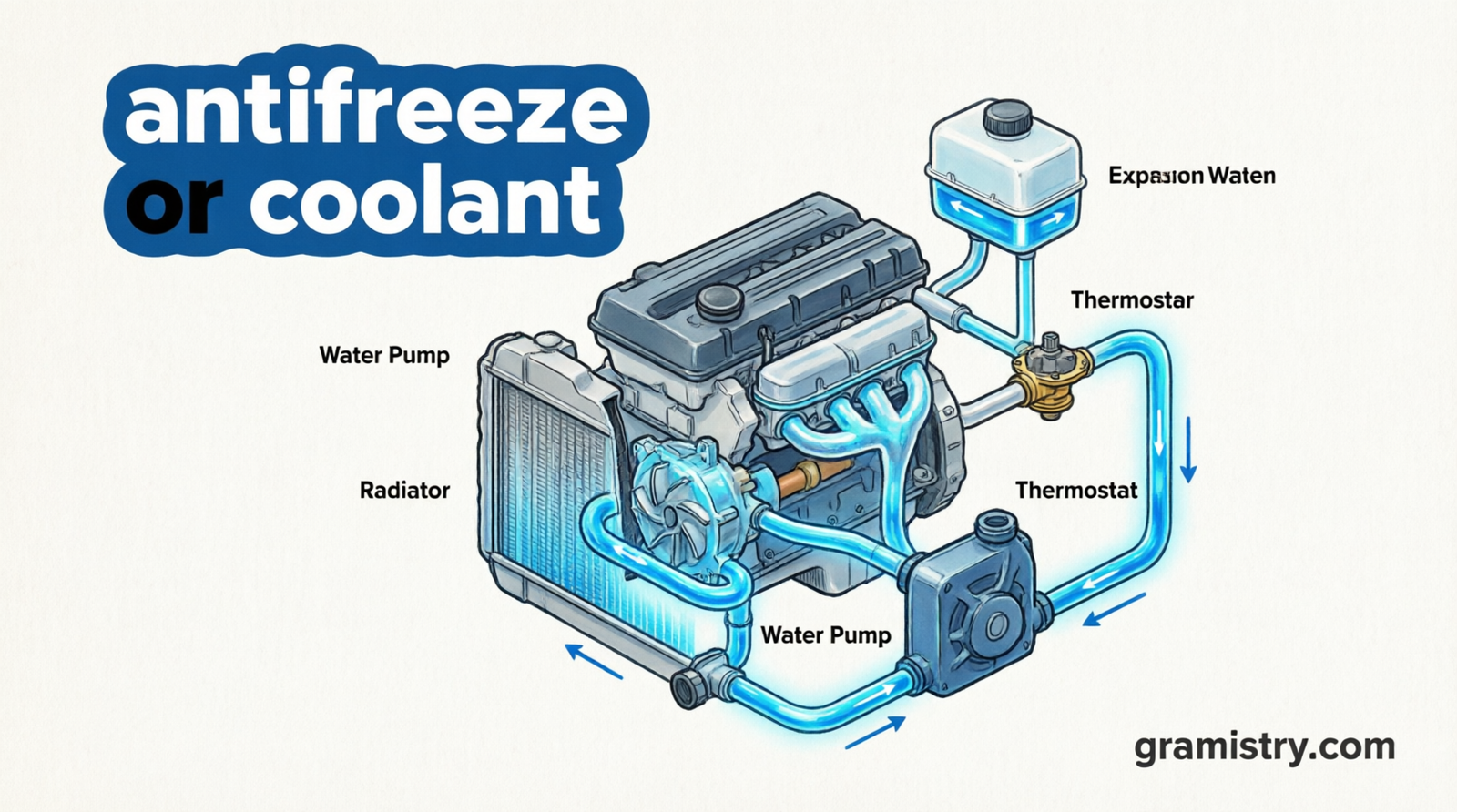
When you look under your car’s hood or shop for an engine cooling fluid, you may hear the terms antifreeze and coolant used as if they mean exactly the same thing.
That can be confusing, especially when bottles are labeled “antifreeze,” “coolant,” or “antifreeze/coolant.”
Although they look or sound similar, they serve completely different purposes.
However, in everyday automotive language, the two terms often overlap because antifreeze is one of the main ingredients used to make engine coolant.
In this guide, we’ll explain what antifreeze and coolant mean, how they work, the difference between concentrated antifreeze and premixed coolant,
whether you can use one instead of the other, and how to choose the right fluid for your vehicle.
We’ll also cover common mistakes, real-life examples, maintenance tips, and frequently asked questions.
If you enjoy clear explanations of confusing terms, resources such as Gramistry can also help you understand everyday language and terminology more easily.
What Is Antifreeze?
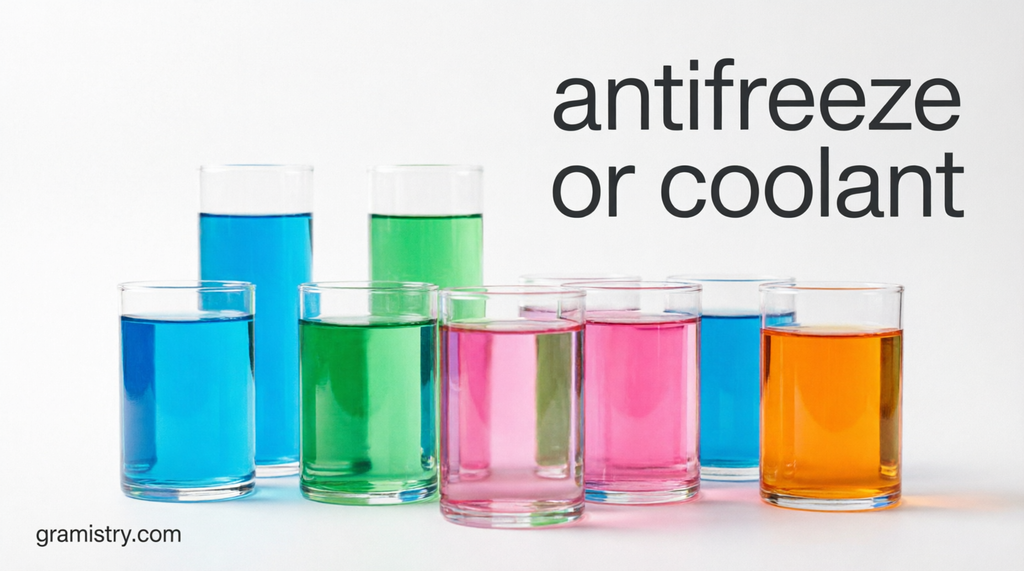
Antifreeze is a concentrated fluid designed to protect an engine’s cooling system from freezing, overheating, corrosion, and other temperature-related problems.
The word “antifreeze” describes its ability to lower the freezing point of the liquid in a vehicle’s cooling system. Most traditional automotive antifreeze is based on ethylene glycol, although some products use propylene glycol.
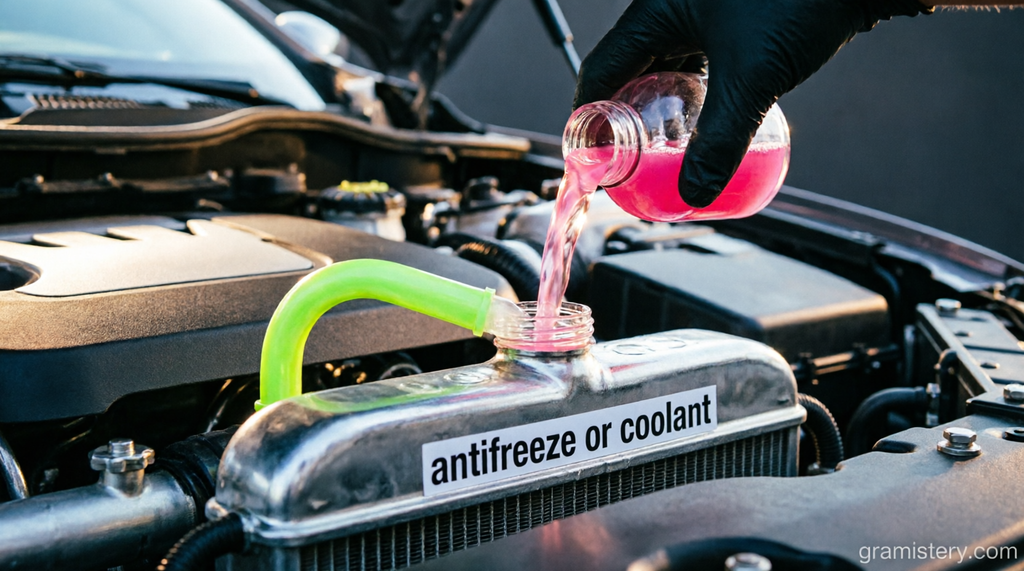
Antifreeze is usually sold as a concentrate. That means it normally needs to be mixed with water before being added to a cooling system, unless the product label specifically says it is ready to use.
What Does Antifreeze Do?
Antifreeze performs several important jobs when properly mixed with water and used in a vehicle’s cooling system.
It can:
- Lower the freezing point of the cooling mixture.
- Raise the boiling point of the mixture.
- Help protect the engine from extreme temperatures.
- Reduce corrosion inside the cooling system.
- Provide protection for components such as the radiator and water pump.
- Help maintain stable engine operating temperatures.
- Supply additives that protect cooling-system materials.
The exact formulation varies by product and vehicle requirement.
Is Antifreeze the Same as Pure Coolant?
Not necessarily.
This is where much of the confusion begins.
In many cases, antifreeze is the concentrated ingredient, while coolant is the liquid mixture that circulates through the engine.
For example, a bottle may contain concentrated antifreeze that must be mixed with distilled or deionized water according to the manufacturer’s instructions. Once properly mixed, the resulting fluid is commonly called engine coolant.
However, manufacturers and retailers do not always use these terms consistently. Some products are labeled “antifreeze/coolant” even when they can be used directly.
Antifreeze as a Noun
“Antifreeze” is normally used as a noun.
Examples:
- I need to buy some antifreeze for my car.
- The mechanic checked the antifreeze level.
- This antifreeze is designed for aluminum cooling systems.
- The manufacturer recommends a specific type of antifreeze.
A Brief History of Antifreeze
Early engine cooling systems relied heavily on water, but water alone has major limitations. It can freeze in cold weather and boil at relatively low temperatures compared with a properly formulated coolant mixture.
Glycol-based fluids became important because they offered better protection across a wider temperature range. Modern antifreeze formulations also contain additive packages designed to help protect cooling-system components from corrosion and deposits.
Today, vehicle manufacturers specify different coolant technologies and formulations depending on the engine, materials, seals, and cooling-system design.
What Is Coolant?
Engine coolant is the fluid that circulates through the engine and cooling system to help control operating temperature.
Coolant typically contains a mixture of water, glycol, and additives. The exact formulation depends on the product and the vehicle.
A properly functioning cooling system transfers heat away from the engine and releases that heat through the radiator. The coolant then circulates back through the engine, continuing the process.
What Does Coolant Do?
Engine coolant helps:
- Carry heat away from the engine.
- Protect against freezing.
- Increase resistance to boiling.
- Reduce corrosion.
- Protect cooling-system components.
- Maintain efficient heat transfer.
- Support reliable engine temperature control.
This makes coolant much more than simply a liquid that “keeps the engine cool.”
Is Coolant Just Water?
No.
Water has excellent heat-transfer properties, but using plain water by itself is generally not the correct long-term solution for a modern vehicle’s cooling system.
Water can freeze, boil, and contribute to corrosion if the cooling system does not contain the appropriate additives.
That is why manufacturers specify a suitable coolant mixture.
What Is Premixed Coolant?
Premixed coolant is coolant that has already been diluted with water and is generally ready to add to the vehicle, provided it meets the vehicle manufacturer’s specification.
A common formulation is a roughly 50/50 mixture of antifreeze and water, but the correct ratio depends on the vehicle, climate, coolant product, and manufacturer recommendations.
Do not assume that every vehicle should use exactly the same concentration. Always follow the vehicle owner’s manual and the coolant manufacturer’s instructions.
Coolant as a Noun
“Coolant” is also a noun.
Examples:
- The coolant level is low.
- The mechanic replaced the engine coolant.
- Check the coolant reservoir when the engine is cold.
- The vehicle requires a specific coolant specification.
Antifreeze vs Coolant: The Key Difference
The easiest way to understand the distinction is this:
Antifreeze is generally the concentrated glycol-based fluid used to create coolant, while coolant is the ready-to-circulate fluid in the engine cooling system.
However, there is an important real-world complication: many manufacturers and retailers use “antifreeze” and “coolant” interchangeably, especially on product labels.
So the label matters more than the word alone.
Key Differences at a Glance
- Antifreeze is commonly sold as a concentrate.
- Coolant generally refers to the fluid circulating through the cooling system.
- Concentrated antifreeze usually needs to be mixed with water.
- Premixed coolant is already diluted.
- Both terms may appear together on the same bottle.
- Both are associated with freeze protection, boiling protection, and corrosion control.
- The correct product depends on the vehicle’s required coolant specification.
- You should never choose coolant solely because its color looks right.
Antifreeze vs Coolant Comparison Table
| Feature | Antifreeze | Coolant |
|---|---|---|
| Basic meaning | Usually concentrated cooling-system fluid | Fluid used in the engine cooling system |
| Typical composition | Glycol plus additives | Water, glycol, and additives |
| Usually ready to use? | Not always | Often, if labeled premixed |
| Main role | Helps provide freeze/boil and corrosion protection | Transfers engine heat and protects the cooling system |
| Requires water? | Often yes when sold as concentrate | Premixed products already contain water |
| Used in vehicles? | Yes, after proper preparation | Yes |
| Can the terms overlap? | Yes | Yes |
| Color determines compatibility? | No | No |
| Best source for compatibility | Vehicle manufacturer’s specification | Vehicle manufacturer’s specification |
Are Antifreeze and Coolant the Same Thing?
They can refer to the same product in everyday automotive conversation, but technically they are not always identical.
For example, a bottle labeled “antifreeze” may contain concentrated coolant ingredients that need dilution. Another bottle labeled “coolant” may already be mixed and ready for use.
Some manufacturers label products “antifreeze/coolant” because the product can serve both roles when prepared according to its instructions.
The important question is therefore not simply, “Is this antifreeze or coolant?”
A better question is:
“Does this product meet my vehicle manufacturer’s coolant specification, and is it ready to use or concentrated?”
Real-Life Conversation Examples
Conversation 1: Buying Coolant
Ali: My car is low on coolant. Should I buy antifreeze?
Bilal: Check the owner’s manual first. Some antifreeze products are concentrates, while some coolant products are already premixed.
Ali: So I shouldn’t just pour any antifreeze in?
Bilal: Exactly. Check both the specification and whether the product needs dilution.
🎯 Lesson: The label and vehicle specification matter more than whether the bottle says “antifreeze” or “coolant.”
Conversation 2: Premixed Coolant
Sara: This bottle says “50/50 premixed coolant.” Do I need to add water?
Hina: Usually no. A 50/50 premixed product is already diluted.
Sara: So adding extra water could change the intended mixture?
Hina: Yes. Follow the product instructions.
🎯 Lesson: Premixed coolant is designed to be used as supplied unless the manufacturer says otherwise.
Conversation 3: Choosing by Color
Ahmed: My coolant is green. I found another green coolant. Can I use it?
Usman: Color alone doesn’t prove compatibility.
Ahmed: Then what should I check?
Usman: Check the coolant specification recommended for your vehicle.
🎯 Lesson: Never choose coolant solely by color.
Conversation 4: Cold Weather
Customer: Do I need antifreeze if I live somewhere warm?
Mechanic: Yes. Coolant does more than prevent freezing. It also helps control boiling and protect against corrosion.
Customer: I thought antifreeze was only for winter.
Mechanic: That’s a common misconception.
🎯 Lesson: Antifreeze and coolant are important throughout the year, not only during freezing weather.
When to Use Antifreeze vs Coolant
The practical rule is simple:
Use Concentrated Antifreeze When:
- The product is specifically sold as a concentrate.
- Your vehicle requires that coolant formulation.
- You are preparing the correct coolant mixture.
- The product instructions tell you to dilute it.
Always use the dilution ratio recommended by the product and vehicle manufacturer.
Use Premixed Coolant When:
- The bottle says it is premixed or ready to use.
- It meets the required vehicle specification.
- You need to top up or refill the cooling system with a compatible product.
What About US vs UK Usage?
Both antifreeze and coolant are understood in American and British English.
However, everyday automotive terminology can vary between manufacturers, mechanics, retailers, and regions.
In the United States, “antifreeze” is commonly used for products that are sold as concentrated or ready-to-use engine coolant. In the United Kingdom and other English-speaking regions, “antifreeze” is also common, while “coolant” is often used when referring to the fluid circulating through the engine.
There is no simple US-versus-UK spelling difference like “color” and “colour.”
The distinction is mainly about automotive terminology and context, not grammar.
Formal, Informal, and Technical Usage
In everyday conversation, people commonly say:
“I need some antifreeze.”
A mechanic may say:
“Your coolant level is low.”
In a technical manual, you are more likely to see a specific coolant specification, mixture requirement, or product standard.
For formal or technical writing, “engine coolant” is often clearer because it identifies the actual fluid circulating in the cooling system.
For general conversation, either term may be understood depending on the context.
Easy Memory Trick
Here is a simple way to remember the difference:
Antifreeze = the concentrated protection ingredient.
Coolant = the prepared fluid that circulates through the engine.
Think of it this way:
Antifreeze + water → coolant mixture
This is a useful general rule, but always check the product label because some manufacturers sell products called “antifreeze/coolant” that are already ready to use.
Common Mistakes People Make
Mistake 1: Assuming Antifreeze Is Always Ready to Use
Wrong:
“Every bottle of antifreeze can be poured directly into the radiator.”
Correct:
“Check whether the antifreeze is concentrated or premixed.”
Why?
Concentrated products may require dilution before use.
Mistake 2: Choosing Coolant by Color
Wrong:
“My car has orange coolant, so any orange coolant must be compatible.”
Correct:
“I should check the manufacturer’s coolant specification.”
Why?
Coolant color is not a universal compatibility standard. Different manufacturers and brands can use similar colors for different formulations.
Mistake 3: Mixing Different Coolants Without Checking Compatibility
Wrong:
“I’ll mix these two coolants because both say they are universal.”
Correct:
“I’ll verify that the products are compatible and meet the vehicle’s requirements.”
Why?
Different coolant formulations can use different additive technologies. “Universal” claims should still be checked against the vehicle manufacturer’s requirements.
Mistake 4: Using Plain Water as a Permanent Replacement
Wrong:
“My car only needs water because water cools the engine.”
Correct:
“Water may be used in specific circumstances, but the cooling system normally requires the manufacturer-specified coolant mixture.”
Why?
Plain water does not provide the same freeze, boil, and corrosion protection as a properly formulated coolant.
Mistake 5: Opening the Cooling System While the Engine Is Hot
Wrong:
“I’ll open the radiator cap now because the coolant level looks low.”
Correct:
“I’ll wait until the cooling system has cooled sufficiently and follow the manufacturer’s safety instructions.”
Why?
A hot cooling system can be pressurized, and opening it can release extremely hot coolant or steam.
How Do You Know Which Coolant Your Car Needs?
The safest approach is to use the information provided by the vehicle manufacturer.
Check:
- The owner’s manual.
- The coolant specification listed by the manufacturer.
- The product label.
- The required mixture or dilution ratio.
- Whether the product is concentrated or premixed.
- Any manufacturer-specific requirements.
If you’re uncertain, a qualified mechanic or the vehicle manufacturer’s service information can help confirm the correct product.
Do not rely only on color, price, or a generic claim that a coolant is suitable for “all cars.”
Fun Facts and History
1. Antifreeze Is Not Only About Freezing
Despite its name, antifreeze does much more than protect against freezing. Properly formulated coolant also helps manage high temperatures and protect cooling-system components from corrosion.
2. Water Is an Important Part of Many Coolant Mixtures
Water is an excellent heat-transfer medium. That’s one reason properly balanced water-and-glycol mixtures are widely used in vehicle cooling systems.
3. Ethylene Glycol Requires Careful Handling
Ethylene glycol is toxic if swallowed. Coolant should therefore be stored securely and kept away from children and animals. Spills should be cleaned up promptly and disposed of according to local requirements.
4. Color Is Not a Universal Language
A coolant’s color can help identify a particular product, but it does not provide a universal technical classification. Two similar colors may have different formulations.
FAQs:
Is antifreeze the same as coolant?
Not always. Antifreeze commonly refers to the concentrated glycol-based product used to make coolant, while coolant refers to the fluid circulating through the engine. However, automotive manufacturers and retailers frequently use the terms interchangeably, and some bottles are labeled “antifreeze/coolant.” Always check whether the product is concentrated or premixed.
Can I put antifreeze directly into my car?
It depends on the product. Some antifreeze is concentrated and must be mixed with water according to the manufacturer’s instructions. Other products are premixed and can be used directly. Never assume a product is ready to use just because it is labeled antifreeze. Check the bottle and your vehicle manufacturer’s requirements first.
Can I use coolant instead of antifreeze?
If by “coolant” you mean a compatible, properly formulated engine coolant, then yes, that is what the cooling system normally uses. However, the specific product must meet your vehicle’s required specification. Do not choose a coolant simply because the label says it is suitable for cars in general.
Can you mix antifreeze and coolant?
It depends on what you mean by each product. If one is concentrated antifreeze and the other is compatible premixed coolant, adding them may be appropriate when preparing the correct mixture. But mixing different coolant formulations without checking compatibility can cause problems. Follow the vehicle and product manufacturer’s instructions rather than relying on the names alone.
Is coolant only needed in winter?
No. Coolant is important throughout the year. It helps transfer heat away from the engine, provides protection against freezing and boiling, and contains additives that help protect cooling-system components. Calling it “antifreeze” can make it sound like a winter-only product, but modern engine coolant performs several important functions.
Does coolant color matter?
Color can provide a clue about a particular product, but it is not a reliable universal compatibility guide. Different manufacturers may use different colors for different formulations. Always check the vehicle manufacturer’s specification and the coolant label rather than choosing a product based only on color.
Can I use water instead of coolant?
Plain water can sometimes be used temporarily in an emergency, depending on circumstances, but it is generally not an appropriate long-term replacement for the manufacturer’s specified coolant mixture. Water does not provide the same freeze, boil, and corrosion protection. Once possible, the cooling system should be restored to the correct coolant mixture.
What is 50/50 coolant?
A 50/50 coolant mixture generally means approximately equal parts coolant concentrate and water. Many automotive cooling systems use mixtures around this ratio, but the correct concentration depends on the vehicle, coolant product, and operating conditions. A bottle labeled “50/50 premixed” is generally already diluted and should not receive additional water unless its instructions say so.
What happens if I use the wrong coolant?
The consequences depend on the products involved and how they interact with the vehicle’s cooling system. An incompatible coolant may reduce corrosion protection or cause deposits and other cooling-system problems. If you accidentally add an unsuitable product, consult the vehicle manufacturer or a qualified mechanic rather than continuing to mix different formulations.
Which is better: antifreeze or coolant?
Neither is automatically “better” because the terms often describe different stages or types of the same cooling-system fluid. The important issue is whether the product is appropriate for your vehicle and prepared at the correct concentration. Choose the coolant specification recommended by the vehicle manufacturer, and confirm whether the product is concentrated or premixed.
Conclusion:
The difference between antifreeze and coolant is easier to understand once you look at how engine cooling systems work.
Antifreeze commonly refers to a concentrated glycol-based product, while coolant is the prepared fluid that circulates through the engine.
In everyday automotive language, however, the terms are often used interchangeably.
The most important rule is to choose the correct manufacturer-approved coolant specification, check whether the product is concentrated or premixed, and never rely solely on color.
Proper coolant helps protect your engine from temperature extremes and corrosion throughout the year.
Next time someone uses these two words, you’ll know exactly what they mean!

Alina Mark is the creative voice behind Gramistry.com, making word meanings, English expressions, and trending slang simple, clear, and interesting. Her mission is to make every word easier to understand, one meaning at a time.
4 thoughts on “Antifreeze vs. Coolant: Are They the Same Thing?”