
Have you ever written “incompass” and wondered whether it is actually a word? You are not alone.
The two spellings look remarkably similar, and the confusion becomes even easier to understand because
encompass is a less common word than everyday alternatives such as include cover and surround.
Although they look or sound similar, they serve completely different purposes.
In fact, the difference is much simpler than it first appears: encompass is the standard English word,
while incompass is generally considered a misspelling when you mean include cover or surround.
In this guide, you will learn what encompass means, why incompass is usually incorrect, how to pronounce and use encompass,
where the word comes from, and how to avoid this spelling mistake in everyday, academic, and professional writing.
Quick answer: Use encompass. If you mean “to include, cover, contain, or surround,” incompass is not the standard spelling.
What Is “Incompass”?

Incompass is not the standard modern English spelling of the verb that means “to include,” “cover,” or “surround.”
When people write incompass, they usually intend to write encompass. The mistake is understandable because English has many words beginning with in-, and some learners naturally assume that “in + compass” should produce “incompass.”
However, standard English uses encompass, not incompass, for this meaning.
Is “Incompass” a real word?
For normal modern English writing, the safest answer is no. It should not be used as the standard spelling of encompass.
If you encounter “incompass” in informal online writing, user-generated content, or an unedited text, it is usually best understood as a spelling error rather than an alternative form of encompass.
For school assignments, professional documents, websites, business communication, and academic writing, write encompass.
Why do people spell it “incompass”?
There are a few understandable reasons for the confusion.
First, the word contains the familiar prefix-like element en-, which can sometimes be confused with in-. Second, English has many words in which in- appears naturally, such as:
- include
- involve
- inform
- inspect
- introduce
A learner may therefore assume that incompass follows the same pattern.
But English spelling does not always work by simply attaching a familiar prefix to a word. The established form is encompass.
What should you write instead?
Use:
The project encompasses several different areas.
Not:
The project incompasses several different areas.
The second version contains a spelling error.
Pronunciation of “encompass”
Encompass is pronounced approximately:
in-KUM-puhs
Cambridge gives the pronunciation as /ɪnˈkʌm.pəs/ in both British and American English.
The stress falls on the second syllable:
en-COM-pass
or, more accurately in sound:
in-KUM-puhs
This pronunciation may also contribute to spelling confusion because the first sound can sound like in-, even though the spelling begins with en-.
What Is “Encompass”?
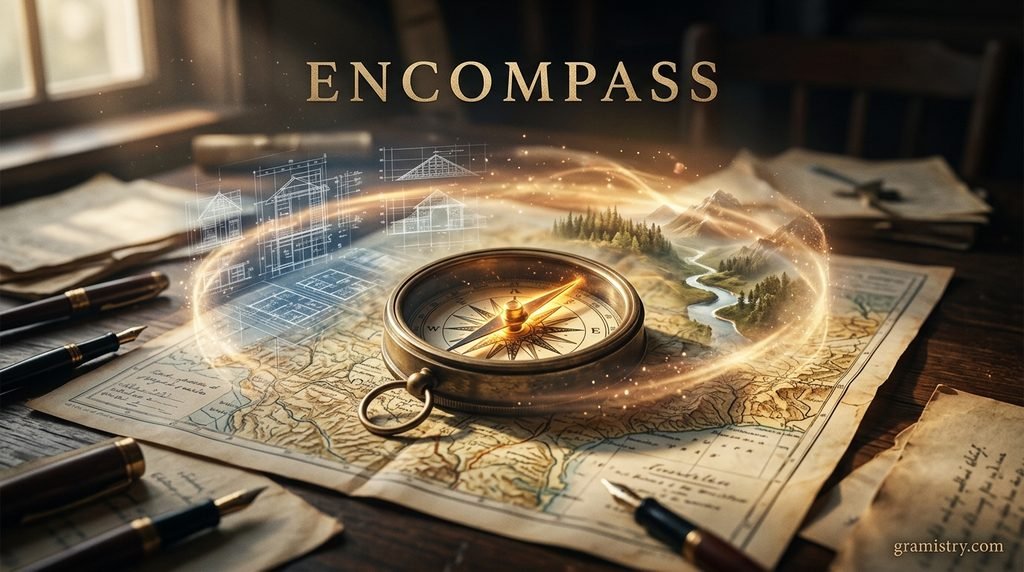
Encompass is a standard English verb meaning to include, contain, cover, or surround something.
Cambridge defines it as a formal verb used to mean “to include different types of things.” It can refer to a wide range of subjects, activities, ideas, places, or other things.
Definition of encompass
Encompass (verb): to include or cover a broad range of things; or to surround something completely.
For example:
The course encompasses grammar, vocabulary, pronunciation, and writing.
Here, encompasses means that the course includes all four areas.
Another example:
The mountains encompass the small village.
Here, encompass has the sense of surrounding the village.
So the word can have both a figurative meaning and a more literal meaning.
Grammar role
Encompass is a verb, specifically a transitive verb. That means it normally takes a direct object.
Examples:
- The program encompasses several subjects.
- The study encompasses different age groups.
- The plan encompasses both short-term and long-term goals.
- The walls encompass the entire garden.
The object comes after the verb:
The project encompasses three major areas.
Common forms include:
| Form | Example |
|---|---|
| Base form | encompass |
| Third-person singular | encompasses |
| -ing form | encompassing |
| Past tense | encompassed |
| Past participle | encompassed |
For example:
The research encompasses several fields.
The research encompassed several fields.
The research is encompassing a broader range of topics.
Country usage
Encompass is used in both British and American English. There is no major US-versus-UK spelling difference comparable to pairs such as colour/color or centre/center. Cambridge lists the same spelling and pronunciation for British and American English.
That means whether you are writing for readers in the United States, United Kingdom, Canada, Australia, Pakistan, or another English-speaking region, encompass is the standard choice.
Examples of “encompass”
Here are some natural examples:
- The program encompasses several areas of study.
- Our responsibilities encompass customer service and technical support.
- The museum’s collection encompasses works from several centuries.
- The report encompasses both economic and environmental issues.
- The national park encompasses forests, lakes, and mountains.
- Good communication encompasses more than simply speaking clearly.
Notice that encompass is especially useful when talking about something that includes many parts, categories, or dimensions.
Incompass vs Encompass: Key Differences
The central difference is simple:
- Encompass is the standard English word.
- Incompass is generally a misspelling when used with the intended meaning of encompass.
- Encompass is a verb.
- Encompass can mean “include,” “cover,” “contain,” or “surround.”
- Incompass should normally be avoided in formal and standard English.
- There is no standard US/UK spelling distinction that makes incompass correct in one variety of English.
- If you are unsure, replace incompass with encompass.
Comparison Table
| Feature | Incompass | Encompass |
| Standard modern English word | No, when intended as this verb | Yes |
| Correct spelling | ❌ | ✅ |
| Part of speech | — | Verb |
| Meaning | Usually intended to mean “include” or “surround” | Include, cover, contain, or surround |
| British English | Not standard | Standard |
| American English | Not standard | Standard |
| Formal writing | Avoid | Appropriate |
| Academic writing | Avoid | Appropriate |
| Professional writing | Avoid | Appropriate |
| Example | ❌ The plan incompasses five areas. | ✅ The plan encompasses five areas. |
Real-Life Conversation Examples
Conversation 1: At School
Student: Does this essay incompass all the required topics?
Teacher: You mean “encompass.” The correct sentence is, “Does this essay encompass all the required topics?”
Student: Got it. So “encompass” means include or cover.
🎯 Lesson: Use encompass when you mean that something includes or covers several things.
Conversation 2: At Work
Manager: What does the new training program encompass?
Employee: It encompasses customer service, communication, and problem-solving skills.
Manager: Excellent. That is the correct use of the word.
🎯 Lesson: Encompass works well when describing several areas included within one larger program.
Conversation 3: Writing an Article
Writer: I wrote that the article “incompasses” grammar and vocabulary.
Editor: Change “incompasses” to “encompasses.”
Writer: So the sentence should be: “The article encompasses grammar and vocabulary.”
🎯 Lesson: The correct spelling is encompasses, with en-, not in-.
Conversation 4: Academic Research
Student: Does the research encompass both historical and modern examples?
Professor: Yes. That is a natural and grammatically correct use of “encompass.”
🎯 Lesson: Encompass is particularly useful in academic writing when describing the broad scope of research.
When to Use Encompass
The easiest rule is:
If you mean “include,” “cover,” “contain,” or “surround,” use encompass.
1. Use “encompass” for broad inclusion
When one thing contains many different parts, encompass is a strong choice.
The course encompasses grammar, vocabulary, and pronunciation.
This means the course includes those areas.
2. Use it for a wide range
The word is especially natural when discussing variety or scope.
The festival encompasses several forms of traditional music.
Here, encompasses means the festival covers or includes several forms.
3. Use it in academic writing
Encompass is common in formal and academic contexts because it clearly describes the scope of a subject.
The study encompasses participants from several age groups.
4. Use it in professional writing
It can also make business writing precise without being unnecessarily complicated.
The role encompasses planning, communication, and team management.
5. Use it for physical surroundings
The word can also describe something physically surrounding another thing.
A high wall encompasses the garden.
In this sense, it is closer to surround or enclose.
Easy Memory Trick
Here is a simple way to remember the spelling:
Think: EN + COMPASS = ENCOMPASS
The word encompass contains compass:
en + compass = encompass
A compass can help define or trace an area or circle, which makes the idea of something being surrounded or covered a useful memory association.
You do not need to memorize complicated spelling rules. Just remember:
Encompass = include or surround.
And:
Incompass = avoid this spelling when you mean encompass.
US vs UK Usage
Unlike some English word pairs, encompass does not change spelling between American and British English.
Both use:
encompass
Both use:
encompassed
And both use:
encompassing
For example:
American English:
The program encompasses several subjects.
British English:
The programme encompasses several subjects.
Notice that the spelling of encompass remains unchanged. The noun program/programme may vary depending on context and regional convention, but the verb encompass does not.
Formal, Informal, and Academic Writing
Formal writing
Encompass is perfectly suitable:
The policy encompasses several environmental objectives.
Academic writing
It is also useful when describing the scope of research:
The investigation encompasses social, economic, and cultural factors.
Informal writing
In casual conversation, people may more often say include or cover:
The course includes grammar and pronunciation.
Instead of:
The course encompasses grammar and pronunciation.
Both are correct, but encompass sounds somewhat more formal.
A useful style tip
Do not use encompass simply because it sounds sophisticated. If include communicates the idea more naturally, use include.
Good writing is not about choosing the longest or most advanced word. It is about choosing the clearest word for the context.
Common Mistakes People Make
Mistake 1: Writing “incompass”
Wrong:
The project incompasses several departments.
Correct:
The project encompasses several departments.
Why?
The standard English verb is encompass.
Mistake 2: Writing “incompasses”
Wrong:
The report incompasses financial and social issues.
Correct:
The report encompasses financial and social issues.
The third-person singular form is encompasses, not incompasses.
Mistake 3: Assuming “incompass” is the American version
Wrong assumption:
“Incompass” is American English, while “encompass” is British English.
Correct:
There is no such standard regional distinction. Encompass is used in both American and British English.
Mistake 4: Confusing “encompass” with “include” in every context
Although encompass and include can be synonyms, they are not always equally natural.
The box includes three books.
This is perfectly natural.
The box encompasses three books.
This is grammatically possible but sounds unusual because encompass often suggests a broader range, scope, or surrounding relationship.
Choose the word that best fits the context.
Fun Facts and History of “Encompass”
1. Encompass has a connection with “compass”
The word encompass developed from en- plus compass. Etymological sources trace the verb to the 1550s, originally carrying the sense of forming a circle around or encircling something.
2. “Compass” once had broader meanings
The noun compass has a long history. It was associated with ideas such as space, area, extent, and circumference before its modern associations with navigational and mathematical instruments became dominant.
3. The meaning expanded beyond physical surroundings
Over time, encompass developed a useful figurative meaning: to include or cover a broad range of things.
That is why today we can say:
The book encompasses several important ideas.
The book does not physically surround the ideas. Instead, it covers or includes them.
4. Encompass is a formal word
Modern dictionaries classify encompass as a formal verb. It is common in academic, professional, analytical, and descriptive writing.
FAQs:
1. Is “incompass” a correct word?
No, not when you intend the standard English verb meaning “to include,” “cover,” or “surround.” The correct spelling is encompass. If you see incompass used in ordinary modern English, it is generally a spelling mistake. For formal, academic, professional, and website content, use encompass.
2. What is the correct spelling: incompass or encompass?
The correct spelling is encompass. It begins with en-, followed by compass. For example: “The course encompasses several subjects.” Writing “incompass” or “incompasses” is normally incorrect when you mean this standard verb.
3. What does encompass mean?
Encompass means to include, cover, contain, or surround something. For example, “The program encompasses several areas of study” means that the program includes several different areas. It can also describe physical surroundings, as in “A wall encompasses the garden.”
4. Is encompass used in American English?
Yes. Encompass is standard in American English as well as British English. There is no standard American spelling incompass. The spelling remains encompass regardless of whether you are writing for a US or UK audience.
5. Is encompass a verb?
Yes. Encompass is a verb. It is normally used with an object: “The course encompasses several topics.” Its common forms include encompass, encompasses, encompassed, and encompassing. Cambridge identifies it as a transitive verb.
6. What is a synonym for encompass?
Depending on the context, synonyms include include, cover, contain, embrace, involve, surround, and enclose. However, these words are not always interchangeable. For example, surround emphasizes physical position, while include is often simpler and more general.
7. Can I use encompass in academic writing?
Yes. Encompass is a useful word in academic writing when describing the scope of research, theories, topics, or evidence. For example: “The study encompasses social, economic, and environmental factors.” It can sound more formal than the simpler word include.
8. Why do people write incompass instead of encompass?
The mistake probably comes from pronunciation and spelling patterns. The beginning of encompass sounds similar to “in,” and English contains many common words beginning with in-. However, the established spelling is encompass, so the pronunciation should not be used as a guide for changing the spelling.
9. Is “encompass” more formal than “include”?
Generally, yes. Encompass often has a more formal or broad-scope feel than include. For everyday conversation, “include” may sound more natural. In academic, professional, and analytical writing, encompass can be useful when emphasizing the range or breadth of something.
10. How can I remember the spelling of encompass?
Use the simple pattern EN + COMPASS. Think of the word as containing the complete word compass: encompass. If you are writing “incompass,” stop and check whether you mean “include,” “cover,” or “surround.” If you do, change it to encompass.
Conclusion:
The choice between incompass or encompass is straightforward once you know the standard spelling.
Encompass is the correct English word, while incompass is generally an incorrect spelling when you mean include cover or surround.
Encompass is a verb used in both British and American English and is especially common when describing the broad scope of a subject,
project, study, or collection. If you are unsure, remember the simple pattern en + compass = encompass.
Clear spelling matters, especially in academic and professional writing, and resources such as
Gramistry can help learners understand these easily confused English words.
Next time someone uses these two words, you’ll know exactly what they mean!

Alina Mark is the creative voice behind Gramistry.com, making word meanings, English expressions, and trending slang simple, clear, and interesting. Her mission is to make every word easier to understand, one meaning at a time.
1 thought on “Incompass or Encompass? Meaning, Spelling, and the Correct Word”