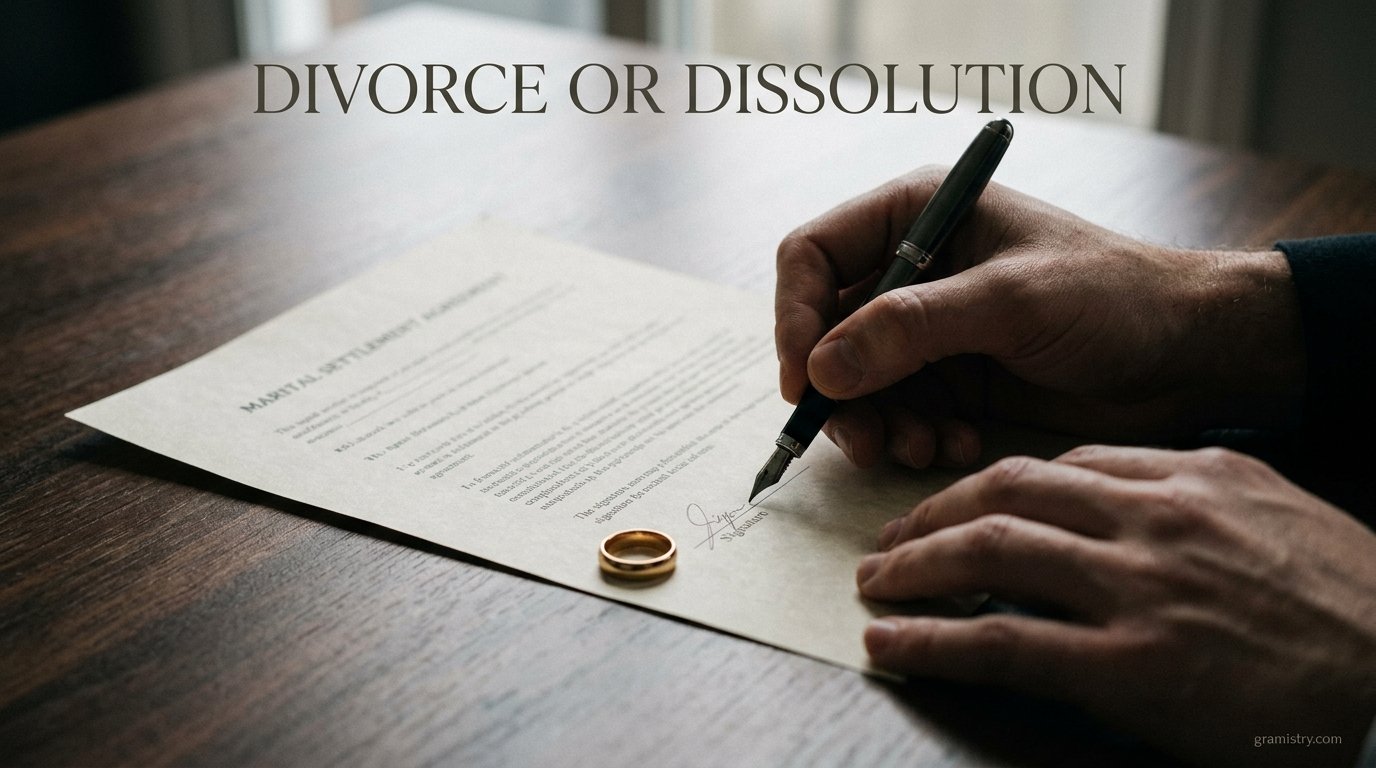
When people talk about ending a marriage, they often use divorce and dissolution as if they mean exactly the same thing.
In everyday English, that is understandable because both terms can describe the legal ending of a marriage.
In legal writing, however, the distinction can depend heavily on the country, state, or court system involved.
Although they look or sound similar, they serve completely different purposes.
The important qualification is that this difference is not universal: in some jurisdictions, dissolution of marriage is simply the formal legal term for what most people call divorce.
So, should you say divorce or dissolution? The answer depends on context.
This guide explains what each word means, how the terms are used, where they differ, and which one is appropriate in everyday, formal, and legal writing.
What Is “Divorce”?

Definition and Meaning
Divorce is the legal process or legal status through which a marriage is ended. In ordinary English, the word usually refers to the process of legally ending a marriage between two spouses.
For example:
- “They decided to get a divorce.”
- “She filed for divorce last year.”
- “The couple divorced after ten years of marriage.”
- “He is going through a difficult divorce.”
The word is common in everyday conversation, journalism, books, and general writing.
Grammar and Word Forms
Divorce can function as both a noun and a verb.
As a noun:
“Their divorce was finalized in June.”
As a verb:
“They decided to divorce.”
It can also appear in related expressions such as:
- divorce proceedings
- divorce lawyer
- divorce court
- divorce settlement
- divorce papers
- divorce decree
- divorce case
- divorce agreement
How Is “Divorce” Used?
In ordinary conversation, divorce is usually the clearest and most familiar word.
Someone might say:
“My sister is getting a divorce.”
A legal document, however, might use more technical language, depending on the jurisdiction. It may refer to the proceeding as a divorce action, dissolution proceeding, or dissolution of marriage.
This is one reason people encounter both terms.
Country and Regional Usage
The meaning of divorce is broadly recognizable in English-speaking countries, including the United States, the United Kingdom, Canada, Australia, and others.
However, the terminology used by courts can vary.
In some places, divorce is the normal legal term. In others, dissolution of marriage is the preferred formal expression. Some legal systems use both terms but give them different procedural meanings.
Therefore, you should not assume that a legal distinction in one country applies everywhere.
A Brief Historical Note
The word divorce comes through Old French divorce and Latin divortium, associated with separation or turning away. The term has a long history in English and has traditionally referred to the legal or social ending of a marriage.
Today, it is one of the most widely understood relationship and family-law terms in English.
Common Mistake With “Divorce”
A common mistake is assuming that divorce always describes the exact legal procedure used in every jurisdiction.
For example, saying:
“The court always calls it a divorce.”
may be incorrect in a jurisdiction that formally uses dissolution of marriage.
A safer approach is to use the terminology required by the relevant court, government agency, or legal document.
What Is “Dissolution”?

Definition and Meaning
Dissolution means the formal ending, termination, or breaking up of something.
It is a much broader word than divorce.
A contract can be dissolved. A business can be dissolved. An organization can be dissolved. A partnership can be dissolved. And, in family law, a marriage can be dissolved.
For example:
“The court granted a dissolution of marriage.”
In this context, dissolution refers to the legal ending of the marriage.
Grammar Role
Dissolution is a noun.
It comes from the verb dissolve.
Related forms include:
- dissolve — verb
- dissolved — past participle/adjective
- dissolution — noun
- dissolving — present participle
For example:
“The court dissolved the marriage.”
and:
“The couple filed for dissolution of marriage.”
Both sentences describe the ending of a marriage, but they use different grammatical forms.
Dissolution Has a Broader Meaning
The most important thing to remember is that dissolution does not automatically mean divorce.
Consider these examples:
- dissolution of a company
- dissolution of a partnership
- dissolution of a contract
- dissolution of an organization
- dissolution of a marriage
The surrounding words tell you what is being ended.
This makes dissolution a more general and formal term.
Dissolution in Family Law
In family-law contexts, dissolution of marriage can be the official legal name for the procedure commonly known as divorce.
For example, a government form may say:
“Petition for Dissolution of Marriage”
while an ordinary person might simply say:
“I filed for divorce.”
The two expressions may refer to the same legal event.
However, legal terminology is jurisdiction-specific. Some places use dissolution as a general legal term, while others use it in particular procedures or contexts.
Historical and Linguistic Note
Dissolution comes from Latin roots associated with loosening or separating. In English, it developed into a broad word for the ending or breaking apart of something that previously existed as a whole.
That broader meaning explains why lawyers can use dissolution for more than marriage.
Divorce vs. Dissolution: Key Differences
The easiest way to understand the difference is to focus on scope and context.
- Divorce specifically refers to the legal ending of a marriage in ordinary usage.
- Dissolution means the formal ending or termination of something and can apply to many things.
- Dissolution of marriage can be the formal legal term for divorce.
- Divorce is more familiar in everyday conversation.
- Dissolution often sounds more formal or technical.
- Legal terminology varies by jurisdiction.
- Neither word should automatically be treated as universally interchangeable in legal documents.
- The phrase dissolution of marriage is much more specific than the word dissolution by itself.
Quick Definition Box
Divorce: The legal ending of a marriage; the most familiar everyday term.
Dissolution: The formal ending or termination of something; in family law, “dissolution of marriage” may mean divorce.
Divorce vs. Dissolution Comparison Table
| Feature | Divorce | Dissolution |
|---|---|---|
| Basic meaning | Legal ending of a marriage | Ending or termination of something |
| Scope | Usually marriage-related | Much broader |
| Grammar | Noun and verb | Mainly a noun |
| Everyday use | Very common | More formal |
| Legal use | Common in many jurisdictions | Official term in some jurisdictions |
| Can refer to a marriage? | Yes | Yes, when specified |
| Can refer to a company? | No | Yes |
| Can refer to a contract? | No | Yes |
| Formality | General to formal | Often formal or technical |
| Exact legal meaning | Depends on jurisdiction | Depends on jurisdiction |
| Best everyday choice | Usually “divorce” | Usually “dissolution of marriage” in formal contexts |
Real-Life Conversation Examples
Conversation 1: Everyday English
A: “Have you heard about Mark and Lisa?”
B: “Yes. I heard they’re getting a divorce.”
A: “That’s sad. I hope they’re both doing okay.”
🎯 Lesson: In ordinary conversation, divorce is usually the natural and familiar choice.
Conversation 2: Legal Language
A: “What does this court form mean?”
B: “It says ‘Petition for Dissolution of Marriage.’”
A: “So is that basically a divorce petition?”
B: “In this jurisdiction, yes. That’s the formal legal terminology.”
🎯 Lesson: Dissolution of marriage may be the official legal expression for divorce.
Conversation 3: A Broader Meaning of Dissolution
A: “Why does the contract mention dissolution?”
B: “It’s talking about how the partnership can be formally ended.”
A: “So it has nothing to do with divorce?”
B: “Right. Here, dissolution simply means termination of the partnership.”
🎯 Lesson: Dissolution has meanings far beyond family law.
Conversation 4: Choosing a Word for an Article
A: “Should I write ‘divorce’ or ‘dissolution’?”
B: “If you’re writing for a general audience, ‘divorce’ will probably be clearer.”
A: “What if I’m discussing a court procedure?”
B: “Then check the terminology used by the relevant court or government authority.”
🎯 Lesson: Choose the word based on audience and legal context, not just preference.
When to Use “Divorce” vs. “Dissolution”
Use “Divorce” When Talking Naturally
Use divorce when you are speaking or writing about the end of a marriage in normal everyday English.
For example:
“My friend is going through a divorce.”
“The couple announced their divorce.”
“She hired a divorce attorney.”
These sentences sound natural to most English speakers.
Use “Dissolution” for a Broader Concept
Use dissolution when discussing the formal ending of something other than a marriage.
For example:
“The dissolution of the partnership required approval from all members.”
“The company entered dissolution proceedings.”
In these examples, divorce would obviously be incorrect.
Use “Dissolution of Marriage” in Relevant Legal Contexts
If a court, statute, government form, or legal authority uses dissolution of marriage, follow that terminology when discussing that specific legal procedure.
For example:
“The petitioner filed a petition for dissolution of marriage.”
This is particularly important in legal writing because terminology can have procedural significance.
What About US vs. UK English?
There is no simple rule saying that one country always uses divorce and another always uses dissolution.
Divorce is widely understood in both American and British English.
Legal terminology, however, can differ between jurisdictions and even between individual legal systems within the same country.
In the United States, for example, some states commonly use dissolution of marriage in official family-law terminology, while everyday speakers may still call the process a divorce.
The safest rule is:
Follow the terminology used by the relevant legal authority when writing about a specific legal procedure.
Formal vs. Informal Writing
informal writing:
“They are getting a divorce.”
general formal writing:
“The couple’s divorce was finalized last year.”
For jurisdiction-specific legal writing:
“The parties filed a petition for dissolution of marriage.”
The third example should be used when it accurately reflects the terminology of the applicable legal system.
Academic Writing
In academic writing, define the term you are using if the distinction matters.
For example:
“In this article, the term ‘divorce’ refers generally to the legal termination of marriage, while ‘dissolution’ is used where it reflects the terminology of a particular legal system.”
This approach prevents readers from assuming that the terminology is identical everywhere.
An Easy Memory Trick
Think of divorce as the specific marriage word and dissolution as the broader ending word.
Remember it this way:
Divorce → marriage
Dissolution → termination of something
So:
- divorce of a marriage → natural
- dissolution of a marriage → possible and often legally formal
- dissolution of a company → correct
- dissolution of a partnership → correct
- divorce of a company → incorrect
The phrase dissolution of marriage connects the broad word dissolution to the specific context of marriage.
Common Mistakes People Make
Mistake 1: Treating “Dissolution” as Always Meaning Divorce
Incorrect assumption:
“Dissolution always means the end of a marriage.”
Why it is incorrect:
Dissolution is a general noun for the ending or termination of something. Marriage is only one possible context.
Better understanding:
“Dissolution of marriage” can refer to divorce, depending on the legal system.
Mistake 2: Using “Divorce” for a Business
Incorrect:
“The company went through a divorce.”
Correct:
“The company went through dissolution.”
Why:
A company can be dissolved, but it cannot literally get a divorce.
Mistake 3: Assuming Legal Terminology Is Universal
Incorrect assumption:
“Every court uses the word divorce.”
Why:
Different jurisdictions use different legal terminology and procedures.
Better approach:
Check the terminology used by the applicable court, statute, official form, or government agency.
Mistake 4: Thinking “Dissolution” Is Always More Correct
Incorrect assumption:
“Dissolution is the professional version of divorce, so I should always use it.”
Why:
In everyday English, divorce is often clearer and more natural. Formal language is not automatically better language.
Divorce or Dissolution: Which One Should You Choose?
Use this simple three-step rule:
- Talking about a marriage generally?
Choose divorce. - Talking about the legal procedure?
Check whether the relevant jurisdiction calls it divorce, dissolution of marriage, or another term. - Talking about ending something other than a marriage?
Dissolution may be appropriate.
This rule works well for everyday writing while avoiding potentially misleading legal assumptions.
Fun Facts and History
1. “Dissolution” Is Much Broader Than “Divorce”
The word dissolution can describe the ending of organizations, partnerships, contracts, companies, and other legal relationships. That makes it a much broader term than divorce.
2. Divorce Is Both a Noun and a Verb
Unlike dissolution, which is a noun, divorce can be used as both a noun and a verb.
Compare:
“Their divorce was finalized.”
and:
“They decided to divorce.”
3. Legal Language Often Differs From Everyday Language
People commonly say divorce, while legal documents may use expressions such as dissolution of marriage. This difference is a useful reminder that legal terminology does not always match ordinary conversation.
4. “Dissolve” Does Not Literally Mean “Disappear”
The verb dissolve can mean to break apart, terminate, or bring an organized arrangement to an end. Its legal use follows this broader idea of ending an established relationship or structure.
FAQs:
Is divorce the same as dissolution?
Sometimes, yes. In family law, dissolution of marriage can be the formal legal term for what people commonly call divorce. However, the exact terminology depends on the jurisdiction. Outside the marriage context, dissolution has a much broader meaning and can refer to ending a partnership, contract, company, or organization.
Is “dissolution of marriage” another word for divorce?
In many legal contexts, yes. Dissolution of marriage can describe the legal process of ending a marriage. However, you should not assume that every jurisdiction uses the phrase in exactly the same way. If you are completing legal paperwork, use the terminology provided by the relevant court or government authority.
Which word is more common: divorce or dissolution?
Divorce is generally more familiar in everyday English. People commonly say “get a divorce,” “file for divorce,” or “go through a divorce.” Dissolution is more formal and broader. In legal contexts, however, some jurisdictions officially use “dissolution of marriage,” so the appropriate term depends on the context.
Can dissolution refer to something other than marriage?
Yes. Dissolution is a broad term that can describe the formal ending of many things. Examples include the dissolution of a company, partnership, organization, contract, or agreement. This is one of the biggest differences between the two terms: divorce is specifically associated with ending a marriage, while dissolution is not.
Is “divorce” a noun or a verb?
Divorce can be both a noun and a verb. As a noun, you might say, “Their divorce was finalized.” As a verb, you could say, “They decided to divorce.” This flexibility makes divorce common in both everyday conversation and formal writing.
Is “dissolution” more formal than “divorce”?
Usually, dissolution sounds more formal or technical, especially when it appears in legal terminology. However, that does not mean it is always the better word. If you are speaking to a general audience, divorce is often clearer. Formal writing should prioritize precision and clarity rather than complicated vocabulary.
Should I write “divorce” or “dissolution” in a legal document?
Use the terminology required by the relevant legal system. If an official court form says dissolution of marriage, follow that wording. If the jurisdiction uses divorce, use divorce. Legal terminology can vary, so relying on a general English rule is not a substitute for checking the applicable official source or obtaining qualified legal advice.
What is the difference between dissolution and divorce in simple English?
In simple terms, divorce usually means the legal ending of a marriage, while dissolution means the formal ending of something. When you say “dissolution of marriage,” the two concepts can overlap and may describe the same legal process. The main difference is that dissolution has a much wider meaning.
Can I use divorce and dissolution interchangeably?
Not always. In a discussion about ending a marriage, they may refer to the same legal event in some jurisdictions. But dissolution can also describe the ending of businesses, partnerships, contracts, and organizations. Therefore, replacing divorce with dissolution in every sentence can make your writing sound unnatural or change its meaning.
Which term should I use in everyday English?
For most everyday conversations about ending a marriage, divorce is the clearest choice. For example, “They are getting a divorce” sounds natural and immediately understandable. Use dissolution when you need the broader meaning or when a particular legal system officially uses dissolution of marriage for the procedure you are discussing.
Conclusion:
The difference between divorce or dissolution is mainly about scope, context, and legal terminology.
Divorce specifically refers to the ending of a marriage, while dissolution is a broader term for formally ending or terminating something.
In family law, dissolution of marriage may be the official term for divorce in some jurisdictions.
For everyday English, divorce is usually the more natural choice.
For legal writing, always follow the terminology used by the relevant jurisdiction.
Understanding this distinction helps you write with greater accuracy, clarity, and confidence especially when discussing legal matters.
Next time someone uses these two words, you’ll know exactly what they mean!

Alina Mark is the creative voice behind Gramistry.com, making word meanings, English expressions, and trending slang simple, clear, and interesting. Her mission is to make every word easier to understand, one meaning at a time.