
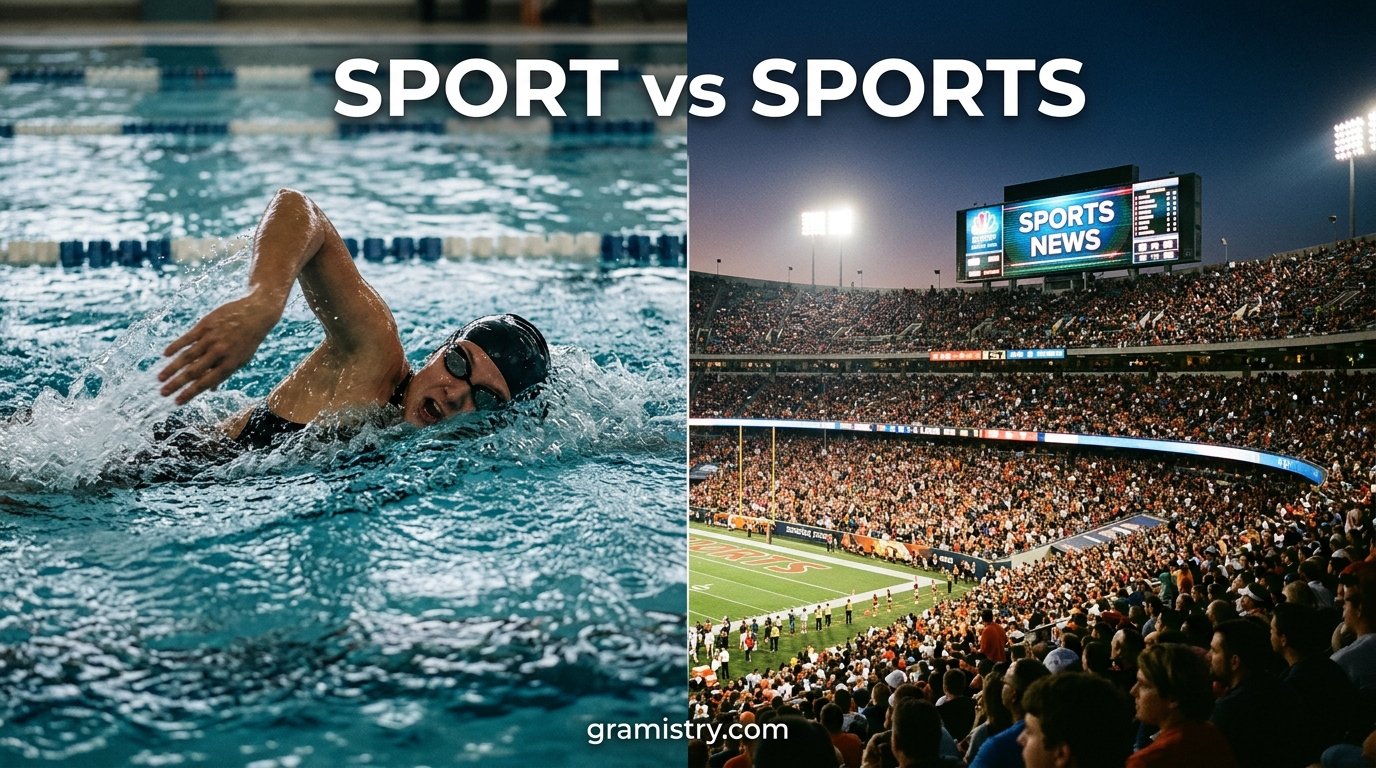
If you have ever wondered whether to say “sport” or “sports,” you are not alone.
Both words are correct, but they are not always interchangeable.
The choice often depends on whether you are talking about physical activity in general, one particular activity, or several different athletic activities.
The difference can also depend on regional English.
British English often uses sport as an uncountable noun when discussing athletic activity in general, while American English commonly uses sports in similar contexts.
That can make the choice confusing for English learners and even native speakers.
Although they look or sound similar, they serve completely different purposes.
In this guide, you will learn what sport and sports mean, how their grammar differs, when to use each word, and how American and British English treat them.
You will also see practical examples, common mistakes, and easy memory tricks.
What Is “Sport”?

Sport is a noun that generally refers to a physical activity, game, or organized form of competition involving physical skill, exercise, or athletic ability.
For example:
- Football is a popular sport.
- I enjoy watching sport.
- Tennis is a competitive sport.
- Swimming is an Olympic sport.
The word sport can refer to one particular athletic activity, such as tennis or cricket. It can also refer to physical competition in a general sense.
Sport as a General Activity
In British English, sport is commonly used as an uncountable noun when people are talking about athletic activity in general.
For example:
Sport is important for a healthy lifestyle.
Here, sport does not mean one particular game. It refers to physical activity and athletics as a general concept.
You might also hear:
He is very interested in sport.
This is especially natural in British English.
In American English, however, sports is often preferred in this type of sentence:
He is very interested in sports.
Both forms can communicate essentially the same general idea, but the preferred wording changes by variety of English.
Sport as a Single Activity
Sport can also be a singular countable noun when it refers to one specific type of activity.
For example:
- Basketball is a sport.
- Golf is an expensive sport in some places.
- Boxing is a demanding sport.
- Cricket is a traditional sport in many countries.
In these sentences, sport means a particular athletic activity.
You can therefore say:
Tennis is a sport.
But you would not normally say:
Tennis is a sports.
That would be grammatically incorrect because tennis refers to one sport.
Grammar of “Sport”
Depending on the sentence, sport can function as either an uncountable or countable noun.
Uncountable:
Sport can bring people together.
Countable:
Football is a sport.
When it is countable, you can use words such as a, one, or another before it:
- a sport
- one sport
- another sport
When it is being used as an uncountable concept, you generally do not use a before it:
- Sport is good for you.
- I enjoy sport.
Pronunciation
In British English, sport is usually pronounced approximately:
/spɔːt/
In American English, it is commonly pronounced:
/spɔːrt/
The difference is mainly related to the pronunciation of the r sound in the two varieties.
Where Is “Sport” Commonly Used?
The singular word sport is particularly common in British English and other varieties influenced by British usage, including English used in countries such as the United Kingdom, Australia, and New Zealand.
For example:
Sport plays an important role in British culture.
American English also uses sport, especially when referring to one particular athletic activity:
Baseball is a sport.
The major difference appears when discussing sports generally.
What Is “Sports”?

Sports is the plural form of the countable noun sport. It usually refers to two or more sports or to athletic activities collectively.
For example:
- I enjoy many sports.
- Which sports do you play?
- The school offers several sports.
- Sports are popular around the world.
If sport means one individual athletic activity, sports can mean multiple athletic activities.
Sports as a General Category
In American English, sports is also very common when referring to athletic activities in general.
For example:
Sports are an important part of American culture.
Here, sports does not necessarily mean that someone is thinking about a specific list of individual sports. It can refer broadly to athletics and competitive physical activities.
This is one of the biggest differences learners notice between American and British English.
Compare:
British English:
I enjoy sport.
American English:
I enjoy sports.
Both sentences are natural in their respective varieties.
Sports Referring to Multiple Activities
The plural sports is straightforward when several different athletic activities are being discussed.
For example:
The university offers sports such as football, swimming, tennis, and athletics.
Here, sports is plural because several activities are included.
Another example:
My favorite sports are cricket and tennis.
Because the speaker names more than one sport, sports is appropriate.
“Sports” as a Modifier
An important point is that sports is frequently used before another noun to describe something connected with athletics.
Examples include:
- sports shoes
- sports equipment
- sports medicine
- sports center
- sports journalist
- sports team
- sports event
- sports channel
- sports fan
For example:
She bought new sports shoes.
Here, sports describes the type of shoes. It is functioning as a modifier rather than simply acting as the plural noun in the sentence.
“Sport” as a Modifier
You will also encounter sport in compounds, although the choice between sport and sports can depend on the established expression and variety of English.
For example:
- sport fishing
- sport climbing
- sport psychology
- sport science
However, many everyday compounds use sports:
- sports medicine
- sports car
- sports equipment
- sports journalist
This means learners should not assume that every compound must follow a simple singular-versus-plural rule. Established English expressions matter.
Sport vs Sports: The Key Differences
The easiest way to understand the difference is to focus on number and meaning.
- Sport can refer to one particular athletic activity.
- Sports refers to multiple athletic activities.
- Sport is often used as an uncountable noun for athletic activity in British English.
- Sports is very common for general athletic activity in American English.
- Sport can be used after a when referring to one activity.
- Sports normally refers to a plural category.
- Both words appear in compound expressions.
- Regional English affects which form sounds most natural.
Quick Definition
Sport usually means one athletic activity or sport in general, especially in British English.
Sports usually means multiple athletic activities and is also widely used for athletics in general, especially in American English.
Sport vs Sports Comparison Table
| Feature | Sport | Sports |
|---|---|---|
| Basic meaning | One sport or athletic activity in general | Multiple sports or athletics generally |
| Number | Singular or uncountable | Plural |
| Example | Tennis is a sport. | Tennis and cricket are sports. |
| British English | Very common for general activity | Used when referring to multiple sports |
| American English | Common for one particular activity | Very common for sports generally |
| Can follow “a”? | Yes, when countable | No |
| General activity | Common in British English | Common in American English |
| Example phrase | a sport | many sports |
| Example question | What sport do you play? | What sports do you play? |
Real-Life Conversation Examples
Conversation 1: Talking About One Activity
Emma: What sport do you play?
Daniel: I play tennis.
Emma: How long have you played?
Daniel: About five years.
🎯 Lesson: Use sport when asking about or identifying one particular athletic activity.
Conversation 2: Talking About Several Activities
Sarah: What sports do you enjoy?
Mike: I enjoy football, swimming, and tennis.
Sarah: Which one is your favorite?
Mike: Probably football.
🎯 Lesson: Use sports when you are talking about several different athletic activities.
Conversation 3: British English
Tom: Are you interested in sport?
James: Yes. I watch football every weekend.
Tom: Do you play anything?
James: I play cricket during the summer.
🎯 Lesson: In British English, sport is commonly used without an article when talking about athletic activity generally.
Conversation 4: American English
Lisa: Are you interested in sports?
Amy: Definitely. I watch basketball and baseball.
Lisa: Do you play any sports?
Amy: I play tennis.
🎯 Lesson: American English commonly uses sports when discussing athletic activities generally.
Conversation 5: School Activities
Teacher: Which sport would you like to try?
Student: I would like to try volleyball.
Teacher: We offer several sports at school, including volleyball, basketball, and swimming.
🎯 Lesson: Sport works for one selected activity, while sports works when referring to several activities as a group.
When to Use “Sport” vs “Sports”
Choosing between these words becomes much easier if you ask yourself one simple question:
Am I talking about one activity, several activities, or athletic activity in general?
Use “Sport” for One Particular Activity
Use sport when one activity is being identified.
Examples:
- Football is my favorite sport.
- Tennis is a difficult sport.
- What sport do you play?
- Boxing is a demanding sport.
A useful pattern is:
[Activity] + is + a sport
For example:
Swimming is a sport.
Use “Sports” for Multiple Activities
Use sports when you mean more than one sport.
Examples:
- I play several sports.
- Which sports do you enjoy?
- The school offers many sports.
- Olympic sports attract millions of viewers.
A useful pattern is:
[Multiple activities] + are + sports
For example:
Tennis and football are sports.
Use “Sport” for General Activity in British English
British English frequently uses sport as an uncountable noun.
Examples:
I love sport.
Sport is important to children.
He is interested in sport.
These sentences sound natural in British English.
Use “Sports” for General Activity in American English
American English commonly uses sports for the same broad idea.
Examples:
I love sports.
Sports are important to children.
He is interested in sports.
This difference is mainly one of regional usage rather than meaning.
What About “What Sport Do You Play?” vs “What Sports Do You Play?”
Both questions are correct, but they can suggest slightly different things.
“What sport do you play?”
This often suggests that the speaker is asking for one sport.
What sport do you play?
Possible answer:
I play tennis.
“What sports do you play?”
This suggests that the person may participate in several sports.
What sports do you play?
Possible answer:
I play tennis, football, and badminton.
In everyday conversation, context can make the distinction flexible. A person may use either question even if they are not strictly counting the number of sports.
Common Mistakes People Make
Mistake 1: “Tennis is a sports.”
Incorrect:
Tennis is a sports.
Correct:
Tennis is a sport.
Why?
The sentence identifies tennis as one athletic activity, so the singular countable noun sport is required.
Mistake 2: “Football and tennis is sports.”
Incorrect:
Football and tennis is sports.
Correct:
Football and tennis are sports.
Why?
The subject contains two activities, so the verb must be plural: are.
Mistake 3: Assuming “Sports” Is Always Wrong
Some learners believe that sport is always the correct form and sports is incorrect.
That is not true.
Sports is completely correct when referring to multiple activities:
She enjoys several sports.
It is also very common in American English when talking about athletic activity generally:
He loves sports.
Mistake 4: Assuming British and American English Must Use the Same Form
English has many regional differences.
For example:
British English: I enjoy sport.
American English: I enjoy sports.
Neither sentence should automatically be labeled wrong simply because it uses a different form.
Mistake 5: Using “Sports” After “A”
Incorrect:
Basketball is a sports.
Correct:
Basketball is a sport.
The article a requires a singular countable noun.
You can say:
a sport
but not:
a sports
Sport or Sports in Formal Writing
Both forms are appropriate in formal writing when they match the intended meaning and regional variety of English.
In academic writing, consistency is more important than forcing one form everywhere.
For example:
Sport has significant social and cultural value.
This is natural in British-oriented academic writing.
An American writer might say:
Sports have significant social and cultural value.
Both can be perfectly acceptable depending on the intended variety of English.
If you are writing for an international audience, choose a consistent style. Do not switch randomly between British and American conventions.
Sport or Sports in Informal Writing
In casual writing, the choice is often influenced by the speaker’s variety of English.
An American might naturally write:
I love sports.
A British speaker might naturally write:
I love sport.
Neither expression needs to sound strange to a native speaker of that variety.
If you are learning English, the most important thing is to understand both forms so that you can recognize them in different contexts.
Easy Memory Trick
Here is a simple way to remember the difference:
Sport = one or general activity in British English
Sports = two or more activities, or general athletics in American English
Think of it this way:
One → sport
Many → sports
Examples:
Cricket is a sport.
Cricket and football are sports.
For general usage, remember the regional difference:
British English → sport
American English → sports
This is not an absolute rule for every sentence, but it is a useful starting point.
Is “Sport” Always Singular?
No. This is an important point.
Sport can be countable or uncountable depending on context.
Countable:
Football is a sport.
Uncountable:
Sport is good for your health.
In the first sentence, sport refers to one particular activity.
In the second, it refers to athletic activity as a broad concept.
This is why simply memorizing “sport = singular” is not enough.
Is “Sports” Always Plural?
Grammatically, sports is the plural form of sport when it refers to multiple sports.
However, English also commonly uses sports in expressions where it functions as a modifier:
- sports medicine
- sports equipment
- sports science
- sports journalist
- sports facilities
So its role can depend on the sentence.
Sport vs Sports in American and British English
Regional usage is one of the most important parts of this topic.
British English
British English commonly uses sport as an uncountable noun:
Sport is popular in the UK.
I enjoy watching sport.
But sports is still used when referring to multiple sports:
The school offers several sports.
American English
American English commonly uses sports for general athletic activity:
Sports are popular in the United States.
I enjoy watching sports.
The singular sport remains completely normal when referring to one specific activity:
Baseball is a sport.
Therefore, the difference is not simply British English versus American English. Both varieties use both words. The main difference is how they commonly frame general athletic activity.
Fun Facts and History
1. “Sport” Has a Long History
The word sport has a long history in English and is related to older words associated with amusement, entertainment, and recreation. Over time, its meaning developed to include organized physical competition and athletic activity.
2. “Sports” Is More Than Just a Plural
Although sports is grammatically the plural of sport, modern English frequently uses it in compound expressions such as sports medicine and sports equipment.
3. Regional English Changes Everyday Usage
British and American English often choose different forms for general references to athletics. This is one reason learners may encounter sport in one source and sports in another.
4. Context Usually Makes the Meaning Clear
Even when speakers use different regional conventions, context normally tells readers what they mean. A sentence such as “I enjoy sports” is unlikely to cause confusion for a British reader, just as “I enjoy sport” is understandable to an American reader.
FAQs:
1. What is the main difference between sport and sports?
Sport can refer to one particular athletic activity, such as tennis or football. It can also refer to athletic activity generally, especially in British English. Sports is the plural form and refers to multiple activities. American English also commonly uses sports when discussing athletics generally. The correct choice depends on number, meaning, and regional English.
2. Is “sport” singular or plural?
Sport can be either a singular countable noun or an uncountable noun. When it refers to one activity, it is countable: “Tennis is a sport.” When it refers to athletics generally, especially in British English, it can be uncountable: “Sport is important.” Therefore, its grammatical role depends on how it is being used.
3. Is “sports” grammatically correct?
Yes. Sports is grammatically correct when referring to multiple sports. For example, “Football and tennis are popular sports.” It is also very common in American English when discussing athletics generally, as in “Sports are important to many people.” The word also appears in many compound expressions, such as sports medicine and sports equipment.
4. Should I say “I like sport” or “I like sports”?
Both can be correct. “I like sport” is particularly natural in British English when speaking about athletic activity generally. “I like sports” is especially common in American English. If you are writing for a particular audience, follow that variety of English consistently. For an international audience, either may be understood, but consistency is helpful.
5. Is “What sport do you play?” correct?
Yes. “What sport do you play?” is completely correct and commonly asks about one type of athletic activity. For example, someone might answer, “I play tennis.” You can also say “What sports do you play?” when you expect the person may participate in several different sports.
6. Is “What sports do you play?” correct?
Yes. “What sports do you play?” is grammatically correct and often suggests that the speaker is asking about multiple athletic activities. For example, someone could answer, “I play football, tennis, and badminton.” In everyday conversation, speakers may use this question even when they are unsure whether the listener plays one sport or several.
7. Which is more common: sport or sports?
It depends on the context and variety of English. Sport is especially common for general athletic activity in British English, while sports is especially common in American English. When referring to multiple individual activities, sports is the natural plural in both varieties. Neither word is universally “more correct.”
8. Can I say “a sports”?
No. When sport is a singular countable noun, the correct form is “a sport.” For example, “Swimming is a sport.” The plural sports cannot normally follow the singular article a. Therefore, “Swimming is a sports” is incorrect.
9. Is “sports” American English only?
No. Sports is not exclusive to American English. British English also uses sports when referring to multiple athletic activities and in many established expressions. The main regional difference is that British English more commonly uses uncountable sport for athletics in general, while American English often prefers sports in that context.
10. Which should English learners use: sport or sports?
English learners should learn both. Use sport for one particular activity, such as “Tennis is a sport,” and use sports for multiple activities, such as “Tennis and football are sports.” Also recognize the regional difference: British English often says “I enjoy sport,” while American English commonly says “I enjoy sports.”
Quick Summary: Sport vs Sports
If you only remember a few points, remember these:
- Sport can mean one particular athletic activity.
- Sports is the plural of sport.
- British English commonly uses sport for athletic activity in general.
- American English commonly uses sports for athletic activity in general.
- Use a sport, not a sports.
- Use sports when discussing multiple athletic activities.
- Both forms are correct when used in the right context.
- Regional English influences which form sounds most natural.
Conclusion:
The difference between sport and sports is mainly about number, meaning, and regional usage.
Sport can describe one particular activity, such as tennis or cricket, and it is also commonly used as an uncountable term for athletics in British English.
Sports refers to multiple activities and is especially common for general athletic activity in American English.
Once you understand these patterns, choosing the right word becomes much easier.
For English learners, resources such as Gramistry can also help clarify everyday vocabulary and usage differences.
Focus on the context rather than memorizing one rigid rule.
Next time someone uses these two words, you’ll know exactly what they mean!

Alina Mark is the creative voice behind Gramistry.com, making word meanings, English expressions, and trending slang simple, clear, and interesting. Her mission is to make every word easier to understand, one meaning at a time.