
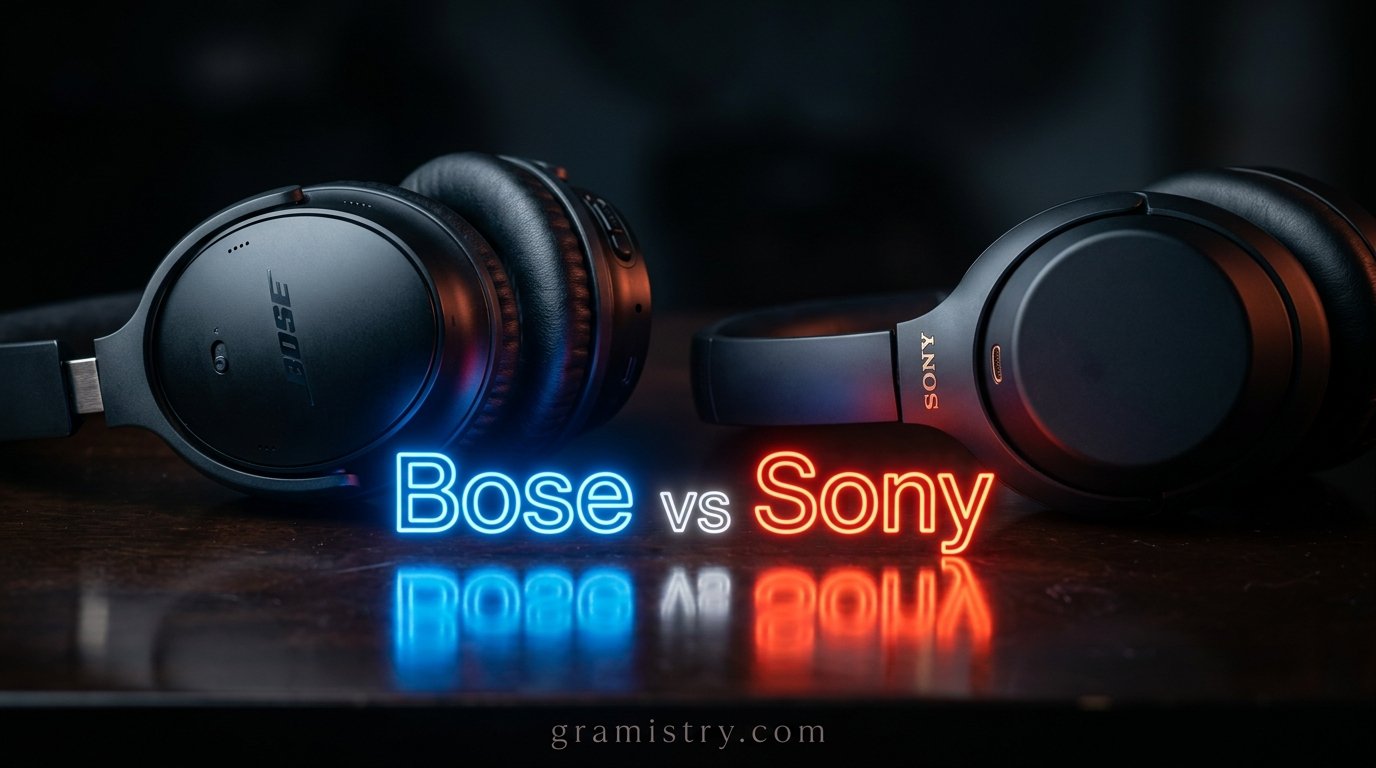
Choosing between Bose or Sony can be surprisingly difficult.
Both brands have built strong reputations in the audio world, and both offer premium headphones, earbuds, speakers, soundbars, and other listening products.
However, they do not always focus on the same strengths.
Although they look or sound similar, they serve completely different purposes.
In this case, that idea applies to two competing brands rather than two interchangeable words.
Bose is especially associated with comfort, noise cancellation, and an easy listening experience,
while Sony combines strong audio performance with extensive features, customization, connectivity, and a broad consumer electronics ecosystem.
So, Bose or Sony which one is better? The honest answer depends on what you value most.
A frequent traveler may prefer Bose, while someone who wants advanced wireless features and detailed sound may lean toward Sony.
In this guide, we will compare Bose and Sony across sound quality, noise cancellation, comfort, battery life, connectivity, speakers, headphones, value, and everyday use so you can make a more informed decision.
What Is Bose?
Bose Corporation is an American audio company founded in 1964 by Dr. Amar Bose. The company has spent decades researching sound reproduction and has become particularly well known for speakers, headphones, automotive audio, and noise-cancellation technology.
Bose’s identity is strongly connected to the idea of making audio more enjoyable and practical rather than simply chasing technical specifications. Its research has included psychoacoustics, the study of how people perceive sound, which has influenced the company’s approach to product design.
What Is Bose Best Known For?
Bose is particularly associated with:
- Active noise cancellation
- Comfortable headphones
- Travel-friendly audio products
- Wireless speakers
- Soundbars and home theater
- Automotive audio
- Simple, user-friendly listening experiences
Bose introduced the 901 Direct/Reflecting speaker system in 1968, establishing a long history in home audio. The company later became especially prominent in noise-cancelling headphones.
Bose also has a long history with noise cancellation. The company says its first noise-cancelling headset was developed for aviation in 1989 before the technology was adapted for consumer products such as the QuietComfort line.
Bose Headphones
The QuietComfort family is one of Bose’s most recognizable headphone lines. Bose emphasizes comfort and noise reduction, making these headphones especially attractive to people who spend hours listening at home, in an office, or while traveling.
In August 2026, Bose announced the QuietComfort Headphones (2nd Gen). The updated model adds Bose TrueSpatial Technology and three Immersive Audio modes while retaining the company’s focus on noise cancellation and comfort.
At the premium end, the QuietComfort Ultra Headphones (2nd Gen) add features such as lossless USB-C audio, improved adaptive noise cancellation, and Cinema Mode.
Bose’s Main Strength
If you want a simple rule, think:
Bose = comfort, quiet, and easy listening.
That does not mean Bose products lack advanced technology. It means the overall experience tends to prioritize practical comfort and effortless listening.
What Is Sony?

Sony Group Corporation is a Japanese technology and entertainment company with roots going back to 1946, when it was founded as Tokyo Tsushin Kogyo K.K. Sony has since developed products across audio, television, cameras, gaming, entertainment, and other areas.
Unlike Bose, Sony is not primarily an audio-only company. Its huge consumer-electronics ecosystem gives it a different approach to audio products.
Sony’s headphone lineup includes premium noise-cancelling models, true wireless earbuds, sports-oriented products, and more affordable options.
What Is Sony Best Known For?
Sony is especially known for:
- Detailed audio
- Advanced noise cancellation
- Wireless connectivity
- Bluetooth multipoint
- Audio customization
- High-resolution audio support
- Strong smartphone and consumer-electronics integration
- A wide range of audio products
One of Sony’s most important current headphone products is the WH-1000XM6.
Sony’s WH-1000XM6 uses the HD Noise Canceling Processor QN3 and an adaptive microphone system that optimizes 12 microphones in real time. Sony also lists support for Bluetooth 5.3, multipoint connection, LDAC, LC3, and up to 30 hours of battery life with noise cancellation enabled.
Sony Headphones
Sony’s premium 1000X family has become a major competitor to Bose’s QuietComfort range.
The WH-1000XM6 is designed around several priorities:
- Noise cancellation
- Sound quality
- Call clarity
- Wireless flexibility
- Customization
- Long battery life
It supports multipoint connection, allowing compatible users to connect to two devices and switch between them without repeatedly pairing.
Sony has also continued updating the WH-1000XM6 through firmware. For example, a June 2026 update added support for the Gaming Audio Profile and improved general performance.
Sony’s Main Strength
A simple way to remember Sony is:
Sony = sound, features, customization, and connectivity.
That makes Sony particularly appealing to users who like controlling their listening experience and taking advantage of advanced wireless features.
Bose or Sony: Key Differences
When comparing Bose or Sony, the most important differences are not simply about which company makes “better” audio.
The real question is which company is better for your specific needs.
Bose tends to be stronger when you prioritize:
- Long-term wearing comfort
- Quiet environments through strong ANC
- Simple controls
- Travel
- Relaxed listening
- Easy everyday use
- Comfortable over-ear headphones
Sony tends to be stronger when you prioritize:
- Audio customization
- Wireless features
- Multipoint connectivity
- High-resolution Bluetooth formats
- Detailed sound
- Advanced app controls
- A wider technology ecosystem
Neither brand wins every category.
That’s why a blanket statement such as “Bose is better than Sony” or “Sony is better than Bose” can be misleading.
Bose vs Sony Comparison Table
| Feature | Bose | Sony |
|---|---|---|
| Brand origin | United States | Japan |
| Founded | 1964 | 1946 |
| Best known for | Comfort, ANC, speakers | Audio, ANC, connectivity |
| Headphone comfort | Excellent | Very good |
| Noise cancellation | Excellent | Excellent |
| Sound customization | Good | Excellent |
| Wireless features | Very good | Excellent |
| Multipoint | Available on many models | Strong feature on premium models |
| High-resolution Bluetooth | Model dependent | Strong support on premium models |
| Travel use | Excellent | Excellent |
| Speakers | Excellent | Excellent |
| Soundbars | Strong | Strong |
| Ecosystem | Primarily audio-focused | Broad electronics ecosystem |
| Best for | Comfort and simplicity | Features and customization |
Important: Features vary considerably by model and generation. A comparison between two specific headphones can produce a different result from a comparison between the two brands overall.
Bose or Sony for Sound Quality?
This is one of the hardest questions to answer because sound quality is partly subjective.
Two people can listen to the same headphones and prefer different presentations.
Bose often aims for a smooth, enjoyable listening experience. Sony’s premium headphones offer extensive processing and support for formats such as LDAC, while the WH-1000XM6 is marketed around detailed, studio-oriented sound.
Choose Bose if you prefer:
- Relaxed listening
- Strong vocals
- Smooth everyday sound
- A less complicated experience
Choose Sony if you prefer:
- More control over sound
- EQ customization
- High-resolution wireless audio
- Detailed listening
- Experimenting with different sound settings
Winner for sound: Sony may be the better choice for listeners who want customization and advanced wireless audio, but Bose can be the better choice for someone who simply wants enjoyable sound without spending much time adjusting settings.
Bose or Sony for Noise Cancellation?
Both brands are major players in active noise cancellation.
Bose has a particularly long history with the technology, from aviation applications to consumer QuietComfort products.
Sony has also pushed advanced ANC technology heavily in its premium headphones. The WH-1000XM6 uses the QN3 processor and 12 microphones to adapt noise cancellation in real time.
For airplanes
Both can be excellent choices.
Bose’s comfort-focused design can be particularly appealing on long flights, while Sony’s advanced processing and customization can appeal to travelers who want more control.
For offices
Either brand can work well. Your decision may come down to fit, comfort, microphone performance, and personal preference.
For public transportation
Both are strong candidates, especially when paired with properly fitting ear cups.
Winner: This category is extremely close. Instead of assuming one brand always wins, compare the specific Bose and Sony models you are considering.
Bose or Sony for Comfort?
Comfort is one area where Bose has built a particularly strong identity.
The QuietComfort family has long emphasized comfortable wearing, and Bose continues to describe comfort as one of the defining qualities of its premium headphones.
Sony’s premium headphones are also designed for long listening sessions, but the shape and pressure of ear cups can feel different from Bose.
Bose is a better fit if:
- You wear headphones for many hours.
- You dislike heavy clamping pressure.
- You travel frequently.
- Comfort is more important than having every possible feature.
Sony is a better fit if:
- You want advanced features alongside good comfort.
- You prefer Sony’s particular headband and ear-cup design.
- You want extensive sound customization.
Winner for comfort: Bose has the edge for many users, but fit is personal. Always consider head size, ear shape, glasses, hair, and clamping pressure.
Bose or Sony for Battery Life?
Battery life depends on the exact model.
For example, Sony lists the WH-1000XM6 at up to 30 hours with noise cancellation enabled and up to 40 hours with noise cancellation disabled.
Bose models have different battery specifications, so you should compare the exact products rather than assuming the entire brand has one battery standard.
For everyday use, either brand can provide enough battery life for commuting, work, travel, and casual listening.
Winner: Sony has a strong showing with the WH-1000XM6, but model-to-model comparisons are more useful than brand-wide comparisons.
Bose or Sony for Connectivity?
Sony often has an advantage when connectivity and wireless features are a priority.
The WH-1000XM6 supports Bluetooth 5.3, multipoint, LDAC, LC3, and several modern Bluetooth profiles.
Multipoint is particularly useful if you regularly switch between a phone and laptop.
For example, you might listen to music from your phone while commuting and then move to a laptop for a work meeting without manually disconnecting and reconnecting every time.
Winner for advanced connectivity: Sony.
Bose or Sony for Speakers?
The comparison changes when you move from headphones to speakers.
Bose has a long history in speaker design, dating back to products such as the Bose 901 introduced in 1968.
The company continues to sell Bluetooth speakers, home speakers, soundbars, and home theater products.
Sony also has an extensive speaker lineup, including portable Bluetooth speakers and home audio products.
Choose Bose for speakers if you want:
- Clear, room-friendly sound
- Premium home audio
- Compact products with strong output
- Soundbars and home theater integration
Choose Sony if you want:
- Portable Bluetooth options
- Strong bass-focused models
- Broader electronics integration
- More variety across price categories
Winner: It depends heavily on the speaker category.
Real-Life Conversation Examples
Conversation 1: Frequent Traveler
Ali: I travel by plane several times a month. Should I buy Bose or Sony?
Hamza: I’d start with Bose if comfort and quiet are your biggest priorities.
Ali: What if I also care about sound customization?
Hamza: Then Sony becomes more attractive.
🎯 Lesson: Frequent travelers should consider comfort and ANC first, then look at sound and connectivity features.
Conversation 2: Work and Phone
Sara: I need headphones for my laptop and phone.
Ayesha: Do you switch between them often?
Sara: Every day.
Ayesha: Then look closely at multipoint support. Sony’s WH-1000XM6 supports connecting to two devices at once.
🎯 Lesson: If you constantly switch devices, connectivity features can matter more than small differences in sound.
Conversation 3: Long Listening Sessions
Usman: I wear headphones for six or seven hours.
Bilal: Then comfort should be one of your first priorities.
Usman: So Bose?
Bilal: Bose is certainly worth considering, especially within the QuietComfort range.
🎯 Lesson: The best headphones are not necessarily the ones with the most specifications. They are the ones you can comfortably wear.
Conversation 4: Audio Enthusiast
Ahmed: I like changing EQ settings and trying different Bluetooth audio options.
Zain: Sony may suit you better.
Ahmed: Why?
Zain: Its premium headphones offer extensive connectivity and audio features, including LDAC on the WH-1000XM6.
🎯 Lesson: Feature-focused listeners may get more value from Sony’s advanced audio controls.
When to Choose Bose vs Sony
Use this simple decision guide.
Choose Bose if:
- Comfort is your top priority.
- You travel frequently.
- You want excellent noise cancellation.
- You prefer straightforward controls.
- You want headphones that are easy to live with.
- You care strongly about long listening sessions.
Choose Sony if:
- Customization matters to you.
- You frequently switch between devices.
- You want advanced Bluetooth features.
- You enjoy adjusting EQ settings.
- You want high-resolution wireless audio options.
- You prefer a technology-rich listening experience.
Easy Memory Trick
Think of it this way:
Bose → Comfort and quiet
Sony → Features and flexibility
This is not a technical rule, but it is a useful starting point when comparing the brands.
Bose vs Sony for Formal and Everyday Use
There is no meaningful US-versus-UK spelling difference here because Bose and Sony are brand names, not alternative spellings of the same English word.
That is an important distinction from traditional word-pair comparisons commonly covered by educational language resources such as Gramistry.
For everyday use, however, your priorities still matter.
For commuting
Both are excellent candidates. Focus on ANC, comfort, battery life, and portability.
For office work
Look at microphone quality, multipoint connectivity, comfort, and transparency or ambient modes.
For studying
Comfort and noise cancellation are especially important.
For music
Compare the sound signature, codec support, EQ controls, and your preferred music genres.
For movies
Look at spatial or immersive audio features as well as comfort.
For travel
ANC and comfort should usually come before small differences in technical specifications.
Common Mistakes People Make When Comparing Bose and Sony
Mistake 1: Assuming one brand is always better
Incorrect thinking: “Sony is better than Bose.”
Better approach: Compare the exact models.
A flagship Sony headphone may beat a lower-priced Bose model in one category, while a premium Bose model may be more comfortable for a particular listener.
Mistake 2: Looking only at specifications
A longer battery rating does not automatically mean better headphones.
Comfort, fit, controls, sound signature, microphones, software, and ANC all affect the real-world experience.
Mistake 3: Ignoring fit
Two headphones with similar specifications can feel completely different on your head.
Mistake 4: Assuming expensive means better for everyone
A premium product can offer more technology without being the best choice for your personal needs.
Mistake 5: Comparing brands instead of products
“Bose vs Sony” is useful for general research, but Bose QuietComfort vs Sony WH-1000XM6 is a much more meaningful comparison.
Fun Facts and History
1. Bose was founded in 1964
Dr. Amar Bose founded Bose in 1964, and the company has remained focused on audio research for decades.
2. Sony began in 1946
Sony’s predecessor, Tokyo Tsushin Kogyo K.K., was founded in 1946 with approximately 20 employees.
3. Bose’s 901 speaker was an important early product
The Bose 901, introduced in 1968, became one of the company’s historically significant speaker products.
4. Both brands continue to evolve
Bose introduced the updated QuietComfort Headphones (2nd Gen) in August 2026, while Sony continues updating its WH-1000XM6 platform through software and firmware improvements.
FAQs:
Is Bose better than Sony?
Not universally. Bose can be the better choice if you prioritize comfort, noise cancellation, and simple everyday listening. Sony may be better if you want advanced connectivity, customization, and high-resolution wireless audio features. The best choice depends on the specific models and your personal priorities.
Is Sony better than Bose for sound quality?
Sony may appeal more to listeners who want detailed sound, EQ customization, and advanced wireless audio support. Bose can be preferable if you enjoy a smoother, more relaxed listening experience. Sound quality is subjective, so there is no universal winner.
Which is better for noise cancellation, Bose or Sony?
Both Bose and Sony produce excellent noise-cancelling headphones. Bose has a particularly long history with noise-cancellation technology, while Sony’s current premium models use advanced processors and adaptive microphone systems. The difference between specific generations can be more important than the brand name.
Which is more comfortable, Bose or Sony?
Bose is often the safer starting point for people who place comfort at the top of their list. The QuietComfort family has a long-standing reputation for comfortable long-session listening. However, comfort depends on head shape, ear shape, glasses, clamp pressure, and personal preference.
Which is better for travel, Bose or Sony?
Both can be excellent travel headphones. Bose is particularly attractive for travelers who prioritize comfort and quiet. Sony is appealing if you want strong ANC together with advanced connectivity, sound customization, and features such as multipoint. For long flights, physical comfort should be one of your main deciding factors.
Does Sony have better battery life than Bose?
It depends on the model. Sony’s WH-1000XM6 is rated for up to 30 hours with noise cancellation enabled and up to 40 hours with it disabled. Bose products have different battery specifications, so compare the exact models rather than making a brand-wide assumption.
Is Bose good for music?
Yes. Bose has decades of experience developing speakers and headphones, and its products are designed around enjoyable listening experiences. Bose may be particularly attractive to listeners who want a smooth, comfortable experience without spending a lot of time adjusting settings.
Is Sony good for professional or detailed listening?
Sony’s premium headphones can be a strong choice for listeners who value detailed reproduction, EQ customization, and high-resolution wireless formats. The WH-1000XM6, for example, supports LDAC and offers extensive connectivity features.
Should I buy Bose QuietComfort or Sony WH-1000XM6?
The answer depends on your priorities. Choose Bose QuietComfort if comfort and straightforward noise-cancelling performance are your main goals. Consider the Sony WH-1000XM6 if you want extensive connectivity, multipoint, LDAC, customization, and advanced processing. Compare current prices and the exact generation before purchasing.
Which brand should I choose, Bose or Sony?
Choose Bose when your priorities are comfort, quiet, and simplicity. Choose Sony when your priorities are features, customization, connectivity, and detailed control over your listening experience. If possible, test the fit of both brands before buying because comfort can be highly personal.
Conclusion:
So, Bose or Sony which one should you choose? There is no single winner for everyone.
Bose has built a powerful reputation around comfort, noise cancellation, and easy listening, while Sony offers an impressive combination of sound quality, customization, connectivity, and advanced technology.
The smartest approach is to start with your own needs instead of the brand name.
Think about where you listen, how long you wear headphones, whether you need multipoint, and how much control you want over your sound.
Once you know your priorities, the right choice becomes much easier.
Next time someone uses these two words, you’ll know exactly what they mean!

Alina Mark is the creative voice behind Gramistry.com, making word meanings, English expressions, and trending slang simple, clear, and interesting. Her mission is to make every word easier to understand, one meaning at a time.