

Choosing between generalist or specialist can be confusing because both words describe people with knowledge, skills, or experience.
However, they describe two very different approaches to learning and working.
A generalist develops knowledge across several areas, while a specialist focuses deeply on one particular field.
You may come across these terms in education, careers, business, medicine, technology, science, and many other professional settings.
Understanding the difference can help you describe someone’s skills more accurately and make better choices about your own career path.
Although they look or sound similar, they serve completely different purposes.
In this guide, we’ll explain what generalist and specialist mean, how they are used, where they differ, common mistakes to avoid, and when each term is appropriate.
What Is a Generalist?

Quick definition: A generalist is a person who has knowledge, skills, or experience across several different areas rather than concentrating deeply on just one field.
The word generalist is a noun. It refers to someone whose knowledge or abilities cover a broad range of subjects, tasks, or disciplines.
For example, a professional who understands marketing, writing, basic design, social media, analytics, and business strategy could be described as a generalist.
A generalist does not necessarily know everything about every subject. Instead, the defining characteristic is breadth.
Generalist meaning
A generalist typically has:
- Broad knowledge across multiple areas
- Several related or transferable skills
- The ability to work on different types of tasks
- A flexible approach to problem-solving
- An interest in learning different subjects
- Enough understanding to connect ideas from different fields
A generalist may know less about one narrow subject than a specialist, but they can often see how different areas fit together.
Generalist as a grammar term
Generalist is primarily used as a noun.
Examples:
- She is a generalist with experience in marketing and communications.
- The company needs a generalist who can handle several responsibilities.
- He considers himself a technology generalist rather than a software specialist.
The related adjective is general, but generalist has a more specific meaning. It describes a person whose expertise or interests extend across multiple areas.
Where is “generalist” used?
The term appears in many professional and academic contexts.
For example:
Business:
A generalist may work across human resources, recruitment, employee relations, and training.
Technology:
A technology generalist may understand hardware, software, networking, cybersecurity, and cloud services without specializing in one narrow technology.
Medicine:
A general practitioner provides broad medical care rather than focusing exclusively on one medical specialty.
Education:
A teacher may have broad knowledge across several subjects or educational areas.
Career development:
Someone who develops multiple transferable skills may be described as a generalist.
Example sentences with “generalist”
- Maria is a marketing generalist who can manage content, email campaigns, and social media.
- A generalist can often adapt quickly when a job requires different skills.
- The startup hired a generalist because it needed someone who could handle several responsibilities.
- He prefers being a generalist because he enjoys learning about different subjects.
- Generalists often work well in roles where flexibility is important.
A simple way to remember “generalist”
Think:
Generalist = broad knowledge
A generalist usually asks:
“How do different things connect?”
The focus is on range, flexibility, and versatility.
What Is a Specialist?
Quick definition: A specialist is a person who focuses deeply on one particular subject, profession, skill, or area of knowledge.
The word specialist is also a noun. It describes someone who has advanced or focused knowledge in a particular area.
For example, a doctor who focuses on heart conditions is a medical specialist. Similarly, a software professional who concentrates specifically on database security may be considered a specialist.
The defining feature of a specialist is depth.
Specialist meaning
A specialist typically has:
- Deep knowledge in one particular field
- Advanced training or experience
- Strong expertise in a specific area
- A focused professional role
- Detailed knowledge of specialized problems
- Skills that may be difficult to replace or generalize
A specialist may know less about unrelated areas, but they can often provide much deeper expertise within their chosen field.
Specialist as a grammar term
Specialist is a noun.
Examples:
- She is a cybersecurity specialist.
- We consulted a financial specialist before making the decision.
- The hospital referred him to a specialist.
The adjective specialized describes something designed for a particular purpose or field.
For example:
- specialized training
- specialized equipment
- specialized knowledge
- specialized software
Where is “specialist” used?
The word is common in professional, academic, technical, and medical settings.
Medicine:
A cardiologist, dermatologist, neurologist, or oncologist is a specialist in a particular area of medicine.
Technology:
A cybersecurity specialist may focus primarily on protecting systems and networks.
Business:
A tax specialist may concentrate on tax-related matters.
Science:
A researcher may specialize in a specific branch of biology, chemistry, or physics.
Education:
A teacher may become a specialist in a particular subject or teaching method.
Example sentences with “specialist”
- The company hired a cybersecurity specialist to improve its security systems.
- You should speak with a tax specialist about complex tax issues.
- She became a specialist in renewable energy technology.
- The hospital referred the patient to a heart specialist.
- A specialist may spend years developing expertise in one narrow field.
A simple way to remember “specialist”
Think:
Specialist = deep knowledge
A specialist usually asks:
“How can I understand this particular thing in greater detail?”
The focus is on depth, expertise, and specialization.
Generalist vs Specialist: Key Differences
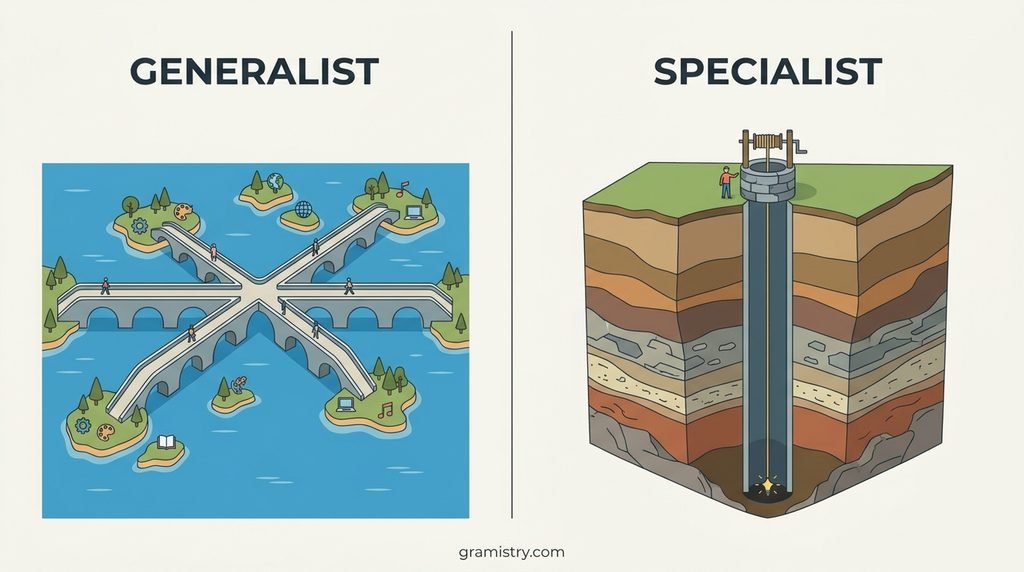
The easiest way to understand generalist or specialist is to compare breadth with depth.
- A generalist develops knowledge across several areas.
- A specialist develops deep knowledge in one particular area.
- A generalist usually has greater breadth.
- A specialist usually has greater depth.
- Generalists often value flexibility and adaptability.
- Specialists often value precision and advanced expertise.
- Generalists may move between different responsibilities more easily.
- Specialists may handle complex problems within their specific field more effectively.
- Generalists are often useful in roles that require cross-functional thinking.
- Specialists are often valuable when a task requires highly specific knowledge.
Neither approach is automatically better. The right choice depends on the role, industry, personal interests, and goals.
Generalist vs Specialist Comparison Table
| Feature | Generalist | Specialist |
|---|---|---|
| Basic meaning | Has broad knowledge across several areas | Has deep knowledge in one particular area |
| Main focus | Breadth | Depth |
| Knowledge | Wide-ranging | Highly focused |
| Skills | Multiple and transferable | Advanced and specialized |
| Flexibility | Usually high | Usually focused on a specific field |
| Problem-solving | Connects ideas across areas | Solves complex problems within a specialty |
| Career path | May work across different roles | Usually develops within one field |
| Example | Marketing professional handling several functions | SEO technical specialist |
| Best suited for | Varied responsibilities | Highly specific responsibilities |
| Main strength | Versatility | Expertise |
Generalist or specialist: Which is better?
There is no universal winner.
A generalist may be more useful when an organization needs someone who can perform different tasks, communicate across teams, and adapt to changing priorities.
A specialist may be more valuable when a problem requires advanced knowledge that cannot easily be gained through general experience.
In many modern careers, the strongest professionals combine both approaches. They have a broad understanding of their industry while developing deep expertise in one or two important areas.
This is sometimes described as a T-shaped skill profile: broad knowledge across several subjects combined with deep expertise in a particular area.
Real-Life Conversation Examples
Conversation 1: Choosing a Job
Ali: What kind of role are you looking for?
Sara: Something where I can work on different types of projects.
Ali: Then you might prefer a generalist position.
Sara: Why?
Ali: Generalist roles often require people to handle several related responsibilities instead of focusing on just one.
🎯 Lesson: A generalist is often suited to roles involving variety and multiple responsibilities.
Conversation 2: Hiring an Expert
Manager: We need someone to fix this complex security problem.
HR Officer: Should we hire a general IT professional?
Manager: This problem is highly technical. I’d rather bring in a cybersecurity specialist.
🎯 Lesson: A specialist is usually the better choice when a task requires deep expertise in a specific field.
Conversation 3: Discussing a Career
David: Are you going to specialize in data science?
James: Maybe. Right now, I’m learning programming, analytics, statistics, and business.
David: So you’re developing more of a generalist skill set.
James: Exactly. I want to understand how the different areas work together before choosing a specialty.
🎯 Lesson: Someone who develops skills across several connected areas may be described as a generalist.
Conversation 4: Medical Care
Patient: Do I need to see a specialist?
Doctor: Your condition may require a more detailed evaluation, so I may refer you to one.
Patient: What is the difference?
Doctor: A general practitioner handles a broad range of health concerns, while a specialist focuses on a particular area of medicine.
🎯 Lesson: In medicine, specialist refers to a professional with focused expertise in a particular medical field.
When to Use Generalist vs Specialist
Use generalist when you want to emphasize broad knowledge multiple skills flexibility or experience across different areas.
- Someone works across several areas.
- Their skills are broad rather than narrowly focused.
- They frequently adapt to different tasks.
- Their role requires cross-functional knowledge.
- You want to emphasize versatility.
Example:
We need a marketing generalist who can manage content, email, and social media.
Use “specialist” when:
- Someone focuses on one specific area.
- Their knowledge is highly advanced or technical.
- They have specialized training.
- A problem requires expert knowledge.
- You want to emphasize depth.
Example:
We hired a paid advertising specialist to manage our search campaigns.
What about formal and informal writing?
Both generalist and specialist are appropriate in formal writing.
They can appear in:
- Academic writing
- Business reports
- Job descriptions
- Professional profiles
- Research papers
- Educational resources
- News articles
- Career discussions
For example:
The organization needs both generalists and specialists to manage its growing operations.
There is no need to replace either word with a more complicated expression simply to sound formal.
Is there a US vs UK difference?
Unlike some spelling differences between American and British English, generalist and specialist are standard terms in both varieties of English.
You can use them in American English and British English without changing the spelling.
For example:
- US English: She is a medical specialist.
- UK English: She is a medical specialist.
The basic meanings remain the same.
Common Mistakes People Make
Mistake 1: Thinking a generalist knows everything
Incorrect idea:
A generalist is an expert in every subject.
Why it is incorrect:
A generalist has broad knowledge across multiple areas, but that does not mean they have expert-level knowledge of all of them.
Better understanding:
A generalist has knowledge across several areas and can often connect them effectively.
Mistake 2: Assuming a specialist cannot do anything outside their field
Incorrect idea:
Specialists only know one thing and cannot perform other tasks.
Why it is incorrect:
Specialization describes the person’s primary area of expertise. It does not mean they have no other skills.
Better understanding:
A specialist focuses deeply on a particular area while potentially having many additional abilities.
Mistake 3: Using “specialist” simply to mean “good”
Incorrect:
She is a specialist writer because she is a very good writer.
Why it may be misleading:
Being good at something does not automatically make someone a specialist.
Better:
She is a specialist writer who focuses on technical medical content.
The second sentence explains the person’s specific area of focus.
Mistake 4: Thinking generalist and specialist are opposites in every situation
They are contrasting terms, but a person can be both.
For example, someone might have broad knowledge of digital marketing while specializing deeply in technical SEO.
That person could reasonably be described as a marketing generalist with a specialization in technical SEO.
Generalist vs Specialist in Different Fields
The distinction becomes clearer when you look at real-world examples.
In technology
A technology generalist may understand several areas, including cloud computing, networking, software, and cybersecurity.
A cybersecurity specialist, by contrast, may spend most of their career focusing specifically on security threats, vulnerabilities, and defensive systems.
In business
A business generalist may understand operations, marketing, finance, sales, and customer service.
A financial analyst or tax specialist concentrates much more deeply on a particular area.
In education
A generalist educator may teach or understand several subjects.
A specialist educator may focus on mathematics, physics, language education, special education, or another specific discipline.
In medicine
Primary-care professionals generally provide broad care and evaluate many different conditions.
Medical specialists focus on particular areas of medicine and often receive additional specialized training.
In language and writing
A language generalist may work with grammar, vocabulary, editing, translation, and communication.
A specialist might focus specifically on technical writing, legal language, academic editing, or another narrow area.
Resources such as Gramistry can be useful for building broad language knowledge while also exploring individual vocabulary and grammar topics in greater depth.
Fun Facts and History
1. “Generalist” comes from “general”
The word generalist is built from the broader idea of being general rather than restricted to one particular category. Its modern use commonly describes people whose knowledge or skills span multiple areas.
2. “Specialist” is connected to “special”
Specialist comes from the idea of something being special or specific to a particular field. Over time, the term became widely used for people with focused professional or technical expertise.
3. Both terms can describe career strategies
The generalist-versus-specialist distinction is not limited to vocabulary. It is also an important concept in career development, education, business, and organizational design.
4. People can develop both breadth and depth
You do not always have to choose one permanently. A professional can build broad knowledge while developing deep expertise in one area.
This combination is especially useful in fields where collaboration between different disciplines matters.
FAQs:
What is the difference between a generalist and a specialist?
A generalist has broad knowledge or skills across several areas, while a specialist focuses deeply on one particular field. Generalists tend to emphasize flexibility and versatility, whereas specialists emphasize detailed expertise. For example, a marketing generalist may handle several marketing functions, while an SEO specialist may focus primarily on search engine optimization.
Is it better to be a generalist or a specialist?
Neither is automatically better. The best choice depends on your career, industry, goals, and personal strengths. A generalist can be valuable when flexibility and cross-functional knowledge are important. A specialist can be valuable when advanced expertise is required. Many successful professionals combine broad knowledge with deep expertise in one key area.
Can someone be both a generalist and a specialist?
Yes. A person can have broad knowledge across a field while specializing in one particular area. For example, someone may be a business generalist with deep expertise in financial planning. This combination provides both versatility and specialized knowledge and is often useful in complex professional environments.
What is an example of a generalist?
A marketing professional who works with content, email marketing, social media, analytics, and campaign planning is a good example of a generalist. They understand several parts of marketing rather than concentrating exclusively on one function. Their broad skill set allows them to move between different tasks and understand how different marketing activities work together.
What is an example of a specialist?
A cybersecurity professional who focuses primarily on network security, threat detection, and vulnerability management can be described as a specialist. Their knowledge is concentrated in a particular technical area. Specialists often develop advanced expertise that allows them to handle complex problems within their chosen field.
Is “generalist” a positive word?
Yes. Generalist is normally a neutral or positive term. It can emphasize versatility, adaptability, broad knowledge, and the ability to connect different areas. However, whether it sounds positive depends on the context. In some highly technical roles, employers may specifically need specialized expertise rather than broad knowledge.
Is “specialist” a positive word?
Yes. Specialist is generally a positive or neutral term. It highlights focused knowledge and expertise. Businesses often use the word in job titles to show that someone has advanced knowledge in a particular area. However, specialization can sometimes mean a person has a narrower professional focus.
Are generalist and specialist nouns?
Yes. Generalist and specialist are both nouns when they refer to people. For example, “She is a generalist” and “He is a specialist.” Related forms include general and specialized, which function differently depending on the sentence.
What is a generalist-specialist combination?
A generalist-specialist combination describes someone who understands a broad field but has deep expertise in one specific part of it. This is often called a T-shaped skill profile. The broad knowledge supports communication and flexibility, while the deep specialization provides valuable expertise in a particular area.
How can I remember the difference between generalist and specialist?
Use this simple memory trick: generalist = general knowledge; specialist = special or specific knowledge. A generalist goes wide, while a specialist goes deep. If someone works across many related areas, “generalist” is likely appropriate. If someone concentrates strongly on one particular area, “specialist” is usually the better word.
Conclusion:
The difference between generalist or specialist is mainly about breadth versus depth.
A generalist develops knowledge and skills across several areas, while a specialist focuses deeply on one particular field.
Generalists are often valued for flexibility, adaptability, and cross-functional thinking.
Specialists are valued for detailed expertise and advanced knowledge in a specific area.
Neither approach is automatically superior. In many careers, the most effective professionals develop broad knowledge while building deep expertise in an important specialty.
Understanding this distinction will help you use both words accurately in everyday, academic, and professional English.
Next time someone uses these two words, you’ll know exactly what they mean!

Alina Mark is the creative voice behind Gramistry.com, making word meanings, English expressions, and trending slang simple, clear, and interesting. Her mission is to make every word easier to understand, one meaning at a time.