
If you are renting a home, apartment, room, or office, you may have seen both sublease and sublet used to describe a similar situation.
That can make it difficult to know which word is correct.
Is one more formal? Does “sublet” mean something different from “sublease”? And which term should you use in a lease agreement or everyday conversation?
Although they look or sound similar, they serve completely different purposes.
More precisely, however, sublease and sublet often describe the same basic rental arrangement, but they can function differently in a sentence.
Sublease is commonly used as a noun and verb, while sublet is especially common as a verb and can also be used as a noun.
In this guide, you’ll learn the meaning of sublease or sublet, how the terms are used, the difference between them, common mistakes, regional usage, and practical examples.
What Is a Sublease?

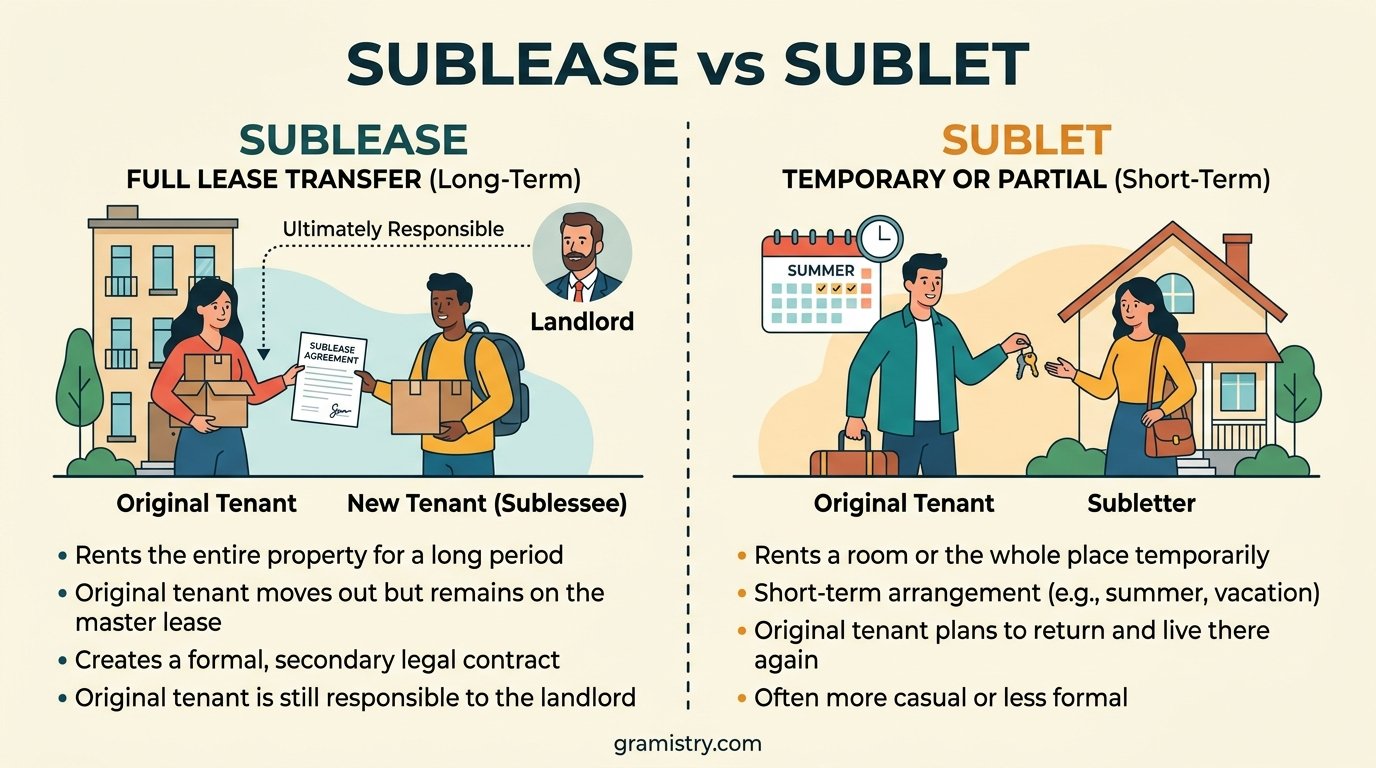
A sublease is a rental arrangement in which a tenant rents all or part of their rented property to another person while the original tenant’s lease remains in effect.
For example, imagine that Sarah rents an apartment for one year. After six months, she needs to move to another city for work. Instead of ending her lease, she rents the apartment to David for the remaining six months, assuming her original lease and local rules allow it.
Sarah is still the original tenant under her lease with the landlord. David becomes a subtenant under a separate agreement with Sarah.
Simple definition of sublease
A sublease is an arrangement where an existing tenant rents their leased property, or part of it, to another person while remaining responsible under the original lease.
The word sublease is particularly common in formal, legal, business, and real-estate contexts.
Is “sublease” a noun or a verb?
Sublease can work as both a noun and a verb.
As a noun:
- “I signed a six-month sublease.”
- “The landlord approved the sublease.”
- “We found a student for the sublease.”
As a verb:
- “I plan to sublease my apartment.”
- “She wants to sublease her office.”
- “The tenant asked whether he could sublease the room.”
This flexibility makes sublease useful in both everyday and formal writing.
Where is “sublease” used?
You can encounter sublease in many English-speaking regions, including the United States, Canada, the United Kingdom, Australia, and other countries where English is used in rental or commercial contexts.
However, exact legal terminology can vary by jurisdiction. A rental agreement may define sublease, sublet, assignment, or related terms differently. Therefore, the ordinary English meaning should not automatically be treated as a legal definition in every country.
What is a subtenant?
The person who receives the rental rights from the original tenant is generally called a subtenant.
The basic relationship looks like this:
Landlord → Original tenant → Subtenant
The original tenant does not necessarily disappear from the rental relationship. In many sublease arrangements, the original tenant remains responsible to the landlord for obligations under the original lease.
That is one reason people should carefully check their lease before subleasing a property.
Example sentences with “sublease”
- “I found a student to take over my apartment through a sublease.”
- “The company signed a short-term sublease for additional office space.”
- “Our landlord requires written approval before any sublease.”
- “She entered into a three-month sublease while studying abroad.”
What Is a Sublet?
Sublet generally means to rent a property that you are already renting to another person, usually for part or all of the remaining rental period.
For example:
“I’m going to sublet my apartment while I’m traveling.”
Here, sublet is being used as a verb.
Like sublease, sublet can refer to renting out a property that you yourself lease from someone else.
Simple definition of sublet
To sublet means to rent a property that you currently lease to another person, while your original rental agreement remains in place.
The word is particularly common in everyday speech.
People often say:
- “I need to sublet my room.”
- “Can I sublet my apartment?”
- “She is subletting her place for the summer.”
These sentences sound natural and conversational.
Is “sublet” a noun or a verb?
Sublet is most commonly used as a verb.
Examples:
- “We decided to sublet the apartment.”
- “He sublet his room while he was away.”
- “They are subletting their house for three months.”
It can also appear as a noun, although sublease may sound more natural in some formal contexts.
For example:
- “I found a sublet near campus.”
- “She is looking for a summer sublet.”
In these examples, sublet refers to the property or rental arrangement being offered.
The unusual verb forms of “sublet”
One interesting feature of sublet is that its past tense is also sublet.
- Present: “I sublet my apartment.”
- Past: “I sublet my apartment last summer.”
- Past participle: “I have sublet my apartment before.”
You do not normally say subletted.
The continuous form is subletting:
- “She is subletting her room.”
Example sentences with “sublet”
- “I want to sublet my apartment for the summer.”
- “He sublet his room while he was studying abroad.”
- “Are you allowed to sublet the property?”
- “We found a furnished sublet close to the university.”
Sublease vs. Sublet: What Is the Difference?
The easiest answer is that sublease and sublet are usually very closely related and are often used interchangeably in ordinary English.
The biggest practical difference is often grammar, tone, and context, rather than the basic rental concept.
Key differences
- Sublease can be a noun or a verb.
- Sublet is especially common as a verb.
- Sublease often sounds more formal or legal.
- Sublet is very common in everyday conversation.
- A sublease can refer specifically to the agreement or contractual arrangement.
- A sublet can refer to the act of renting out the property and, informally, to the place being rented.
- The exact legal meaning can depend on the lease and local law.
- Neither word automatically means that the original tenant has permanently transferred the lease.
Quick answer
Sublease and sublet usually refer to the same basic idea: a tenant rents their leased property to another person. Sublease is often more formal and works naturally as a noun, while sublet is especially common as a verb and in everyday speech.
Sublease vs. Sublet Comparison Table
| Feature | Sublease | Sublet |
|---|---|---|
| Basic meaning | Renting leased property to another person | Renting leased property to another person |
| Common grammar role | Noun and verb | Mainly verb; also noun |
| Formality | Often more formal | Often more conversational |
| Legal/business writing | Very common | Also used |
| Everyday conversation | Common | Very common |
| Person receiving the rental | Subtenant | Subtenant |
| Example | “I signed a sublease.” | “I will sublet my apartment.” |
| Past tense | Subleased | Sublet |
| Main difference | Often emphasizes the agreement or arrangement | Often emphasizes the act of renting out |
| Exact legal meaning | Depends on the agreement and jurisdiction | Depends on the agreement and jurisdiction |
Real-Life Conversation Examples
Conversation 1: Student Apartment
Maya: “I’m going home for the summer. I need someone to rent my room.”
Emma: “Are you going to sublet it?”
Maya: “Yes. I found a student who wants it for three months.”
Emma: “Did your landlord approve it?”
Maya: “I’m checking the lease now.”
🎯 Lesson: Sublet sounds very natural when talking casually about renting your place to someone else.
Conversation 2: Formal Rental Agreement
Manager: “Have you received the landlord’s approval?”
Tenant: “Yes. We have permission to enter into a sublease.”
Manager: “Good. Make sure the agreement covers the entire six-month period.”
🎯 Lesson: Sublease often fits better in formal, business, and contractual contexts.
Conversation 3: Looking for Temporary Housing
Alex: “What are you looking for?”
Ben: “A furnished sublet near the university.”
Alex: “How long do you need it?”
Ben: “About four months.”
🎯 Lesson: Sublet can also function as a noun in informal rental conversations, especially when describing a temporary place.
Conversation 4: Office Space
Lisa: “Our company has too much office space right now.”
Daniel: “Could you sublease part of it?”
Lisa: “Possibly. We need to check our commercial lease first.”
🎯 Lesson: Sublease is common in commercial real estate and formal business discussions.
When to Use “Sublease” vs. “Sublet”
Choosing between the two is usually easier if you focus on context and grammar.
Use “sublease” when talking about the agreement
If you are referring to a formal rental arrangement or contract, sublease is often the clearest choice.
Examples:
- “The landlord approved the sublease.”
- “We signed a sublease agreement.”
- “The commercial sublease lasts for two years.”
This is especially useful in formal writing.
Use “sublet” when talking about the action
When you mean the act of renting your leased property to another person, sublet sounds very natural.
Examples:
- “I need to sublet my apartment.”
- “She plans to sublet her room.”
- “Can I sublet this house while I’m away?”
Use either when the context allows it
In many situations, both words communicate the same basic idea.
For example:
“I want to sublease my apartment.”
and
“I want to sublet my apartment.”
Both can be understood as saying that the tenant wants to rent the apartment to someone else.
The better choice often depends on the surrounding sentence and the level of formality.
Sublease or Sublet in the US vs. UK
Both sublease and sublet appear in American and British English. However, usage preferences can vary by context and speaker.
In American English, both terms are widely understood. Sublet is especially common in everyday rental conversations, while sublease frequently appears in legal, real-estate, and commercial contexts.
British English also uses both terms, although rental terminology can vary depending on the type of property and legal context.
The important point is that there is no simple rule saying one word belongs exclusively to the United States and the other belongs exclusively to the United Kingdom.
If you are writing a formal document, follow the terminology used in the relevant lease and local legal system rather than choosing a word based only on regional English.
Formal, Informal, and Academic Writing
Formal writing
For contracts, business correspondence, and real-estate documents, sublease often fits naturally.
Example:
“The tenant may not enter into a sublease without the landlord’s prior written consent.”
Informal writing
In text messages, conversations, and rental advertisements, sublet is extremely common.
Example:
“I’m looking to sublet my room from June through August.”
Academic writing
Academic writing should focus on precision rather than choosing one word simply because it sounds more sophisticated.
If you are discussing rental law or housing policy, define the term you are using and remain consistent throughout your paper.
For example:
“A sublease occurs when an existing tenant rents the premises to a subtenant while retaining the original lease.”
Common Mistakes With “Sublease” and “Sublet”
Mistake 1: Treating them as completely unrelated concepts
Incorrect idea:
“A sublease means one thing, while a sublet means an entirely different type of rental.”
Better understanding:
They usually describe the same general rental concept. The difference is often grammatical or stylistic rather than a completely different arrangement.
Mistake 2: Assuming subletting automatically ends your lease
Incorrect assumption:
“Once I sublet my apartment, I am no longer responsible for it.”
That is not necessarily true.
A sublease commonly leaves the original lease in place. The original tenant may continue to have obligations to the landlord.
Always check the original lease and applicable local rules.
Mistake 3: Confusing a sublease with an assignment
A sublease is not necessarily the same as an assignment.
In a sublease, the original tenant generally remains connected to the original lease.
In an assignment, the tenant generally transfers their interest in the lease to another party.
The precise legal effect varies by jurisdiction and contract, so these terms should not be treated as identical.
Mistake 4: Assuming landlord permission is never necessary
Some leases prohibit subleasing or require the landlord’s written consent. Local laws may also affect the situation.
Instead of assuming you can sublet, check:
- Your original lease.
- Any applicable housing rules.
- Local landlord-tenant law.
- Whether written permission is required.
Mistake 5: Using “subletted”
The past tense of sublet is generally sublet, not subletted.
Correct:
“She sublet her apartment last year.”
Not:
“She subletted her apartment last year.”
A Simple Memory Trick
Here is an easy way to remember the difference:
Sublease = think “agreement.”
Sublet = think “action.”
For example:
- “I signed a sublease.” → the agreement
- “I will sublet my apartment.” → the action
- “I found a sublet.” → the temporary rental/place
This is not an absolute grammatical rule, but it is a useful shortcut for everyday English.
Sublease or Sublet: Which One Is Correct?
Both can be correct.
Choose sublease when you want to emphasize the rental agreement, contract, or formal arrangement.
Choose sublet when you want to emphasize the act of renting out a property or when speaking casually.
Compare:
“The company signed a sublease for additional office space.”
with:
“I’m going to sublet my apartment while I travel.”
Neither word is inherently more correct in every situation.
The surrounding sentence determines which one sounds most natural.
Fun Facts and History
1. “Sub-” means under or secondary
The prefix sub- comes from Latin and generally carries the idea of something beneath, secondary, or subordinate. In sublease, it helps describe a lease that exists under or alongside an original lease.
2. “Sublet” has an unusual verb pattern
Unlike many regular English verbs, sublet does not normally change form in the past tense.
You can say:
- “I sublet the apartment.”
- “I have sublet the apartment.”
- “She sublet the room last year.”
That makes it one of those useful English verbs whose present and past forms look identical.
3. Rental terminology can be legal-language dependent
Although the everyday meanings of sublease and sublet overlap heavily, contracts and housing laws can assign specific meanings to these terms.
That is why a dictionary definition should not replace reading the actual rental agreement.
4. “Sublet” is common in temporary housing
Students, travelers, interns, and people relocating for work often use sublet when discussing short-term housing arrangements.
This is one reason the word appears frequently in informal rental listings.
FAQs:
Is a sublease the same as a sublet?
In ordinary English, sublease and sublet usually refer to the same basic rental arrangement. A tenant rents their leased property to another person while the original lease remains relevant. The main difference is often usage: sublease sounds more formal and works naturally as a noun, while sublet is especially common as a verb.
Is it better to say sublease or sublet?
Neither is universally better. Use sublease when discussing a formal agreement, contract, or business arrangement. Use sublet when describing the action of renting out your apartment, room, or house. In everyday conversation, sublet is very natural. In formal documents, sublease may be more appropriate.
What does it mean to sublet an apartment?
To sublet an apartment generally means to rent the apartment, or part of it, to another person while you remain the tenant under the original lease. The person renting from you is usually called a subtenant. Whether you are allowed to sublet depends on your lease and applicable local rules.
What is a sublease agreement?
A sublease agreement is an agreement between an original tenant and a subtenant concerning the rental of property that the original tenant already leases. It commonly identifies the property, rental period, rent, responsibilities, and other conditions. The original lease may continue to govern the tenant’s relationship with the landlord.
Is sublet a noun or a verb?
Sublet is most commonly a verb, as in “I plan to sublet my apartment.” It can also be used as a noun in informal contexts, such as “I found a summer sublet.” The exact usage depends on the sentence and regional preferences.
What is the difference between a subtenant and a tenant?
A tenant generally rents property directly from the landlord or property owner. A subtenant usually rents from an existing tenant through a sublease or sublet arrangement. The original tenant normally remains connected to the landlord through the original lease, although the precise legal relationship depends on the agreement and local law.
Is subleasing the same as assigning a lease?
No. A sublease and an assignment are generally different legal arrangements. A sublease usually involves an existing tenant renting to a subtenant while retaining an interest in the original lease. An assignment generally involves transferring the tenant’s leasehold interest to another person. Legal effects vary by jurisdiction and contract.
Can I use “sublease” as a verb?
Yes. Sublease can function as both a noun and a verb. For example, “We signed a sublease” uses it as a noun, while “We plan to sublease the office” uses it as a verb. This flexibility makes sublease particularly useful in formal and professional writing.
Is “subletted” correct?
In standard English, the past tense and past participle of sublet are normally sublet, not subletted. For example, “He sublet his apartment last summer” and “She has sublet the room before” are standard constructions. The continuous form is subletting, as in “They are subletting their apartment.”
Which word should I use in a rental advertisement?
Both can work, but sublet is often natural for casual rental advertisements, especially phrases such as “room for sublet” or “apartment available to sublet.” Sublease may be preferable when emphasizing the formal contractual arrangement. Always make sure the listing accurately reflects the rights and conditions allowed under the original lease.
Conclusion:
Sublease and sublet are closely related words that usually describe the same basic rental idea: an existing tenant rents their leased property to another person.
The main distinction is often one of grammar, tone, and context. Sublease commonly appears in formal agreements and can function as both a noun and verb, while sublet is especially common when describing the action of renting out a property.
If you are dealing with an actual rental arrangement, remember that the legal meaning can depend on your lease and local rules.
For clear explanations of confusing English terms, resources such as Gramistry can help you understand how words work in real contexts.
Next time someone uses these two words, you’ll know exactly what they mean!

Alina Mark is the creative voice behind Gramistry.com, making word meanings, English expressions, and trending slang simple, clear, and interesting. Her mission is to make every word easier to understand, one meaning at a time.
1 thought on “Sublease vs Sublet: What’s the Difference? Meaning, Examples”