
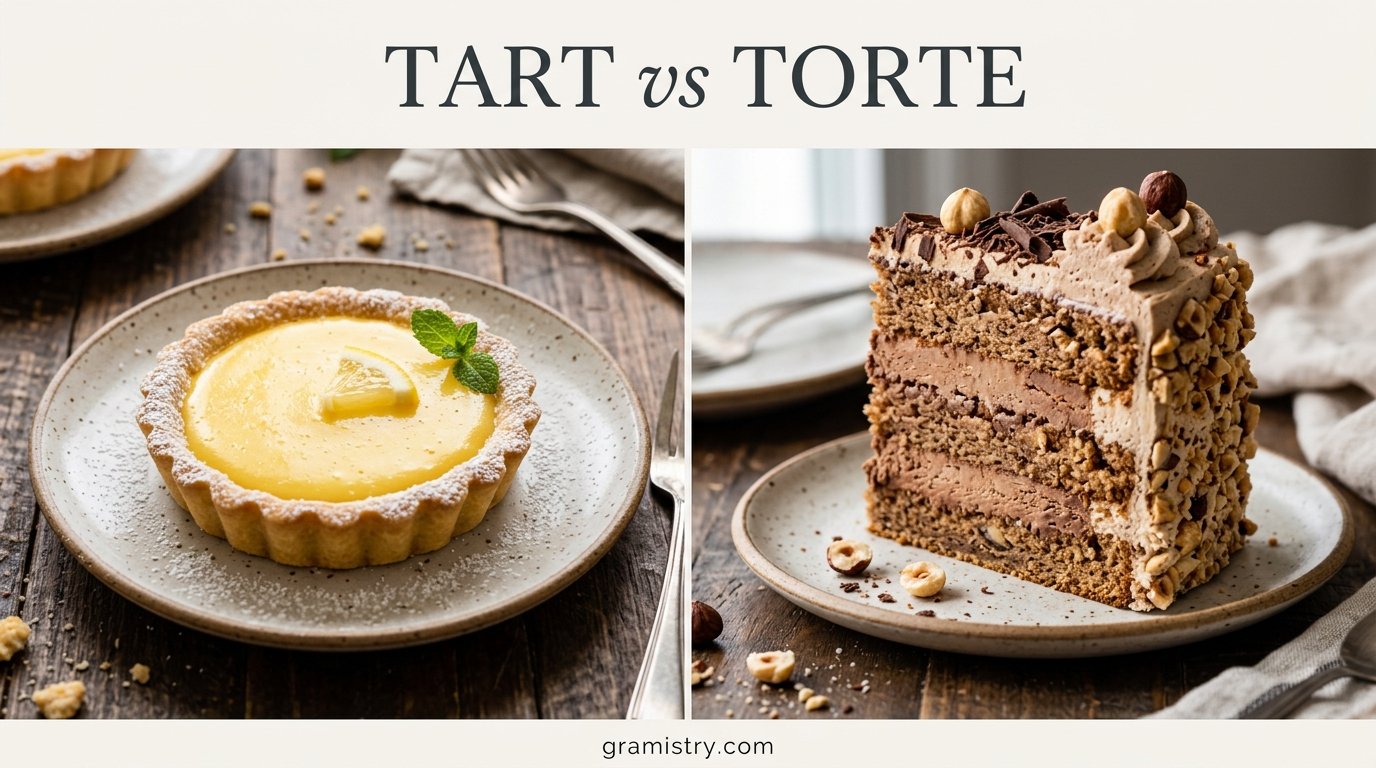
If you have ever seen tart and torte on a dessert menu, you may have wondered whether they are simply two spellings of the same word.
They are related, but in modern English they usually describe different kinds of desserts.
A tart is generally a pastry with a filling, while a torte is usually a rich, cake-like dessert that may contain nuts, eggs, cream, fruit, or other rich ingredients.
The confusion is understandable because both words have European culinary histories and are connected through older words for round baked foods.
Although they look or sound similar, they serve completely different purposes.
In this guide, you will learn the meaning, pronunciation, origin, grammar, usage, and practical difference between tart or torte, along with examples, common mistakes, and easy ways to remember which word to use.
What Is a Tart?
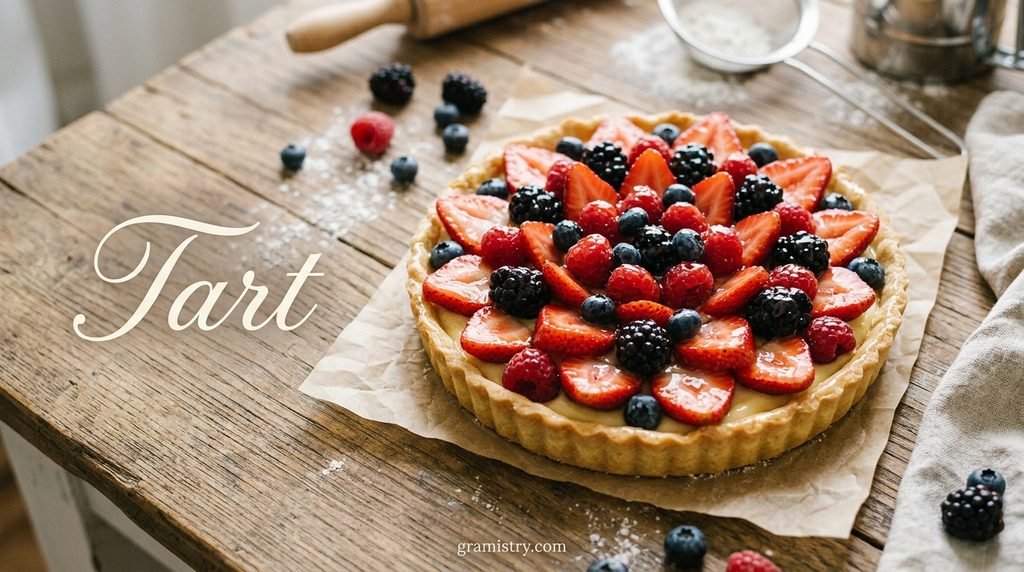
A tart is a baked dish made with a pastry shell and a filling. In its most familiar form, it has an open top, so the filling is visible rather than covered by a second layer of pastry.
Oxford defines a tart as an open pie filled with sweet food such as fruit, while Merriam-Webster describes it as a dish baked in a pastry shell, including a small pie or pastry shell containing ingredients such as fruit, custard, or jelly.
Tart: Definition
Tart (noun): A pastry with a crust or shell and a filling, usually baked without a pastry covering on top.
Common examples include:
- Apple tart
- Strawberry tart
- Lemon tart
- Chocolate tart
- Custard tart
- Jam tart
- Bakewell tart
- Fruit tart
A tart can be sweet or, depending on the culinary tradition, savory. In everyday English, however, the word often brings to mind a sweet pastry filled with fruit, custard, chocolate, or cream.
Pronunciation of Tart
Tart is generally pronounced:
/tɑːrt/ in American English
/tɑːt/ in British English
The spelling is straightforward, and the word is usually easy to pronounce once you hear it.
How Is “Tart” Used in Grammar?
When tart refers to a dessert, it is a noun.
For example:
We ordered a lemon tart after dinner.
Here, tart names a type of dessert.
However, tart has another completely different use as an adjective. It can describe a food or drink with a sharp, acidic, or pleasantly sour taste.
For example:
These berries have a tart flavor.
It can also describe someone’s words or manner as sharp or cutting:
She gave him a tart reply.
So, context matters. A tart can be a dessert, a taste description, or, in some contexts, a description of someone’s speech.
Where Is “Tart” Used?
The word tart is widely used in English-speaking countries, including the United States, the United Kingdom, Canada, Australia, and New Zealand.
British English commonly uses names such as Bakewell tart, jam tart, and custard tart. American English also uses tart for open pastries, particularly fruit and dessert pastries.
History and Origin of “Tart”
The culinary noun tart dates back to Middle English. Merriam-Webster traces it to Anglo-French tarte, probably connected with older French forms such as torte or tourte, ultimately associated with the Late Latin tōrta, meaning a round loaf. Merriam-Webster records the first known English use of the noun tart in the 14th century.
Interestingly, the adjective tart, meaning sharp or sour, has a separate history. It is traced to Old English teart, meaning harsh or severe. The culinary noun and the taste adjective therefore should not automatically be treated as having exactly the same origin.
Examples of “Tart” in Sentences
- I made an apple tart for dessert.
- The lemon tart was sweet with a slightly sour filling.
- She served a beautiful strawberry tart at the party.
- This blueberry tart has a crisp pastry crust.
- The restaurant offers a chocolate tart with vanilla cream.
- The green apples taste pleasantly tart.
What Is a Torte?
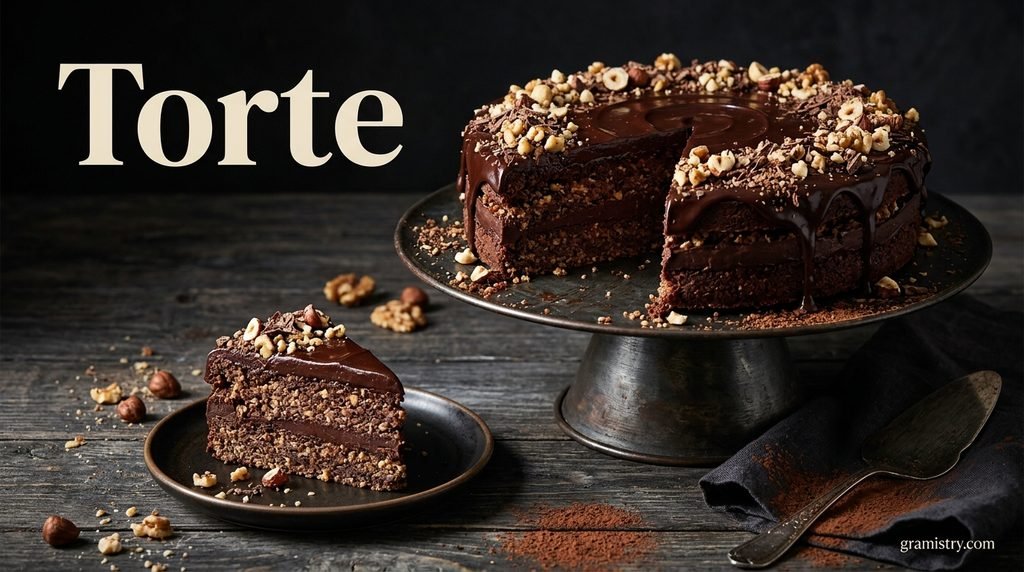
A torte is a rich cake-like dessert. It is often made with many eggs and may contain ground nuts, such as almonds or hazelnuts, instead of relying heavily on ordinary wheat flour.
Merriam-Webster defines a torte as a cake made with many eggs and often grated nuts or dry bread crumbs, usually finished with a rich frosting. Cambridge similarly describes it as a round, flat, sweet cake that is often served with cream or fruit.
Torte: Definition
Torte (noun): A rich, usually round cake that may contain nuts, eggs, fruit, cream, chocolate, or rich frosting and may be made in layers.
Popular examples include:
- Chocolate torte
- Almond torte
- Linzer torte
- Sacher torte
- Blackcurrant torte
- Hazelnut torte
A torte may look similar to an ordinary cake, but it is often denser and richer. Some tortes contain very little flour or use ground nuts as an important structural ingredient.
Pronunciation of Torte
The pronunciation varies slightly between British and American English:
British English: /ˈtɔːt/
American English: /ˈtɔːrt/
In simple terms, English speakers often pronounce it approximately like “tort” in American English and “tawt” in British English.
How Is “Torte” Used in Grammar?
Torte is a noun.
For example:
We shared a chocolate torte after dinner.
The word refers to the dessert itself.
Unlike tart, torte is not normally used as an adjective to describe sourness or sharp taste.
You would say:
The lemon tart was tart.
But you would not normally say:
The lemon torte was torte.
That distinction is one useful way to remember the two words.
Where Is “Torte” Used?
Torte is an English culinary term borrowed through European languages, particularly German. It is especially associated with Central European baking traditions and with famous desserts such as Sacher Torte and Linzer Torte.
That does not mean the word is restricted to German-speaking countries. English-language menus, cookbooks, restaurants, and bakeries around the world use torte for particular styles of rich cake.
History and Origin of “Torte”
Merriam-Webster traces English torte to German Torte, with connections to French tarte and tourte and Italian torta. These forms ultimately go back to the Late Latin tōrta, associated with a round loaf. The English word torte is recorded from 1748.
This shared history explains why tart and torte look so similar. They are not unrelated words that happened to develop similar spellings.
At the same time, modern English has developed a practical distinction between them: tart usually points to a pastry shell with filling, while torte usually points to a rich cake.
Key Differences Between Tart and Torte
The easiest way to understand tart vs. torte is to focus on the structure of the dessert.
Tart
- Usually has a pastry crust or shell.
- Usually has an open top.
- Often contains fruit, custard, jam, chocolate, or cream.
- The filling is usually a major visible part of the dessert.
- It is generally considered a type of pastry.
- It can be sweet or, in some culinary contexts, savory.
- The word tart can also describe a sharp or sour taste.
Torte
- Usually has a cake-like structure.
- Often contains many eggs and may include ground nuts.
- Can be dense and rich.
- May have multiple layers.
- Often includes frosting, cream, fruit, chocolate, or other rich fillings.
- It is generally classified as a type of cake or rich baked dessert.
- The word torte does not normally describe a sour taste.
Tart vs. Torte Comparison Table
| Feature | Tart | Torte |
|---|---|---|
| Basic meaning | Open pastry with filling | Rich cake-like dessert |
| Main structure | Pastry shell | Cake-like layers or body |
| Top | Usually open | May be covered or decorated |
| Common fillings | Fruit, custard, jam, chocolate | Cream, fruit, chocolate, nuts |
| Texture | Often crisp pastry with soft filling | Usually rich, dense, or moist |
| Typical flour use | Pastry flour is common | May use less flour and more nuts/eggs |
| Layers | Usually not the defining feature | Layers are common in some styles |
| Common examples | Apple tart, lemon tart | Sacher torte, chocolate torte |
| Grammar | Noun; also adjective | Noun |
| Taste meaning | Can mean sharp or sour | No equivalent taste meaning |
| Culinary association | Pastry | Rich cake |
| Origin | French/Anglo-French culinary history | German, with wider European connections |
Quick answer: A tart is generally an open pastry with a filling, while a torte is generally a rich, cake-like dessert.
Real-Life Conversation Examples
Conversation 1: Choosing Dessert
Emma: What are you having?
Daniel: I think I’ll have the lemon tart.
Emma: I was deciding between that and the chocolate torte.
Daniel: What’s the difference?
Emma: The tart has a pastry shell and lemon filling. The torte is more like a rich cake.
🎯 Lesson: Choose tart when you’re talking about an open pastry with a filling and torte when you’re talking about a rich cake-like dessert.
Conversation 2: Talking About a Recipe
Sara: Is this recipe for a tart?
Mike: No, it’s an almond torte.
Sara: So does it have a pastry crust?
Mike: Not in the usual sense. The cake gets much of its texture from eggs and ground almonds.
🎯 Lesson: A torte may use nuts and eggs to create a rich cake structure rather than relying on a traditional pastry shell.
Conversation 3: Describing Flavor
Lily: How does the fruit taste?
Tom: It’s quite tart.
Lily: You mean the fruit tart?
Tom: No. I mean the fruit tastes sharp and sour.
🎯 Lesson: Tart can be an adjective describing a sharp or sour flavor. Torte cannot be used this way.
Conversation 4: Reading a Menu
Customer: What’s the difference between the berry tart and berry torte?
Server: The tart has a pastry base with berries and cream. The torte is a rich cake served with berries.
Customer: I’ll take the tart.
🎯 Lesson: On a menu, the surrounding description matters. A tart and a torte can contain similar ingredients but have very different bases.
When to Use Tart vs. Torte
When you are unsure, ask yourself one simple question:
“Am I talking about a pastry shell or a rich cake?”
Use “tart” when:
- The dessert has a pastry shell.
- The top is generally open.
- The filling is fruit, custard, jam, chocolate, or another soft ingredient.
- You are describing a sharp or sour flavor.
Examples:
- lemon tart
- apple tart
- strawberry tart
- custard tart
- The sauce tastes tart.
Use “torte” when:
- The dessert is primarily cake-like.
- It is rich or dense.
- Nuts and eggs play an important role.
- It is layered or richly decorated.
- You are referring to a traditional named dessert such as Sacher Torte.
Examples:
- chocolate torte
- almond torte
- hazelnut torte
- Sacher Torte
- Linzer torte
Easy Memory Trick
Think:
TART = pastry + filling
TORTE = rich cake
The memory trick is not a strict culinary rule for every traditional dessert, but it works well for everyday English.
What About US vs. UK English?
There is no major US-versus-UK spelling rule that turns tart into torte. Both words are used in British and American English.
The important difference is meaning, not regional spelling.
However, food terminology can vary by tradition. A dessert with one name in Austria, Germany, Italy, France, Britain, or the United States may be classified somewhat differently elsewhere. Modern food vocabulary does not always fit into perfectly rigid categories.
For that reason, named desserts should be treated according to their established names rather than forced into a simple dictionary definition.
Common Mistakes People Make
Mistake 1: Treating “torte” as another spelling of “tart”
Incorrect:
I ordered a chocolate torte, which is just another word for chocolate tart.
Better:
I ordered a chocolate torte, which is a rich cake-like dessert.
Why?
Although the words have related histories, they normally describe different dessert styles in modern English.
Mistake 2: Calling Every Round Dessert a Tart
Incorrect:
This layered almond cake is a tart.
Better:
This layered almond cake is a torte.
Why?
Shape alone does not determine whether something is a tart. A round dessert can be a cake, tart, torte, or another type of pastry.
Mistake 3: Using “Torte” for Sour Flavor
Incorrect:
The green apple is very torte.
Correct:
The green apple is very tart.
Why?
Tart can be an adjective meaning sharp or sour in taste. Torte is a noun referring to a type of dessert.
Mistake 4: Assuming All Tortes Are Identical
Not every torte follows exactly the same recipe. Some are dense and nut-based, while others may be layered, fruit-filled, chocolate-based, or heavily decorated.
The word describes a broad family of rich cake-like desserts rather than one single recipe.
Mistake 5: Assuming the Definitions Never Overlap
Food terminology can be messy. Some traditional desserts have names and structures that do not fit perfectly into modern simplified definitions. For example, Linzer torte has a pastry-like character, showing why culinary traditions cannot always be reduced to one rigid rule. Even modern reference sources acknowledge that definitions can vary depending on culinary tradition and naming.
Tart or Torte: Which One Should You Choose?
Use this quick decision guide:
Is it an open pastry shell with a filling?
→ Tart
Is it a rich cake, often made with eggs and nuts?
→ Torte
Are you describing a sharp or sour flavor?
→ Tart
Are you talking about a layered chocolate dessert?
→ Torte is often the appropriate term if that is how the dessert is named or classified.
Is it a famous traditional dessert with a fixed name?
→ Keep its established name, such as Sacher Torte or Linzer Torte.
For language learners, resources such as Gramistry can also be useful for understanding how small spelling differences can signal meaningful differences in English vocabulary.
Fun Facts and History
1. Tart and torte are historically connected
Despite their modern differences, the words are historically related through European culinary vocabulary. Merriam-Webster traces tart through Anglo-French tarte and torte through German Torte, with both connected to older European words ultimately associated with Late Latin tōrta.
2. “Tart” has more than one important meaning
A tart is not only a dessert. As an adjective, tart can describe something with a sharp or acidic taste, such as a lemon or green apple. It can also describe a sharp or cutting remark.
3. Torte is a relatively later English borrowing
Merriam-Webster records the first known English use of torte in 1748. The word entered English through German and has strong associations with European cake traditions.
4. Dessert names do not always follow strict categories
A traditional dessert’s name may reflect its history rather than a modern dictionary definition. That is why some famous desserts can sit somewhere between the categories of cake, tart, and torte.
FAQs:
1. What is the main difference between a tart and a torte?
A tart is generally an open pastry with a filling, while a torte is generally a rich cake-like dessert. Tarts often have a crisp pastry shell filled with fruit, custard, chocolate, or jam. Tortes are commonly richer and denser and may contain eggs, ground nuts, cream, fruit, or chocolate.
2. Is a torte the same as a cake?
A torte is a type of cake-like dessert, but the word usually suggests a richer or more specialized preparation. Tortes often contain many eggs, nuts, rich fillings, or frosting and may be layered. The exact characteristics vary by recipe and culinary tradition, so there is no single ingredient that defines every torte.
3. Is a tart a pie?
A tart is closely related to a pie, but the terms are not always interchangeable. A tart typically has an open top and a pastry shell, while a traditional pie may have a pastry top covering the filling. Culinary traditions differ, so the exact distinction can depend on the type of dessert being discussed.
4. Why are tart and torte spelled differently?
The words have different histories in English, although their histories are connected. Tart entered English through Anglo-French tarte, while torte was borrowed through German Torte. Both are ultimately connected with older European words for round baked foods.
6. Can “tart” describe a taste?
Yes. Tart can describe something that has a sharp, acidic, or sour taste. For example, you might say, “The lemon tastes tart.” This meaning is separate from the noun tart, which refers to a type of pastry.
7. Is chocolate tart the same as chocolate torte?
Usually, no. A chocolate tart generally has a pastry shell containing a chocolate filling or similar preparation. A chocolate torte is usually a rich cake-like dessert made with ingredients such as chocolate, eggs, nuts, cream, or other rich components. The exact recipe can vary.
8. Is a Linzer torte a tart or a cake?
The name itself is Linzer torte, and it is a traditional Central European dessert with a distinctive pastry-like structure and fruit filling. This is a good reminder that culinary categories are not always perfectly rigid. It is better to use the established name rather than changing it simply because it does not fit a simplified modern definition.
9. Can a tart be savory?
Yes. Although sweet tarts are extremely common, the broader concept of a tart can include savory preparations. Ingredients and terminology vary across culinary traditions. The key structural idea is usually a pastry shell or base with a filling.
10. What is the easiest way to remember tart vs. torte?
Remember this simple rule: tart usually means pastry with filling; torte usually means rich cake. Also remember that tart can describe a sharp or sour flavor. If you are describing a dessert’s structure, think pastry = tart and rich cake = torte.
Conclusion:
The difference between tart and torte becomes much easier once you focus on structure.
A tart is generally an open pastry shell filled with ingredients such as fruit, custard, jam, or chocolate.
A torte is generally a rich, cake-like dessert that may contain eggs, nuts, cream, chocolate, fruit, or frosting.
Although their histories are connected, modern English uses them differently.
And remember that traditional dessert names can sometimes blur these boundaries.
For everyday writing and conversation, the simple rule is enough: tart = pastry with filling; torte = rich cake.
Next time someone uses these two words, you’ll know exactly what they mean!

Alina Mark is the creative voice behind Gramistry.com, making word meanings, English expressions, and trending slang simple, clear, and interesting. Her mission is to make every word easier to understand, one meaning at a time.