

If you have ever wondered whether to say “I fractured my arm” or “I broke my arm,” you are not alone.
Both fracture and break are commonly used when talking about an injury to a bone, and in everyday English, they can often describe the same situation.
The confusion usually comes from the fact that fracture sounds more medical, while break sounds simpler and more conversational.
Although they look or sound similar, they serve completely different purposes.
More precisely, they overlap in meaning but differ mainly in register, context, and grammar.
A doctor is more likely to use fracture, while an ordinary conversation may use break.
In this guide, we will explain fracture vs break, their meanings, grammar, pronunciation, usage, examples,
common mistakes, and the small differences that matter in formal and informal English.
What Is “Fracture”?
A fracture is a crack, partial break, or complete break in a bone. The word is especially common in medical, scientific, and formal contexts.
Fracture as a noun
As a noun, fracture refers to the injury or damage itself.
Examples:
- The X-ray showed a fracture in his wrist.
- She suffered a leg fracture during the accident.
- The doctor diagnosed a hairline fracture.
- He has a small fracture in one of the bones in his foot.
In these examples, fracture names the medical condition.
Fracture as a verb
Fracture can also function as a verb. It means to cause a bone to crack or break, or for a bone to become cracked or broken.
Examples:
- He fractured his ankle while playing football.
- She fractured her wrist in the fall.
- The impact fractured two ribs.
- The athlete fractured a bone in his hand.
As a verb, fracture is generally more formal and clinical than break.
Pronunciation of “fracture”
Fracture is commonly pronounced:
FRAK-chur
Its pronunciation is similar in American and British English, although accents can affect the exact sound.
How is “fracture” used?
The word appears frequently in medical conversations, hospital records, news reports, sports coverage, and formal writing.
You may hear phrases such as:
- bone fracture
- wrist fracture
- ankle fracture
- hip fracture
- stress fracture
- hairline fracture
- compound fracture
- simple fracture
- spinal fracture
The exact medical classification of a fracture depends on factors such as the affected bone, the pattern of the injury, and whether the skin has been broken.
A brief history of the word
Fracture comes from Latin fractura, meaning a breaking or break. It is related to the Latin verb frangere, meaning “to break.”
That connection explains why fracture and break are closely related in meaning. The major difference today is not that they describe entirely separate injuries, but that they belong to different levels of formality and usage.
Common mistake with “fracture”
One common mistake is assuming that a fracture must always be a tiny crack rather than a complete break.
That is not generally correct.
A fracture can range from a small crack to a complete separation of the bone. Therefore, saying that a fracture is always less serious than a break can be misleading.
What Is “Break”?
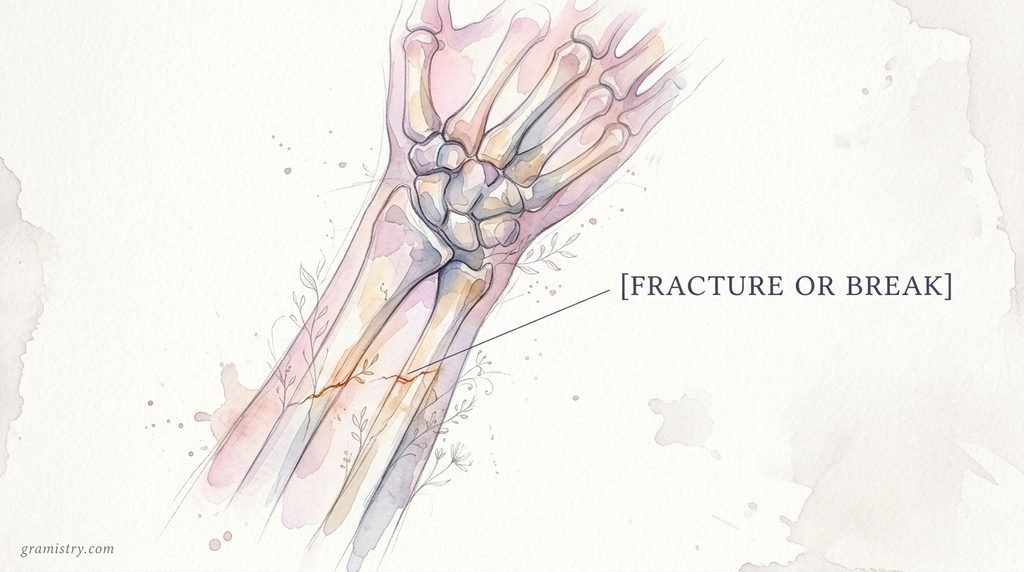
Break is a much more general English word. When talking about bones, it means that a bone has been damaged so that its normal structure is disrupted.
It is extremely common in everyday conversation.
Break as a verb
When break is used as a verb, it can describe the action or event involving the bone.
Examples:
- I broke my arm.
- She broke her leg skiing.
- He broke his finger playing basketball.
- Tom broke his wrist in an accident.
These sentences sound natural and conversational.
Break as a noun
Break can also be used as a noun to refer to the injury.
Examples:
- He has a broken arm.
- The doctor said it was a bad break.
- She suffered a break in her wrist.
However, in medical writing, fracture is generally more precise and conventional.
“Broken” is often more natural than “break”
When describing the condition of a person’s bone, English speakers frequently use the adjective or past participle broken.
For example:
- I have a broken arm.
- She has a broken ankle.
- His finger is broken.
Compare this with:
- I have a fracture in my arm.
- She has a fracture of the ankle.
Both can be correct, but the first group sounds more natural in ordinary conversation, while the second sounds more clinical.
How is “break” used?
Unlike fracture, break has many meanings unrelated to bones.
For example:
- Take a break from work.
- Be careful not to break the glass.
- The machine broke down.
- He broke the record.
- They broke the news yesterday.
This makes break one of the most versatile words in English.
When the context involves an injury, however, break a bone is a very common expression.
Fracture vs Break: Key Differences
The most important point is simple:
- Fracture is the more medical and formal term for a broken bone.
- Break is the more common everyday term.
- A bone described as “fractured” is not necessarily less seriously injured than one described as “broken.”
- In many situations, the two words can refer to the same physical injury.
- Fracture works naturally as both a noun and a verb.
- Break has many meanings beyond bone injuries.
- Doctors and medical professionals commonly use fracture in clinical contexts.
- Friends, family members, and patients commonly use break in casual conversation.
Quick answer
Are a fracture and a break the same thing?
In everyday English, yes, they can refer to the same type of bone injury. Fracture is the more formal medical term, while break is the simpler everyday word. However, medical professionals may use specific fracture classifications to describe the exact nature of an injury.
Fracture vs Break Comparison Table
| Feature | Fracture | Break |
|---|---|---|
| Basic meaning | A crack or break in a bone | A bone becoming damaged or separated |
| Common context | Medical and formal | Everyday and informal |
| Grammar | Noun and verb | Noun, verb, and adjective form “broken” |
| Tone | Clinical or formal | Conversational |
| Common phrase | “a bone fracture” | “a broken bone” |
| Example | “She fractured her wrist.” | “She broke her wrist.” |
| Used by doctors | Very common | Common in patient-friendly speech |
| Used in casual conversation | Yes | Extremely common |
| Can describe non-bone situations? | Yes, but less broadly | Yes, very broadly |
| US vs UK difference | Generally similar | Generally similar |
Real-Life Conversation Examples
Conversation 1: Talking to a friend
Sarah: Why are you wearing a cast?
Mike: I broke my wrist yesterday.
Sarah: Oh no! How did it happen?
Mike: I fell while playing football.
🎯 Lesson:
Break is very natural in casual conversations. “I broke my wrist” sounds completely normal when speaking with friends.
Conversation 2: At a hospital
Doctor: The X-ray shows a fracture in your left wrist.
Patient: Is it serious?
Doctor: It is a relatively straightforward fracture, but you will need to keep the wrist protected while it heals.
🎯 Lesson:
Fracture is especially common in medical settings because it is a precise and professional term.
Conversation 3: Talking about the same injury in two ways
Ali: What happened to your brother?
Sam: He broke his leg in a cycling accident.
Ali: What did the doctor say?
Sam: The doctor said he has a fracture in his lower leg.
🎯 Lesson:
The two words can naturally appear in the same conversation. Break may be used by the family member, while fracture may be preferred by the medical professional.
Conversation 4: Formal writing
Reporter: The athlete was taken to hospital after suffering a wrist fracture.
Editor: That sounds appropriate for the report.
Reporter: Would “broken wrist” also work?
Editor: Yes, but “wrist fracture” has a more formal and medical tone.
🎯 Lesson:
Both expressions can be correct. Your choice depends on the audience and context.
When to Use “Fracture” vs “Break”
Choosing between these words is usually easy if you think about the situation.
Use “break” in everyday conversation
Choose break when talking casually with friends, family, coworkers, or other people who do not need technical medical language.
Examples:
- I broke my arm.
- She broke her ankle.
- He broke his finger.
- My son broke his leg.
These are simple, natural sentences.
Use “fracture” in medical or formal contexts
Choose fracture when writing or speaking in a medical, scientific, academic, or professional context.
Examples:
- The patient suffered a femoral fracture.
- The X-ray confirmed a wrist fracture.
- The study examined stress fractures among athletes.
- The patient was diagnosed with a rib fracture.
What about academic writing?
In academic or medical writing, fracture is usually preferable because it is more specific and fits professional terminology.
For example:
Less formal:
The researchers studied people who had broken bones.
More formal:
The researchers studied patients with bone fractures.
The second sentence sounds more appropriate for a scientific paper.
What about informal writing?
In emails, messages, social media posts, and casual stories, break is often easier and more natural.
Example:
I broke my ankle, so I won’t be able to come to work tomorrow.
There is no need to replace broke with fractured simply to sound sophisticated.
Easy Memory Trick
Here is a simple way to remember the difference:
Break = everyday English
Fracture = medical/formal English
Think of it this way:
Friend: “I broke my arm.”
Doctor: “You have a fracture.”
Both people may be describing the same injury.
The important thing is not to assume that fracture automatically means a minor injury or that break automatically means a severe one. The words themselves do not reliably tell you how serious the injury is.
US vs UK English
There is no major American-versus-British spelling difference between fracture and break when they refer to bone injuries.
Both varieties of English commonly use expressions such as:
- break a bone
- broken bone
- fracture a bone
- bone fracture
- wrist fracture
However, word choice can vary according to personal preference, profession, and context.
A British speaker might say:
“I broke my arm.”
An American speaker might say:
“I fractured my arm.”
But either speaker could use either expression. This is mainly a difference in register and individual usage, not a strict US-versus-UK grammar rule.
Common Mistakes People Make
Mistake 1: Thinking “fracture” and “break” describe completely different injuries
Incorrect assumption:
A fracture is a small crack, but a break means the bone is completely separated.
This is too simplistic.
Better understanding:
A fracture can include different types and degrees of bone damage. In everyday English, break and fracture can refer to the same injury.
Mistake 2: Using “fracture” just to sound more intelligent
Some writers replace every instance of break with fracture because they think the medical word sounds better.
For example:
“I fractured my finger while opening a box.”
This is grammatically correct, but if you are having a relaxed conversation with a friend, “I broke my finger” may sound more natural.
Lesson: Choose the word that fits the context, not the word that sounds more complicated.
Mistake 3: Saying “I have a breaked arm”
This is incorrect.
The past tense of break is broke, and its past participle is broken.
Correct:
- I broke my arm.
- I have a broken arm.
Incorrect:
- I breaked my arm.
- I have a breaked arm.
Mistake 4: Confusing “fracture” with only a tiny crack
A fracture is not necessarily a minor injury. The word can describe different types of bone injuries.
Therefore, do not use fracture as a synonym for “small injury.”
Mistake 5: Saying “a fracture bone”
The natural phrase is:
a fractured bone
or:
a bone fracture
For example:
- She has a fractured ankle.
- The X-ray revealed an ankle fracture.
Grammar: Fracture vs Break
Understanding the grammar can make your English sound more natural.
“Fracture” as a verb
Subject + fracture + object
She fractured her wrist.
“Fracture” as a noun
Subject + have/suffer + a fracture
She has a wrist fracture.
“Break” as a verb
Subject + break + object
She broke her wrist.
Remember that break is an irregular verb:
- Present: break
- Past: broke
- Past participle: broken
Examples:
I break bones? — Not normally unless describing a repeated action.
I broke my arm yesterday.
I have broken my arm.
“Broken” as an adjective
Broken commonly describes the condition of the bone:
He has a broken leg.
This construction is extremely common in everyday English.
Fractured vs Broken: Which Is More Natural?
Both can be correct.
Compare:
She has a broken wrist.
and:
She has a fractured wrist.
The first sounds more conversational. The second sounds more clinical.
Similarly:
He broke his ankle.
sounds natural in everyday speech.
He fractured his ankle.
sounds somewhat more medical or formal.
Neither is automatically “more correct.” The context determines the better choice.
Can “Fracture” Be Used for Things Other Than Bones?
Yes. Although fracture is strongly associated with broken bones, it can have broader meanings.
It can describe something splitting, cracking, or becoming divided.
For example:
- The material developed a fracture.
- The political alliance suffered a serious fracture.
- The conflict caused a fracture within the organization.
In these contexts, fracture is being used metaphorically or technically.
By contrast, break has a much wider range of meanings:
- break a glass
- break a promise
- break a record
- break a rule
- break the news
- take a break
- break down
- break apart
This makes break one of the most flexible verbs in English.
Fun Facts About “Fracture” and “Break”
1. “Fracture” has Latin roots
The English word fracture comes from Latin roots connected with breaking. The same historical family appears in other English words related to breaking or splitting.
2. “Break” is much older and broader
Break comes from an old Germanic language family and has been part of English for centuries. Its meaning expanded over time, which helps explain why it is now used in so many different expressions.
3. Doctors often adapt their language to patients
A medical professional may use fracture in clinical documentation but say “broken bone” when explaining an injury to a patient. Good communication often means choosing language the listener can understand easily.
4. “Broken bone” is not unprofessional
There is sometimes a misconception that broken bone is somehow incorrect because fracture sounds more medical.
That is not true. “Broken bone” is perfectly natural English and is widely understood.
FAQs:
Is a fracture the same as a break?
In everyday English, a fracture and a break can describe the same bone injury. Fracture is generally the more medical or formal term, while break is more common in ordinary conversation. Medical professionals may use additional terms to describe the exact type and characteristics of a fracture.
Is it better to say “fractured” or “broken”?
Neither is always better. Use broken for casual, everyday communication and fractured when a more medical or formal tone is appropriate. For example, “I broke my wrist” sounds natural when speaking to a friend, while “The patient fractured his wrist” fits a clinical context.
Is a fracture worse than a break?
No. The words themselves do not establish which injury is more serious. In everyday English, fracture and break can refer to the same type of bone injury. The seriousness depends on the actual injury, including factors such as the bone involved and the nature of the damage.
Do doctors say “break” or “fracture”?
Doctors commonly use fracture, particularly in medical records, diagnoses, and professional discussions. However, doctors may also say “broken bone” when communicating with patients because it is simple and easy to understand. Both expressions are valid English.
Is “I fractured my arm” grammatically correct?
Yes. Fracture can be used as a verb, so “I fractured my arm” is grammatically correct. It means that you suffered a fracture to your arm. In casual conversation, however, “I broke my arm” is often more natural.
Is “I broke my arm” correct English?
Yes. “I broke my arm” is completely correct and very common. The verb break has an irregular past tense: broke. The sentence is appropriate for everyday conversation and does not need to be changed to “I fractured my arm.”
Can a fracture be a complete break?
Yes. A fracture can involve different forms and degrees of bone damage. The everyday word break does not provide enough medical detail to explain the exact nature of the injury. A healthcare professional may use a more specific fracture classification when necessary.
What is the difference between a broken bone and a fractured bone?
Usually, there is little or no difference in the basic meaning. “Broken bone” is the everyday expression, while “fractured bone” has a more medical tone. In both cases, the speaker is describing damage to a bone. The exact medical nature of the injury requires professional assessment rather than simply choosing one word over the other.
Which word is better for formal writing: fracture or break?
Fracture is generally better for medical, scientific, or highly formal writing. For example, “The patient suffered a wrist fracture” is appropriate in a medical report. However, formal writing does not require complicated vocabulary everywhere. If the audience is general, “broken wrist” may be clearer and more reader-friendly.
Is “fracture” more serious than “break”?
Not necessarily. Fracture is primarily a difference in terminology and register, not a built-in measure of severity. A person can have a serious fracture or a relatively uncomplicated fracture. Similarly, saying someone “broke a bone” does not tell you exactly how severe the injury is.
Conclusion:
The easiest way to understand fracture vs break is to remember that they often refer to the same basic bone injury, but they do not have the same style.
Fracture is more common in medical, technical, and formal contexts, while break is simpler and more natural in everyday conversation.
“I broke my arm” and “I fractured my arm” can therefore describe the same event.
If you are learning English through resources such as Gramistry, focusing on context is more useful than memorizing one word as universally correct.
Choose the word that matches your audience, purpose, and level of formality.
Next time someone uses these two words, you’ll know exactly what they mean!

Alina Mark is the creative voice behind Gramistry.com, making word meanings, English expressions, and trending slang simple, clear, and interesting. Her mission is to make every word easier to understand, one meaning at a time.