
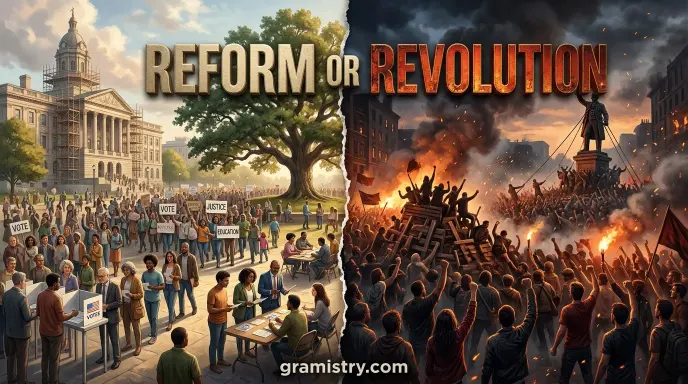
Have you ever wondered whether reform and revolution mean the same thing?
Many people use these words interchangeably because both involve change.
However, they describe very different ways of creating change in society, politics, organizations, and even personal life.
Understanding the distinction is important, especially when reading history, discussing current events, or writing academic content.
Although they look/sound similar, they serve completely different purposes.
A reform improves an existing system step by step, while a revolution replaces or completely transforms the existing system.
Knowing when to use reform or revolution can make your communication clearer and more accurate.
In this guide, we’ll explore the meaning, usage, examples, history, and key differences between these two important concepts in simple, conversational English.
What Is Reform?
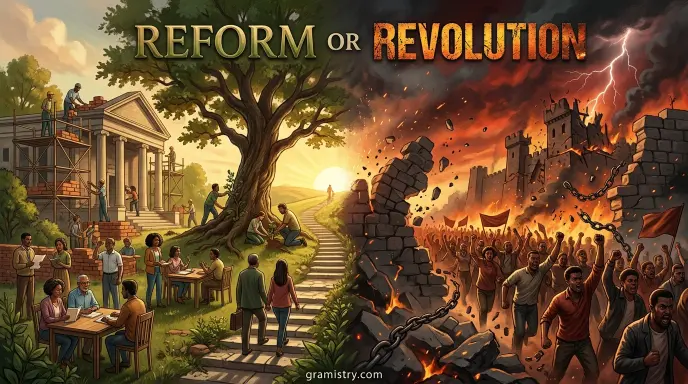
Reform is the process of making improvements to an existing system without completely replacing it. The goal of reform is to fix problems while keeping the basic structure intact.
People often choose reform when they believe a system still works but needs adjustments to become fairer, more efficient, or more effective.
How Is Reform Used?
The word reform commonly appears in discussions about:
- Government policies
- Education
- Healthcare
- Criminal justice
- Economics
- Business management
- Social change
Unlike dramatic changes, reforms are usually introduced through laws, policies, negotiations, or public discussions.
Examples of Reform in Sentences
- The government introduced tax reforms to help small businesses.
- Education reform improved the national curriculum.
- The company implemented workplace reforms after employee feedback.
- Many activists demanded police reform instead of replacing the entire system.
Where Is Reform Used?
The word reform is widely used in both American English and British English. There are no spelling differences between the two varieties.
It functions as both:
- Noun: The reform was successful.
- Verb: Leaders want to reform the healthcare system.
Historical Note
The word reform comes from the Latin reformare, meaning to shape again or to improve. Throughout history, many countries have experienced political, economic, and educational reforms without changing their entire governments.
For example, several democratic nations regularly pass reforms to improve voting systems, healthcare, or education instead of creating an entirely new political system.
What Is Revolution?
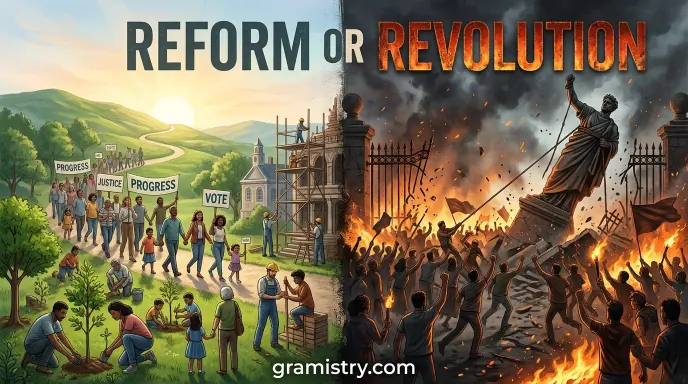
A revolution is a major and often rapid change that completely replaces an existing system, government, or way of life. Unlike reform, revolution aims for a fundamental transformation rather than gradual improvement.
A revolution may occur peacefully, but many famous revolutions have involved conflict, protests, or armed struggles.
How Is Revolution Used?
The word revolution is commonly used in discussions about:
- Politics
- History
- Technology
- Science
- Culture
- Industry
It can describe both physical events and major breakthroughs.
Examples of Revolution in Sentences
- The French Revolution changed European history.
- Smartphones created a technological revolution.
- The country experienced a political revolution after years of unrest.
- Artificial intelligence is causing another digital revolution.
Where Is Revolution Used?
Like reform, revolution has the same spelling in both US and UK English.
It can function as:
- Noun: The revolution changed society.
- Occasionally in related forms:
- Revolutionary
- Revolutionize
- Revolutionized
Historical Note
The word revolution originates from the Latin revolutio, meaning to turn around.
Some of history’s best-known revolutions include:
- The French Revolution (1789)
- The American Revolution (1775–1783)
- The Industrial Revolution
- The Digital Revolution
These events dramatically transformed governments, economies, or technologies.
Key Differences Between Reform and Revolution
Although reform or revolution both involve change, their goals, methods, and outcomes differ significantly.
Main Differences
- Reform improves an existing system.
- Revolution replaces an existing system.
- Reform usually happens gradually.
- Revolution often happens rapidly.
- Reform generally works within existing laws.
- Revolution may reject or overthrow existing institutions.
- Reform seeks improvement.
- Revolution seeks transformation.
- Reform is usually less disruptive.
- Revolution often produces widespread political or social change.
Reform vs Revolution Comparison Table
| Feature | Reform | Revolution |
|---|---|---|
| Meaning | Improves an existing system | Completely replaces a system |
| Speed | Gradual | Rapid or sudden |
| Goal | Fix problems | Create an entirely new system |
| Level of Change | Moderate | Radical |
| Method | Laws, policies, negotiations | Major political or social transformation |
| Risk | Usually lower | Often higher |
| Examples | Tax reform, education reform | French Revolution, Digital Revolution |
| Existing Structure | Remains in place | Is replaced |
| Public Impact | Limited to targeted improvements | Broad societal transformation |
| Common Fields | Politics, education, healthcare | Politics, history, technology |
Real-Life Conversation Examples
Dialogue 1
Emma: We need better healthcare.
Liam: So you’re asking for a revolution?
Emma: No, I want healthcare reform, not an entirely new government.
🎯 Lesson: Use reform when improving an existing system.
Dialogue 2
Alex: The citizens demanded a revolution.
Sarah: Did they want small policy changes?
Alex: No. They wanted a completely new government.
🎯 Lesson: A revolution replaces the old system rather than improving it.
Dialogue 3
Teacher: What’s the difference between reform and revolution?
Student: Reform changes the rules. Revolution changes the whole game.
🎯 Lesson: Reform improves; revolution transforms.
Dialogue 4
Manager: Should we reform the company’s policies?
Employee: Definitely. We don’t need a corporate revolution!
🎯 Lesson: Businesses usually seek reform, not revolution.
Dialogue 5
David: AI is creating another technological revolution.
Nina: So it’s changing how people work?
David: Exactly. It’s transforming entire industries.
🎯 Lesson: Revolution also describes groundbreaking technological change.
When to Use Reform vs Revolution
Choosing between reform or revolution depends on the scale of change you want to describe.
Use reform when:
- Improving existing laws
- Updating policies
- Fixing problems
- Making gradual progress
- Keeping the current structure
Examples:
- Education reform
- Tax reform
- Prison reform
- Electoral reform
Use revolution when:
- Describing complete political change
- Referring to historic uprisings
- Talking about technological breakthroughs
- Explaining radical transformation
Examples:
- French Revolution
- American Revolution
- Industrial Revolution
- Digital Revolution
Simple Memory Tricks
Remember this easy rule:
- Reform = Repair
- Revolution = Replace
Another trick:
Think of renovating a house.
- Painting the walls is reform.
- Demolishing and rebuilding the house is revolution.
US vs UK Usage
Good news!
Both American English and British English use reform and revolution in exactly the same way.
There are:
- No spelling differences
- No pronunciation differences that affect meaning
- No grammar differences
The distinction depends entirely on the type of change, not the variety of English.
Common Mistakes People Make
Many learners confuse reform or revolution because both involve change. Here are a few common mistakes and how to avoid them.
Mistake 1: Calling Every Big Improvement a Revolution
If an organization updates its policies or procedures, it is usually a reform, not a revolution.
Correct: The school introduced education reform.
Incorrect: The school started an education revolution. (Unless it completely transformed the education system.)
Mistake 2: Using Reform for Complete Overhauls
When a government or society replaces an entire political system, revolution is the correct term.
Correct: The country experienced a political revolution.
Incorrect: The country experienced political reform after overthrowing the government.
Mistake 3: Ignoring Context
Sometimes the same event can involve both concepts. A society may attempt reforms for years, but if those reforms fail, a revolution may eventually occur.
Understanding the context helps you choose the right word.
Fun Facts and History
Here are a couple of interesting facts about reform or revolution.
1. Not Every Revolution Is Political
When people hear the word revolution, they often think of governments. However, revolutions also happen in science and technology.
For example:
- The Industrial Revolution transformed manufacturing.
- The Internet Revolution changed communication worldwide.
- Artificial intelligence is driving another technological revolution today.
2. Many Revolutions Begin with Calls for Reform
History shows that some revolutions started because people first demanded reform. When governments refused to make gradual improvements, public frustration sometimes grew into revolutionary movements.
This demonstrates how closely these two concepts can be connected, even though they represent different levels of change.
FAQs:
Is reform better than revolution?
Neither is automatically better. Reform is often preferred when existing systems can be improved peacefully. Revolution may occur when people believe meaningful reform is impossible.
Can a revolution be peaceful?
Yes. While many revolutions involve violence, some are largely peaceful and rely on mass protests, political movements, or civil resistance.
Can reforms lead to revolutions?
Yes. If reforms fail or do not address major problems, dissatisfaction can grow and eventually contribute to revolutionary movements.
Is the Industrial Revolution actually a revolution?
Yes. Although it wasn’t primarily political, it dramatically transformed manufacturing, transportation, economies, and daily life, making the term revolution appropriate.
Conclusion:
Understanding the difference between reform vs revolution helps you communicate more accurately in everyday conversations, academic writing, and discussions about history or current events.
While both words describe change, they represent very different approaches.
Reform focuses on improving an existing system through gradual adjustments, whereas revolution aims to replace or fundamentally transform that system.
Remember the simple rule: reform repairs, revolution replaces.
Once you recognize this distinction, choosing the correct word becomes much easier.
Next time someone uses these two words, you’ll know exactly what they mean!

Alina Mark is the creative voice behind Gramistry.com, making word meanings, English expressions, and trending slang simple, clear, and interesting. Her mission is to make every word easier to understand, one meaning at a time.