
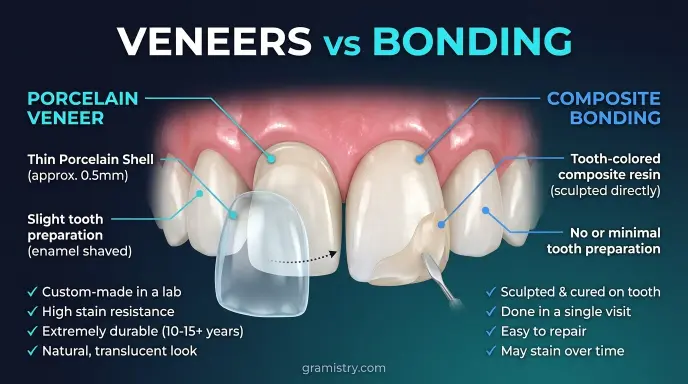
Choosing between dental veneers and dental bonding can be confusing, especially when both treatments can improve the appearance of your smile.
They can fix chipped teeth, hide discoloration, close small gaps, and make uneven teeth look better. However, they work in different ways and offer different results.
If you are considering veneers or bonding, understanding their differences can help you make a more informed decision.
One option may be better for long-lasting cosmetic results, while the other may suit smaller repairs and a tighter budget.
Although they look or sound similar, they serve completely different purposes.
In this guide, we will explain what veneers and bonding are, how each treatment works, their advantages, disadvantages, costs, durability, and maintenance.
You will also learn which option may be more suitable for different dental needs.
What Are Dental Veneers?
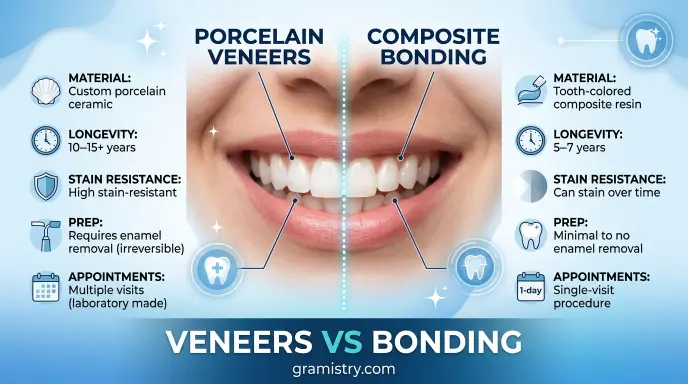
Dental veneers are thin, custom-made shells that cover the front surface of teeth to improve their appearance. They are commonly made from porcelain or composite resin and are designed to create a more even, attractive smile.
Veneers can change the color, shape, size, and overall appearance of teeth. They are often used when whitening or smaller cosmetic repairs cannot achieve the desired result.
Meaning and Definition of Dental Veneers
In simple terms, a dental veneer is a thin covering attached to the front of a natural tooth.
Think of it as a protective-looking cosmetic cover that hides certain imperfections without covering the entire tooth.
Dentists commonly recommend veneers for:
- Deep stains that do not respond well to teeth whitening.
- Chipped or slightly damaged front teeth.
- Small gaps between teeth.
- Uneven or irregular tooth shapes.
- Teeth that appear too short or small.
- Minor cosmetic alignment concerns.
Veneers improve the visible appearance of teeth, but they do not replace orthodontic treatment when someone has significant alignment or bite problems.
Types of Dental Veneers
There are two main material options:
1. Porcelain veneers
Porcelain veneers are custom-made ceramic shells created to fit individual teeth.
Their main characteristics include:
- Natural-looking appearance.
- Good resistance to staining.
- Long-lasting results with proper care.
- A higher initial cost than composite bonding.
- Usually requiring some enamel removal.
2. Composite veneers
Composite veneers use tooth-colored resin material, similar to the material used in dental bonding.
A dentist applies and shapes the resin directly on the tooth or uses a prepared composite restoration.
They generally cost less than porcelain veneers and may require less tooth preparation. However, they are more likely to stain, wear, or chip over time.
How Are Dental Veneers Applied?
The procedure depends on the material selected.
For traditional porcelain veneers, the process usually involves:
- Dental examination: The dentist checks your teeth, gums, bite, and overall oral health.
- Tooth preparation: A small amount of enamel is usually removed to create room for the veneer.
- Dental impressions: The dentist takes impressions or digital scans of your teeth.
- Custom manufacturing: A dental laboratory creates veneers that match your desired shape and shade.
- Final placement: The dentist checks the fit and appearance before bonding the veneers to your teeth.
Composite veneers may be completed in one visit because the dentist can shape the resin directly on the teeth.
The procedure should always be performed by a qualified dental professional. MouthHealthy+2
Advantages of Dental Veneers
Veneers offer several cosmetic benefits:
- Better appearance: They can improve the color, shape, and symmetry of teeth.
- Stain resistance: Porcelain veneers resist many common stains better than composite resin.
- Long-term results: Porcelain veneers can last around 10–15 years or longer in some cases, depending on care and individual circumstances.
- Natural appearance: Quality veneers can closely resemble natural tooth enamel.
- Multiple improvements: They can address several cosmetic concerns at once.
Disadvantages of Dental Veneers
Despite their benefits, veneers are not suitable for everyone.
Some disadvantages include:
- Higher cost: Porcelain veneers generally require a larger investment.
- Enamel removal: Traditional porcelain veneers usually require removing some natural enamel.
- Limited reversibility: Once enamel has been removed, the procedure is generally irreversible.
- Possible sensitivity: Some people experience temporary sensitivity to hot or cold temperatures.
- Potential damage: Veneers can chip, crack, loosen, or require replacement.
- Ongoing care: Natural teeth underneath veneers can still develop cavities.
People who grind or clench their teeth may have a higher risk of veneer damage. A dentist may recommend treating these habits or using a protective night guard. MouthHealthy+2
Example Sentences
Here are some everyday examples of how the term veneers is used:
- Sarah chose porcelain veneers to improve the appearance of her front teeth.
- Dental veneers can cover stains that regular whitening treatments cannot remove.
- My dentist explained the advantages and disadvantages of veneers before treatment.
- Porcelain veneers are usually more resistant to staining than composite resin.
- He wanted veneers to make his uneven teeth look more uniform.
Quick definition: Dental veneers are thin porcelain or composite coverings attached to the front of teeth to improve their color, shape, and appearance.
What Is Dental Bonding?
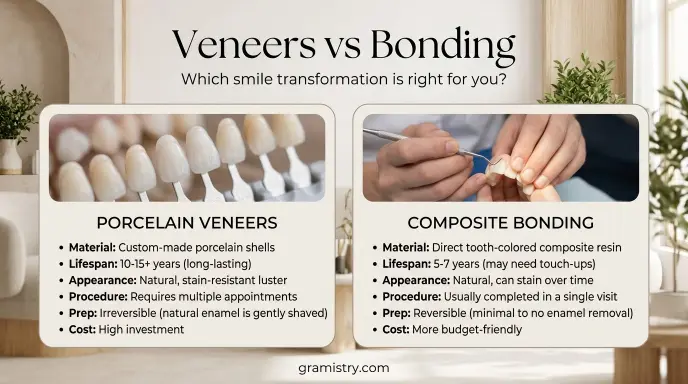
Dental bonding is a cosmetic dental procedure in which a dentist applies tooth-colored composite resin to a tooth to repair minor damage or improve its appearance.
Unlike traditional porcelain veneers, bonding usually requires little or no removal of natural enamel. The dentist shapes the resin directly on the tooth and hardens it with a special curing light.
It is a popular choice for people who want to improve small imperfections without undergoing a more involved cosmetic procedure
Meaning and Definition of Dental Bonding
Dental bonding refers to attaching tooth-colored composite resin to a natural tooth using dental adhesive materials.
The dentist uses this material to restore or reshape the tooth while keeping the result as natural-looking as possible.
Bonding is commonly used for:
- Repairing small chips and cracks.
- Closing minor gaps between teeth.
- Covering certain stains and discoloration.
- Improving uneven tooth edges.
- Making short teeth appear longer.
- Correcting minor shape imperfections.
It is especially useful when only one or a few teeth need small cosmetic improvements.
How Does Dental Bonding Work?
Dental bonding is usually a straightforward procedure that can be completed during one appointment.
Here is how it generally works:
- Shade selection: The dentist chooses a resin shade that closely matches your natural teeth.
- Tooth preparation: The tooth surface is gently roughened, and a conditioning liquid may be applied.
- Resin application: The dentist places tooth-colored composite resin onto the tooth.
- Shaping: The resin is carefully molded to create the desired shape.
- Hardening: A special curing light hardens the material.
- Polishing: The dentist smooths and polishes the bonded area to create a natural finish.
The procedure often takes approximately 30–60 minutes per tooth, although the actual time depends on the size and complexity of the repair.
In many cases, anesthesia is unnecessary unless the treatment involves other dental work or the patient experiences discomfort. Cleveland Clinic+1
Advantages of Dental Bonding
Dental bonding offers several practical advantages.
- Affordable treatment: It generally costs less than porcelain veneers.
- Quick procedure: Many bonding treatments can be completed in one visit.
- Minimal tooth preparation: Little or no enamel removal is usually needed.
- Natural appearance: Tooth-colored resin blends with surrounding teeth.
- Easy repairs: Small chips or damaged areas can often be repaired without replacing the entire restoration.
- Versatility: It can correct several minor cosmetic problems.
Another important advantage is that bonding is generally reversible when the natural tooth structure has not been removed.
Disadvantages of Dental Bonding
Bonding is convenient, but it also has limitations.
- Shorter lifespan: Composite bonding usually needs maintenance or replacement sooner than porcelain veneers.
- Staining: Resin can become discolored from coffee, tea, tobacco, and other staining substances.
- Chipping: The material may chip or wear down, especially when exposed to excessive biting pressure.
- Polishing requirements: Bonded teeth may need occasional polishing to maintain their appearance.
- Limited cosmetic changes: Bonding may not be the best choice for major smile transformations.
People who regularly bite hard objects, chew ice, or grind their teeth may damage bonded areas more easily.
How Long Does Dental Bonding Last?
Dental bonding commonly lasts around 3–10 years, although its lifespan varies.
Several factors influence how long it remains in good condition:
- The size and location of the bonded area.
- The quality of the dental procedure.
- Oral hygiene habits.
- Eating and chewing habits.
- Teeth grinding or clenching.
- Regular dental examinations.
Good oral hygiene and avoiding unnecessary pressure on bonded teeth can help extend their lifespan. Cleveland Clinic+1
Example Sentences
Here are some natural examples of how the term dental bonding is used:
- Mark chose dental bonding to repair a small chip in his front tooth.
- Composite bonding can improve the appearance of uneven teeth.
- My dentist recommended bonding because I only had a minor cosmetic problem.
- Dental bonding is usually less expensive than porcelain veneers.
- She had her chipped tooth repaired with composite resin.
Quick definition: Dental bonding is a cosmetic procedure that uses tooth-colored composite resin to repair chips, close small gaps, and reshape teeth.
Key Differences Between Veneers and Bonding
Veneers and bonding both improve the appearance of teeth, but their materials, procedures, costs, and long-term results are different.
The most important distinction is that traditional porcelain veneers cover the front surface of a tooth, while dental bonding involves applying and shaping composite resin directly onto the tooth.
Main Differences at a Glance
- Material: Porcelain veneers are made from ceramic, while traditional bonding uses composite resin.
- Procedure: Veneers are often custom-made, while bonding is usually shaped directly on the tooth.
- Cost: Bonding is generally more affordable.
- Durability: Porcelain veneers usually last longer than composite bonding.
- Stain resistance: Porcelain generally resists stains better than composite resin.
- Tooth preparation: Traditional veneers usually require enamel removal, while bonding generally requires little or none.
- Treatment time: Bonding often takes one appointment, while porcelain veneers usually require multiple visits.
- Repairs: Bonding can often be repaired directly, while a damaged porcelain veneer may need repair or replacement.
Veneers vs Bonding: Comparison Table
| Feature | Dental Veneers | Dental Bonding |
|---|---|---|
| Material | Porcelain or composite | Composite resin |
| Main purpose | Broader cosmetic improvement | Minor repairs and cosmetic changes |
| Application | Covers the front surface | Applied directly to the tooth |
| Durability | Often 10–15 years for porcelain | Around 3–10 years |
| Cost | Generally higher | Generally lower |
| Stain resistance | High for porcelain | Lower |
| Tooth preparation | Usually needed for traditional porcelain | Usually minimal |
| Treatment time | Often multiple visits | Usually one visit |
| Maintenance | Regular dental care | Regular care and possible polishing |
| Repairs | May require repair or replacement | Often easier to repair |
| Reversibility | Traditional porcelain is irreversible | Usually reversible |
| Best for | More extensive cosmetic changes | Small chips, gaps, and minor flaws |
Important: These are general comparisons. Composite veneers and different bonding techniques can have overlapping features. Actual results depend on the material and the dentist’s treatment plan. MouthHealthy+3
Real-Life Conversation Examples: Veneers vs Bonding
Understanding how people use these terms in everyday conversations can make the difference easier to remember.
Conversation 1: Choosing a Cosmetic Dental Treatment
Emma: My front teeth have some stains. I’m thinking about improving my smile.
Lisa: Have you considered dental veneers?
Emma: Yes, but my dentist also mentioned bonding.
Lisa: You should compare both options before deciding.
Emma: That’s a good idea. I want something that looks natural and lasts.
🎯 Lesson: Veneers and bonding can both improve tooth appearance, but they differ in durability, cost, and treatment methods.
Conversation 2: Repairing a Chipped Tooth
Daniel: I chipped a small corner of my front tooth yesterday.
James: Are you going to get a veneer?
Daniel: My dentist suggested composite bonding instead.
James: That makes sense. A small chip may not require a complete veneer.
Daniel: Exactly. The dentist said bonding could restore its original shape.
🎯 Lesson: Dental bonding is often suitable for repairing small chips without covering the entire front surface of a tooth.
Conversation 3: Discussing Treatment Costs
Sophia: I want to improve my smile, but porcelain veneers seem expensive.
Olivia: Have you asked your dentist about composite bonding?
Sophia: Yes. It costs less, but I heard it doesn’t last as long.
Olivia: That’s true in many cases. You should consider both the initial cost and future maintenance.
🎯 Lesson: Bonding is generally more affordable initially, while porcelain veneers may offer longer-lasting results.
Conversation 4: Understanding Durability
Michael: Why do some people choose porcelain veneers instead of bonding?
David: Porcelain usually lasts longer and resists stains better.
Michael: Does that mean bonding is a bad option?
David: Not at all. It’s useful for smaller repairs and may preserve more natural tooth structure.
🎯 Lesson: The best treatment depends on the dental problem, budget, and long-term expectations.
Conversation 5: Getting Professional Advice
Rachel: I want to fix the gaps between my front teeth.
Amy: Are you considering veneers or bonding?
Rachel: I’m not sure which one is better.
Amy: Your dentist can examine your teeth and explain which treatment suits your situation.
Rachel: I’ll schedule an appointment before making a decision.
🎯 Lesson: A dentist should assess tooth condition, spacing, and bite before recommending cosmetic treatment.
When to Use Veneers vs Bonding
Choosing between veneers and bonding depends on the condition of your teeth and the results you want.
Neither treatment is automatically better for everyone. The right option is the one that meets your dental needs while preserving as much healthy natural tooth structure as possible.
When Should You Choose Dental Veneers?
Veneers may be a suitable option if:
- You have deep stains that do not respond to professional whitening.
- Several front teeth have uneven shapes.
- You want to improve the appearance of multiple teeth.
- You have cosmetic imperfections that require more extensive correction.
- You prefer the stain resistance of porcelain.
- You are comfortable with the higher cost and possible enamel removal.
Porcelain veneers are particularly useful for people seeking a more uniform smile. However, your teeth and gums must be healthy before treatment.
When Should You Choose Dental Bonding?
Bonding may be a better option if:
- You have a small chip in one or two teeth.
- You want to close a minor gap.
- Your teeth have small shape imperfections.
- You prefer a less invasive procedure.
- You have a limited cosmetic dentistry budget.
- You want treatment that can often be completed in one appointment.
Bonding is especially practical when the problem is minor and does not require a major change to the tooth’s appearance.
Easy Memory Trick
Here is a simple way to remember the difference:
- Veneers = Cover: Think of veneers as thin covers placed over the front of teeth.
- Bonding = Build: Think of bonding as building up or reshaping a tooth with composite resin.
This simple trick helps you remember their basic functions.
US vs UK Usage
The terms veneers and bonding are widely understood in both American and British English.
However, dental terminology can vary slightly between clinics and countries.
| Context | US English | UK English |
|---|---|---|
| Dental veneers | Dental veneers | Dental veneers |
| Composite treatment | Dental bonding | Composite bonding |
| Tooth-colored material | Composite resin | Composite resin |
| Cosmetic treatment | Cosmetic dentistry | Cosmetic dentistry |
In the United States, people commonly say dental bonding or composite bonding. In the United Kingdom, composite bonding is especially common.
The word veneers generally refers to thin cosmetic coverings in both countries.
Formal, Informal, and Academic Usage
Formal writing: Use specific terms such as porcelain dental veneers and composite resin bonding when discussing treatment options.
Informal conversations: You can simply say veneers or bonding when speaking with friends or family.
Academic writing: Use precise dental terminology and explain whether you are discussing porcelain veneers, composite veneers, or direct composite bonding.
For example:
- Informal: “I’m thinking about getting bonding.”
- Formal: “The patient is considering composite resin bonding to repair a chipped anterior tooth.”
- Academic: “Porcelain veneers and direct composite restorations differ in material properties, preparation requirements, and clinical longevity.”
Common Mistakes People Make When Comparing Veneers and Bonding
Many people misunderstand these treatments because both can produce similar cosmetic results.
Here are some common mistakes and the correct explanations.
Mistake 1: Thinking Veneers and Bonding Are the Same
Incorrect assumption
“Veneers and dental bonding are exactly the same procedure.”
Correct explanation
“Veneers are coverings placed over the front surface of teeth, while bonding uses composite resin applied directly to a tooth.”
Why? Their materials, application methods, and treatment requirements can be different.
Mistake 2: Assuming Bonding Always Lasts Longer
Incorrect assumption
“Composite bonding is more durable than porcelain veneers.”
Correct explanation
“Porcelain veneers generally last longer than composite bonding when properly maintained.”
Why? Porcelain is typically more resistant to staining and everyday surface wear than composite resin.
Mistake 3: Believing Veneers Are Completely Risk-Free
Incorrect assumption
“Getting veneers never affects natural teeth.”
Correct explanation
“Traditional porcelain veneers usually require removing some natural enamel.”
Why? Tooth preparation is often necessary to ensure proper fit and appearance. This makes traditional porcelain veneer treatment generally irreversible.
Mistake 4: Thinking Bonding Is Only for Broken Teeth
Incorrect assumption
“Dental bonding is only used to repair damaged teeth.”
Correct explanation
“Dental bonding can also improve tooth shape, close small gaps, and conceal certain stains.”
Why? Composite resin is versatile and can be used for both restorative and cosmetic purposes.
Mistake 5: Assuming Veneers Prevent Tooth Decay
Incorrect assumption
“Once I get veneers, I won’t need to worry about cavities.”
Correct explanation
“Natural teeth underneath and around veneers can still develop cavities.”
Why? Veneers do not replace normal dental hygiene. Brushing, flossing, and regular dental examinations remain important.
Fun Facts and History About Veneers and Bonding
Dental veneers and bonding have developed significantly over time. Modern materials and techniques allow dentists to create more natural-looking cosmetic results.
Here are four interesting facts.
1. Early Cosmetic Veneers Appeared in the 1920s
Temporary dental veneers were developed during the early days of Hollywood filmmaking. They helped improve actors’ smiles for the camera.
These early coverings were very different from modern dental veneers, which are designed for longer-term use.
2. Porcelain Is Popular for Its Natural Appearance
Porcelain can reflect and transmit light in ways that resemble natural tooth enamel. This is one reason it is widely used in cosmetic dentistry.
3. Bonding Uses a Versatile Dental Material
Composite resin is not limited to cosmetic bonding. Dentists also use it for tooth-colored fillings and other restorative procedures.
4. Veneers and Bonding Can Sometimes Be Combined
Some patients receive porcelain veneers on certain teeth and composite bonding on others.
A dentist may recommend a combination to achieve a balanced appearance while avoiding unnecessary treatment.
FAQs:
Here are answers to common questions about veneers and bonding.
1. Are veneers better than bonding?
Veneers may be better for people who want broader cosmetic changes, improved stain resistance, and longer-lasting results. Bonding may be better for small repairs, minor gaps, and people who prefer a less invasive treatment. The best choice depends on your tooth condition, budget, and cosmetic goals.
2. Is dental bonding cheaper than veneers?
Yes, dental bonding is generally less expensive than porcelain veneers. It usually requires less preparation and can often be completed in one visit. However, bonding may need more frequent repairs or replacement. The total long-term cost depends on the number of treated teeth, local dental fees, and maintenance requirements.
3. How long do veneers and bonding last?
Porcelain veneers commonly last around 10–15 years, while composite bonding often lasts around 3–10 years. These are general estimates rather than guarantees. Your oral hygiene, eating habits, teeth grinding, dental technique, and regular checkups all influence how long the results last.
4. Does dental bonding damage natural teeth?
Dental bonding generally does not require significant enamel removal, making it a conservative cosmetic treatment. However, the dentist may slightly prepare the tooth surface to help the resin attach. When properly performed on suitable teeth, bonding can preserve much of the original tooth structure.
5. Are veneers permanent?
Traditional porcelain veneers are generally considered permanent because dentists usually remove some natural enamel before placing them. Once this enamel is removed, the process cannot be reversed. Veneers may eventually need replacement, so anyone considering them should understand the long-term commitment.
6. Can dental bonding fix gaps between teeth?
Yes, dental bonding can close small gaps between teeth by adding tooth-colored composite resin to the sides of selected teeth. It can create a more even appearance without orthodontic treatment in suitable cases. However, larger gaps or bite problems may require orthodontic treatment or another dental solution.
7. Which looks more natural, veneers or bonding?
Both treatments can produce natural-looking results when performed by an experienced dentist. High-quality porcelain veneers often have an advantage because porcelain can closely resemble natural enamel and resist stains. However, carefully shaped and polished composite bonding can also blend beautifully with surrounding teeth.
8. Can you whiten veneers or bonded teeth?
Traditional teeth-whitening treatments do not change the color of porcelain veneers or existing composite bonding in the same way they lighten natural enamel. If your restorations become discolored or no longer match your teeth, your dentist can discuss polishing, replacement, or other suitable options.
9. Can I get veneers or bonding if I grind my teeth?
Possibly, but teeth grinding can increase the risk of chipping, cracking, or damaging either treatment. Your dentist should assess your bite and grinding habits before recommending cosmetic work. A protective night guard may help reduce damage, although it does not eliminate every risk.
10. Which is better for a chipped front tooth, veneers or bonding?
For a small chip, dental bonding is often a suitable first option because it can restore the missing area with minimal tooth preparation. A larger fracture or a tooth with extensive damage may need a different restoration. A dentist must examine the tooth to determine the safest treatment.
Conclusion:
Understanding the difference between veneers and bonding makes it easier to choose the right cosmetic dental treatment.
Veneers are generally better for broader smile improvements, stain resistance, and longer-lasting results.
Dental bonding is often more suitable for minor repairs, small gaps, and affordable cosmetic changes.
Both treatments have advantages and limitations, so the best choice depends on your dental health, personal goals, and budget.
Always consult a qualified dentist before making a decision. Gramistry aims to make confusing terms and concepts easier to understand through clear, helpful explanations.
Next time someone uses these two words, you’ll know exactly what they mean!

Alina Mark is the creative voice behind Gramistry.com, making word meanings, English expressions, and trending slang simple, clear, and interesting. Her mission is to make every word easier to understand, one meaning at a time.