
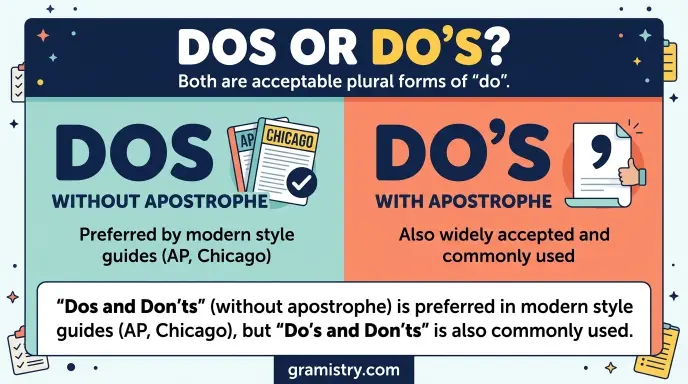
Have you ever written “dos and don’ts” and wondered whether you should add an apostrophe to dos? It is a common English spelling question.
The word do looks unusual when it becomes plural, so some writers prefer do’s because it seems easier to read. Others follow the standard rule that ordinary plural nouns do not need apostrophes.
So, which spelling should you choose: dos or do’s? In most modern edited English, dos is the preferred form. However, do’s still appears in some publications and informal writing.
In this guide, you will learn what both spellings mean, why the apostrophe causes confusion, how to write “dos and don’ts” correctly, and which form is best for professional, academic, and everyday use.
What Does “Dos” Mean?
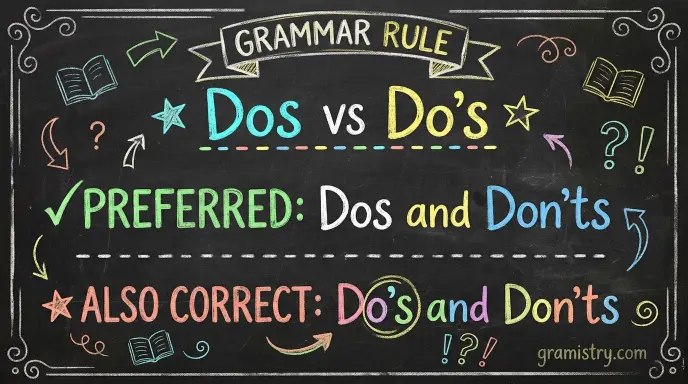
Dos is the plural form of the noun do. In this expression, a do means an action, recommendation, or thing that someone should do.
When you refer to several recommended actions, you can call them dos.
Definition of Dos
Dos (plural noun): Recommended actions, helpful practices, or things that a person should do.
For example:
- The guide explains the dos of writing a professional email.
- One of the dos of good communication is listening carefully.
- The teacher gave the students a list of classroom dos.
- These dos can help beginners avoid common mistakes.
In each sentence, dos refers to actions that are encouraged or recommended.
How Do You Pronounce “Dos”?
In the phrase dos and don’ts, dos is usually pronounced like “dooz,” with a voiced z sound at the end.
It is formed from the word do with a plural ending. The pronunciation may sound unusual to learners because the spelling does not look like many familiar English plurals.
Do not confuse this English word with the Spanish word dos, which means “two.”
How Is “Dos” Used in a Sentence?
The word dos is mainly used when talking about rules, recommendations, and useful actions.
Here are some examples:
- The article lists the dos of healthy communication.
- Learning the dos and don’ts of online safety is important.
- The manager explained the dos of professional behavior.
- These are the basic dos for first-time travelers.
- The workshop covered the dos of effective teamwork.
The word often appears with don’ts because the two words create a simple way to explain what people should and should not do.
Grammar Role of “Dos”
In the expression dos and don’ts, both words work as plural nouns.
- Do: A recommended action or something a person should do.
- Dos: More than one recommended action.
- Don’t: Something a person should not do, used as a noun in this expression.
- Don’ts: More than one action or behavior to avoid.
Consider this example:
“Read the dos and don’ts before using the equipment.”
Here, dos refers to recommended actions, while don’ts refers to actions that should be avoided.
The word do can also be a verb, as in “I do my homework.” However, in dos and don’ts, it is being used as a noun.
Where Is “Dos” Used?
The spelling dos is used in modern English writing across different English-speaking countries.
You may see it in:
- American English publications
- British English publications
- Australian English writing
- Canadian English writing
- Educational materials
- Newspapers and magazines
- Professional documents
- Online guides and articles
Individual publishers may have different house styles, but dos and don’ts is a well-established form in modern editorial writing.
Why Does “Dos” Have No Apostrophe?
The reason is simple: apostrophes are not normally used to form ordinary plural nouns.
Most English nouns become plural by adding -s or -es:
| Singular | Plural |
|---|---|
| Book | Books |
| Rule | Rules |
| Idea | Ideas |
| Tip | Tips |
| Do | Dos |
The word do is treated as a noun in this expression. Therefore, its regular plural is dos.
Examples:
- Preferred: The guide includes several dos.
- Less preferred in standard edited writing: The guide includes several do’s.
The second form is familiar to many readers, but it does not follow the usual rule for forming plural nouns.
What Does “Do’s” Mean?
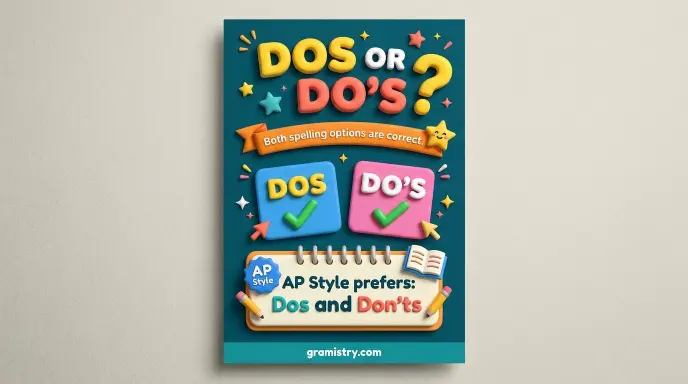
Do’s is a spelling sometimes used as an alternative plural of the noun do. Writers may add the apostrophe because the word dos can look unusual or may be mistaken for another word.
In this use, the apostrophe does not indicate ownership. It is being used to make the plural easier to recognize.
For example:
- The article lists the do’s and don’ts of online safety.
- She explained the do’s of successful interviewing.
- The presentation covered the basic do’s of customer service.
These examples are intended to communicate the same meaning as their versions without the apostrophe.
Is “Do’s” Grammatically Correct?
You may encounter do’s in books, websites, and informal writing. Some writers and editors accept or prefer it because they believe the apostrophe improves readability.
However, several major editorial authorities recommend dos instead. The Chicago Manual of Style specifically gives “dos and don’ts” as its example of the correct plural form. The University of Oxford Style Guide also advises against using apostrophes to form ordinary plurals and gives “dos and don’ts” as its preferred example. <Cite refs={[“turn832826search0″,”turn832826search1”]}/>
For formal and professional writing, dos is therefore the safer general choice.
Why Do Some Writers Use the Apostrophe?
The main reason is readability.
Without an apostrophe, dos may look unfamiliar to some readers. They may briefly mistake it for another word or find the spelling visually awkward.
Adding an apostrophe makes the connection with the singular word do more obvious:
- Dos and don’ts
- Do’s and don’ts
Some editors prioritize this visual clarity. The Apostrophe Protection Society, for example, argues for “do’s and don’ts” as a readability choice, even while acknowledging the traditional plural rule. <Cite refs={[“turn832826search5”]}/>
This shows why you may find different recommendations. The choice can depend on the publication’s editorial approach. When no house style is specified, dos and don’ts is the more widely supported standard choice.
Is the Apostrophe in “Do’s” Possessive?
No. In this particular spelling, the apostrophe is not showing possession.
A possessive apostrophe indicates that something belongs to someone or something:
- The student’s notebook
- The teacher’s desk
- The company’s policy
In do’s, there is no ownership. The apostrophe is being used as part of an alternative plural spelling.
This is an important distinction because apostrophes have more than one use. Their presence does not always mean that a word is possessive.
Key Differences Between “Dos” and “Do’s”
The main difference between dos and do’s is spelling and punctuation, not meaning.
Both forms can refer to recommended actions or things people should do. However, dos follows the standard rule for ordinary plural nouns and is generally preferred by major style guides.
Quick Summary
- Dos: The standard plural spelling of the noun do.
- Do’s: An alternative spelling used by some writers for visual clarity.
- Meaning: Both forms can refer to recommended actions.
- Apostrophe: The apostrophe in do’s does not indicate possession.
- Best general choice: Use dos and don’ts in most modern writing.
Dos vs Do’s: Comparison Table
| Feature | Dos | Do’s |
|---|---|---|
| Word type | Plural noun | Alternative plural spelling |
| Meaning | Recommended actions | Recommended actions |
| Apostrophe | No | Yes |
| Possessive meaning | No | No |
| Grammar pattern | Regular plural | Apostrophe used for clarity |
| Modern style preference | Generally preferred | Less widely preferred |
| Formal writing | Recommended | Follow house style |
| Informal writing | Suitable | Also encountered |
| Example | The dos of good writing | The do’s of good writing |
What Is the Difference Between “Dos and Don’ts” and “Do’s and Don’ts”?
The phrase dos and don’ts is generally the preferred form in modern edited English.
The word dos is a regular plural noun, so it does not need an apostrophe. The word don’ts, however, keeps its apostrophe because it comes from the contraction don’t, meaning do not.
Compare these examples:
- Preferred: The dos and don’ts of job interviews.
- Alternative: The do’s and don’ts of job interviews.
- Not recommended: The do’s and don’t’s of job interviews.
- Incorrect: The dos and donts of job interviews.
The apostrophe in don’ts has a different grammatical purpose from the optional-looking apostrophe in do’s. It marks the omitted letters in the contraction don’t.
Real-Life Conversation Examples
These short conversations show how the two spellings may appear in everyday situations.
Example 1: Preparing for a Job Interview
Ali: I have an interview tomorrow. Do you have any advice?
Sara: Yes. Learn the dos and don’ts of a professional interview.
Ali: What are some important dos?
Sara: Arrive on time, dress appropriately, and prepare answers to common questions.
🎯 Lesson: Dos refers to recommended actions, such as arriving on time and preparing in advance.
Example 2: Writing an Assignment
Teacher: Did you check the writing guidelines?
Student: Yes. They include the dos and don’ts of academic writing.
Teacher: Good. Remember to cite your sources and avoid copying other people’s work.
🎯 Lesson: Dos and don’ts is a useful phrase for explaining rules and expectations.
Example 3: Using a New Device
Brother: I bought a new smartphone. Can you help me use it safely?
Sister: Of course. First, learn the dos and don’ts of battery care.
Brother: Such as?
Sister: Use a suitable charger and avoid exposing the phone to extreme heat.
🎯 Lesson: The phrase can describe recommended and discouraged actions in practical situations.
Example 4: Choosing the Correct Spelling
Editor: Should this heading say “Dos and Don’ts” or “Do’s and Don’ts”?
Writer: I would use “Dos and Don’ts.”
Editor: Why?
Writer: It follows the usual rule of forming plural nouns without an apostrophe.
🎯 Lesson: Dos and don’ts is a strong default choice for edited and professional content.
When to Use “Dos” vs “Do’s”
Choosing between these spellings is easier when you understand your audience and the style guide you are following.
1. Use “Dos” for Standard Modern Writing
Choose dos when you want to follow the common rule for plural nouns.
Examples:
- The dos of effective communication
- Five dos for new employees
- The dos and don’ts of online learning
- Important dos for first-time travelers
This spelling is a suitable default for websites, educational articles, reports, and professional documents.
2. Use “Do’s” Only When Your Style Guide Allows It
Some writers use do’s because they believe it looks more familiar or easier to understand.
For example:
- The do’s of successful parenting
- A beginner’s guide to the do’s and don’ts of cooking
If you are writing for a publication that uses this spelling, follow its house style. Avoid switching between dos and do’s in the same article.
3. What About American and British English?
There is no simple rule that says American English always uses do’s or British English always uses dos.
The choice is largely a matter of editorial style rather than a major difference between national varieties of English.
For example:
- An American publication may use dos and don’ts.
- A British publication may also use dos and don’ts.
- A publisher with a different house style may accept do’s and don’ts.
The University of Oxford’s style guide recommends dos and don’ts and says not to use apostrophes to form ordinary plurals. <Cite refs={[“turn832826search1”]}/>
The safest approach is to check the dictionary or style guide used by your publisher.
4. What Should You Use in Formal and Academic Writing?
For formal and academic writing, dos and don’ts is generally the safer choice.
It follows the standard rule that ordinary plural nouns do not take apostrophes. It is also the form specifically recommended in Chicago style and Oxford’s university style guidance. <Cite refs={[“turn832826search0″,”turn832826search1”]}/>
However, academic institutions and publishers may have their own style requirements. Always follow the instructions provided for your assignment, journal, or publication.
5. What Should You Use in Informal Writing?
In informal writing, readers will usually understand both forms.
For example:
- Here are the dos and don’ts of traveling.
- Here are the do’s and don’ts of traveling.
If you do not have a specific style preference to follow, use dos and don’ts for consistency.
Easy Memory Trick
Remember this simple rule:
A normal plural usually does not need an apostrophe.
- One book → two books
- One rule → several rules
- One tip → many tips
- One do → several dos
But don’t is different because its apostrophe represents missing letters in do not. That is why the standard expression is written dos and don’ts.
Common Mistakes People Make
Even confident English writers sometimes make mistakes with apostrophes. Here are some common examples and their corrections.
Mistake 1: Adding an Apostrophe to Every Plural
Less preferred in standard edited writing: The guide explains the do’s of good communication.
Preferred: The guide explains the dos of good communication.
Why? Ordinary plural nouns usually take -s without an apostrophe. Although do’s is encountered, dos follows the standard plural rule.
Mistake 2: Removing the Apostrophe From “Don’ts”
Incorrect: Read the dos and donts before starting.
Correct: Read the dos and don’ts before starting.
Why? Don’t is a contraction of do not. Its apostrophe represents omitted letters and remains in the plural form don’ts.
Mistake 3: Writing “Don’t’s”
Incorrect: The article explains the do’s and don’t’s of social media.
Preferred: The article explains the dos and don’ts of social media.
Why? The plural of don’t is don’ts. You do not need another apostrophe before the final s.
Mistake 4: Treating “Do’s” as a Possessive
Incorrect explanation: The apostrophe in do’s means the actions belong to someone.
Correct explanation: In this alternative spelling, the apostrophe is being used to clarify the plural form.
Why? Apostrophes can have different uses. Here, the apostrophe is not showing ownership.
Mistake 5: Mixing Spellings in the Same Article
Inconsistent: The first section lists the dos, while the next section explains the do’s.
Better: Choose one spelling and use it consistently.
Why? Consistent spelling makes your writing look polished and helps readers follow your style.
Fun Facts About “Dos and Don’ts”
The expression has a few interesting details that make it a useful example of English grammar and punctuation.
1. “Do” Can Be a Noun
Most learners first meet do as a verb, as in “I do my homework.” However, it can also function as a noun.
For example:
- One important do is to check your work.
- The article lists several dos.
In these examples, do refers to an action or recommendation.
2. “Don’t” Is a Contraction
The word don’t combines do and not. The apostrophe takes the place of the omitted letter.
When it becomes plural in the expression dos and don’ts, the apostrophe remains because the contraction still contains the missing letter.
3. Apostrophes Are Not Usually Used to Form Plurals
A common punctuation mistake is adding an apostrophe before the s in ordinary plural words.
For example:
- Correct: books
- Incorrect: book’s
- Correct: ideas
- Incorrect: idea’s
- Preferred: dos
- Less preferred in standard style: do’s
There are special cases, such as plurals of individual letters, where some style guides use apostrophes for clarity. But ordinary nouns generally do not need them.
4. Major Style Guides Prefer “Dos and Don’ts”
The Chicago Manual of Style gives dos and don’ts as an example of a plural that does not need an apostrophe. The University of Oxford’s style guide also recommends the same form. <Cite refs={[“turn832826search0″,”turn832826search1”]}/>
This makes dos and don’ts a reliable choice when you want to follow established editorial conventions.
FAQs:
1. Is it “dos” or “do’s”?
Dos is generally the preferred plural spelling of the noun do. The spelling do’s is also used by some writers as an alternative to make the word easier to recognize. If you are unsure which one to choose, use dos in standard modern writing and follow your publisher’s style guide when one is provided.
2. Is “do’s” grammatically correct?
Do’s is an alternative spelling that appears in some published and informal writing. However, it is not the preferred form in several major modern style guides. The apostrophe does not show possession in this expression. It is used to make the plural visually clearer. For formal writing, dos is usually the safer choice.
3. Why is “dos” written without an apostrophe?
The word dos is the regular plural of the noun do. English normally forms plural nouns by adding -s or -es without an apostrophe. Since do is being used as a noun in this expression, the standard plural form is dos.
4. Is “dos and don’ts” the correct phrase?
Yes. Dos and don’ts is the standard form recommended by several major style guides. Dos refers to recommended actions, while don’ts refers to actions people should avoid. The apostrophe in don’ts remains because it is part of the contraction don’t.
5. Why does “don’ts” have an apostrophe but “dos” does not?
The two words use apostrophes for different reasons. Dos is a regular plural noun, so it does not need an apostrophe. Don’ts comes from the contraction don’t, which means do not. Its apostrophe represents omitted letters and must remain.
6. Is “do’s and don’ts” wrong?
You may see do’s and don’ts in published and informal writing. Some writers use the apostrophe to improve readability. However, many modern style guides prefer dos and don’ts. If you are following a particular publication’s rules, use its preferred spelling.
7. Should I use “dos and don’ts” in academic writing?
Yes, dos and don’ts is generally a suitable choice for academic writing because it follows the usual rule for plural nouns. However, universities, journals, and publishers may have their own style requirements. Check the relevant guidelines before submitting an assignment or manuscript.
8. Is there a difference between “dos” and “do’s” in meaning?
No meaningful difference is intended when these spellings are used as plurals of the noun do. Both refer to recommended actions or things people should do. The difference is mainly punctuation and editorial preference, not meaning or pronunciation.
9. Is “dos and don’ts” used in both American and British English?
Yes. The expression dos and don’ts is understood in both American and British English. The spelling preference is not a strict national rule. Individual dictionaries, publishers, and style guides may differ, so consistency with the chosen style matters most.
10. What is the plural of “do”?
When do is used as a noun meaning an action or recommendation, its regular plural is dos. For example, “The handbook lists the dos of safe online behavior.” Some writers use do’s as an alternative, but dos is generally preferred in standard edited English.
Conclusion:
The choice between dos and do’s is mainly about spelling style, not meaning. Both forms can refer to recommended actions, but dos is generally preferred because ordinary plural nouns do not need apostrophes.
The word don’ts keeps its apostrophe for a different reason: it comes from the contraction don’t.
For clear, consistent, and professional writing, use dos and don’ts unless your style guide says otherwise.
Gramistry aims to make confusing English spelling and grammar choices easier to understand through practical explanations and examples.
Next time someone uses these two words, you’ll know exactly what they mean!

Alina Mark is the creative voice behind Gramistry.com, making word meanings, English expressions, and trending slang simple, clear, and interesting. Her mission is to make every word easier to understand, one meaning at a time.