
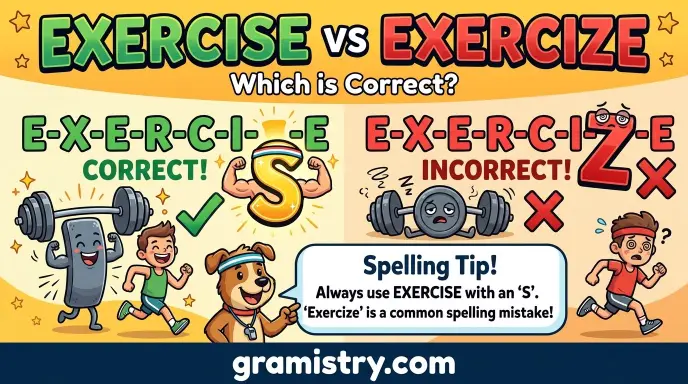
Have you ever written exercize and wondered whether you should use a Z instead of an S? It is an understandable mistake.
English has many words that use the letters -ize, such as organize, realize, and recognize. The word exercise sounds similar at the end, so its spelling can catch people off guard.
However, exercise is the correct spelling in modern standard English.
Exercize is an obsolete historical variant, not a standard alternative used in everyday writing.
In this guide, you will learn the meaning of exercise, how to use it as a noun and verb, where the unusual spelling comes from, and why the Z version is outdated.
You will also find practical examples, common mistakes, and answers to frequently asked questions.
What Is “Exercise”?
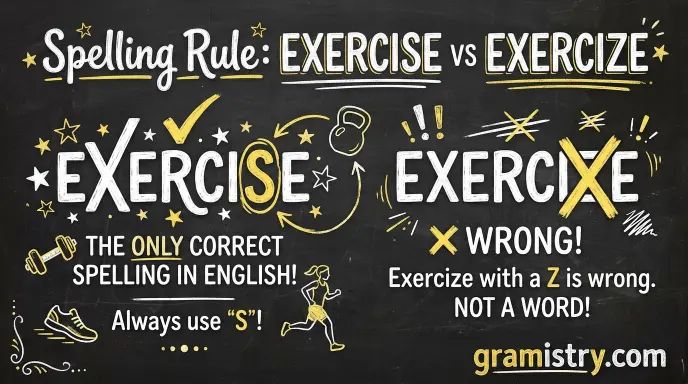
Exercise is the correct modern English spelling. It can function as both a noun and a verb. As a noun, it can refer to physical activity, a practice task, or the use of a skill or ability. As a verb, it means to take part in physical activity, practise a skill, or use a right, power, or quality.
Definition of Exercise
Exercise (noun): Physical or mental activity performed to improve health, strength, fitness, or ability. It can also mean a task designed to practise or test a skill.
Exercise (verb): To take part in physical activity, practise or develop a skill, or put a right, power, or quality into use.
The word has several meanings, depending on the context.
For example:
- Physical activity: Walking is a simple form of exercise.
- Mental activity: Solving puzzles is a good exercise for the brain.
- Schoolwork: The teacher gave us a grammar exercise.
- Practice: Regular exercise can improve your writing skills.
- Use of a right: Every citizen should be able to exercise their rights.
- Careful action: Drivers should exercise caution on wet roads.
These examples show that exercise is not limited to sports or gym activities. It can describe many kinds of physical, mental, and practical actions.
How Do You Pronounce “Exercise”?
The word exercise is usually pronounced:
- American English: /ˈɛk.sɚ.saɪz/
- British English: /ˈɛk.sə.saɪz/
A simple pronunciation guide is EK-ser-size.
The word has three syllables:
Ex-er-cise
The ending sounds like the word size. This sound may be one reason some learners mistakenly write exercize. However, pronunciation does not determine the correct spelling. The standard spelling remains exercise.
How Is Exercise Used in a Sentence?
The word can appear in different sentence structures because it works as both a noun and a verb.
As a noun:
- Regular exercise helps people stay active.
- Swimming is an enjoyable form of exercise.
- The students completed a difficult exercise.
- Breathing exercises can help you relax.
- The coach prepared several exercises for the team.
As a verb:
- I exercise every morning.
- She exercises at the gym three times a week.
- You should exercise your judgment before making a decision.
- The organization exercised its legal rights.
- He exercises caution when driving in bad weather.
Notice how the meaning changes with the sentence. In the first group, exercise names an activity or task. In the second group, it describes an action.
Grammar Role of Exercise
The word exercise has two main grammatical roles.
1. Exercise as a noun
It can be countable or uncountable.
- Uncountable: Exercise is important for good health.
- Countable: The instructor demonstrated three exercises.
When it is countable, its plural form is exercises.
2. Exercise as a verb
It can describe physical activity or the use of something.
Common verb forms include:
| Verb Form | Example |
|---|---|
| Base form | exercise |
| Third-person singular | exercises |
| Past tense | exercised |
| Past participle | exercised |
| Present participle | exercising |
Examples:
- I exercise every day.
- He exercises after work.
- They exercised yesterday.
- She is exercising at the moment.
Where Is Exercise Used?
Exercise is the standard spelling in American, British, Canadian, and Australian English.
Unlike some words that have accepted regional spelling differences, such as organize and organise, exercise is not normally changed to exercize in American English.
For example:
- American English: I exercise every morning.
- British English: I exercise every morning.
- Canadian English: I exercise every morning.
- Australian English: I exercise every morning.
The spelling stays the same. Pronunciation may vary slightly between accents, but the written form does not.
History and Origin of Exercise
The word exercise has a long history. It entered English through Middle English and Old French, with roots in the Latin word exercitium, meaning training or practice.
The Latin verb exercēre meant to keep busy, train, or put something to use. Over time, the English word developed several related meanings, including physical activity, mental practice, training, and the use of authority or rights.
The noun appeared in English during the Middle English period, while the verb developed soon afterward. The meaning connected with physical activity for fitness became established later. This history helps explain why exercise has so many uses today. <Cite refs={[“turn543973search0″,”turn543973search2”]}/>
Common Mistakes With Exercise
Some writers confuse the spelling because they expect the word to follow the same pattern as organize or realize.
Here are examples of spelling errors to avoid:
- Incorrect: I need to exercize every morning.
- Correct: I need to exercise every morning.
- Incorrect: Regular excersise is good for your health.
- Correct: Regular exercise is good for your health.
- Incorrect: The teacher gave us a grammar excercise.
- Correct: The teacher gave us a grammar exercise.
Remember the spelling pattern: ex-er-cise.
What Is “Exercize”?
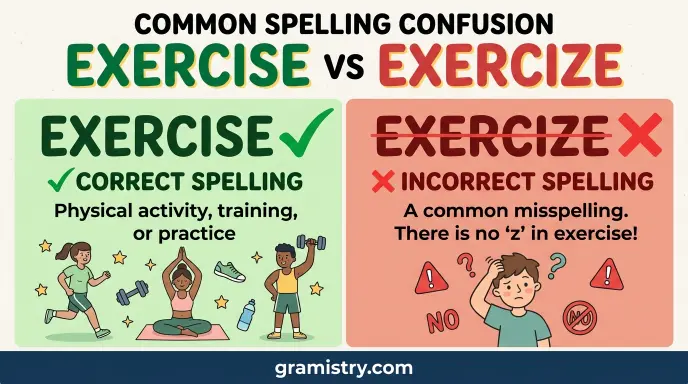
Exercize is an obsolete spelling variant of exercise. It appeared in historical English writing, but it is not the standard spelling used in modern English.
If you are writing an email, school assignment, article, report, or professional document, use exercise, not exercize.
Definition of Exercize
Exercize is a historical spelling of the word exercise. It does not have a separate modern meaning.
In older texts, it could be used in the same general sense as exercise, including training, practice, or putting something into action. Historical dictionaries and word references identify exercize as an obsolete alternative form. <Cite refs={[“turn543973search1″,”turn543973search4”]}/>
Today, however, exercise is the accepted standard spelling.
Is Exercize a Real Word?
The answer depends on what you mean by “real.”
Exercize is a historically recorded spelling, so it is not simply a random combination of letters. However, it is obsolete and is not the standard form today.
There is an important difference between a historical spelling and a current standard spelling:
- Historical spelling: A form used in older writing.
- Modern standard spelling: The form accepted in present-day English.
- Exercize: An obsolete variant.
- Exercise: The correct modern spelling.
Therefore, do not use exercize in ordinary modern writing.
Why Do People Write Exercize?
There are several reasons people make this spelling mistake.
1. The pronunciation sounds like “size.”
The ending of exercise sounds like the word size. Some writers therefore assume that the final letters should be -ize.
2. English has many words ending in -ize.
Words such as organize, realize, and recognize use the letter z. This can lead learners to apply the same pattern to exercise.
3. The spelling looks unusual.
Some English words do not follow the spelling patterns learners expect. Exercise is one of them.
4. Typing mistakes happen.
A writer may type exercize without realizing that the standard form uses s.
The best solution is to remember the correct spelling and check unfamiliar words before publishing or submitting important writing.
Example Sentences: Correcting Exercize
Here are examples showing how to replace the incorrect modern spelling with the correct form.
- Incorrect: I need to exercize every morning.
- Correct: I need to exercise every morning.
- Incorrect: Regular exercize is good for your health.
- Correct: Regular exercise is good for your health.
- Incorrect: The teacher gave us a grammar exercize.
- Correct: The teacher gave us a grammar exercise.
- Incorrect: She is exercizing at the gym.
- Correct: She is exercising at the gym.
The same spelling rule applies to related forms. Write exercises, exercised, and exercising, not forms built from exercize.
Key Differences Between Exercise and Exercize
The main difference between these two forms is their status in modern English. Exercise is the correct standard spelling, while exercize is an obsolete variant.
Quick Summary
- Exercise: Correct modern English spelling.
- Exercize: Obsolete historical spelling.
- Meaning: The historical form had the same general meaning as exercise.
- Grammar: Exercise can be a noun or a verb.
- Country usage: Exercise is standard in American, British, Canadian, and Australian English.
- Best choice: Always use exercise in modern writing.
Exercise vs Exercize: Comparison Table
| Feature | Exercise | Exercize |
|---|---|---|
| Spelling status | Correct modern spelling | Obsolete variant |
| Meaning | Physical or mental activity, practice, or use | Historical form of exercise |
| Grammar role | Noun and verb | Historical spelling variant |
| Pronunciation | EK-ser-size | Historically used for the same word |
| American English | Standard | Not standard |
| British English | Standard | Not standard |
| Formal writing | Correct choice | Avoid |
| Academic writing | Correct choice | Avoid |
| Everyday writing | Recommended | Avoid |
| Example | I exercise daily. | I exercize daily. |
Important Spelling Rule
Do not assume that every English word pronounced with a final /aɪz/ sound must end in -ize.
English spelling depends on a word’s history and established form. For example:
- Exercise
- Advise
- Surprise
- Revise
- Advertise
These words use s in their standard spelling, even though the final sound is similar to the sound in words such as realize.
Real-Life Conversation Examples
These short conversations show how exercise is used naturally in everyday English.
Example 1: Talking About Fitness
Ahmed: Do you exercise every day?
Bilal: I try to. I usually walk for thirty minutes in the morning.
Ahmed: That’s a good habit. Regular exercise can help you stay active.
Bilal: Yes, I feel better when I keep moving.
🎯 Lesson: Exercise is a noun when it refers to physical activity.
Example 2: Correcting a Spelling Mistake
Sara: I wrote, “I need to exercize more.” Is that correct?
Ayesha: The meaning is clear, but the spelling is wrong.
Sara: What should I write?
Ayesha: Write, “I need to exercise more.”
🎯 Lesson: The correct spelling is exercise, not exercize.
Example 3: Discussing Schoolwork
Teacher: Have you completed the English exercise?
Student: Yes. I finished all ten questions.
Teacher: Excellent. These exercises will help you improve your grammar.
🎯 Lesson: Exercise can also mean a school task or practice activity.
Example 4: Talking About Mental Skills
Ali: How can I improve my memory?
Hassan: Try reading, solving puzzles, and doing other mental exercises.
Ali: Do these activities really help?
Hassan: They can give your brain useful practice.
🎯 Lesson: The plural exercises can refer to activities that train mental skills.
Example 5: Using a Right or Power
Manager: Can the company change this agreement?
Employee: It can exercise its legal rights, but it must follow the contract.
Manager: That makes sense. We should review the terms first.
🎯 Lesson: As a verb, exercise can mean to use a right, power, or authority.
When to Use Exercise Instead of Exercize
The choice is straightforward: use exercise in modern English. There is no need to choose between the two forms based on country, writing style, or level of formality.
1. Use Exercise in Everyday Writing
Use exercise in messages, conversations, social media posts, and personal writing.
Examples:
- I want to exercise more often.
- Walking is my favorite exercise.
- Do you exercise on weekends?
- My trainer gave me three new exercises.
2. Use Exercise in Formal Writing
In business emails, reports, applications, and professional documents, always use exercise.
Examples:
- Employees should exercise caution when using the equipment.
- The organization exercised its right to review the agreement.
- The committee will exercise its authority under the policy.
3. Use Exercise in Academic Writing
Students and researchers should also use exercise.
Examples:
- The participants completed a short exercise.
- This exercise tests the students’ understanding of the topic.
- The study examined the relationship between physical exercise and sleep.
If you see exercize in an old book or historical document, understand it as an older spelling rather than copying it into modern academic work.
4. What About American vs British English?
Some English words have different accepted spellings in American and British English. For example:
| American English | British English |
|---|---|
| Color | Colour |
| Center | Centre |
| Organize | Organise (also accepted: organize) |
| Traveling | Travelling |
| Exercise | Exercise |
The final row is important: exercise is spelled the same way in both varieties.
Easy Memory Trick
A simple way to remember the correct spelling is:
Exercise has an S, not a Z.
You can also connect it with other common words that use s:
- Exercise
- Advise
- Revise
- Surprise
- Advertise
If you are unsure, remember that the standard spelling is always exercise.
Common Mistakes People Make
English learners often make small spelling changes that seem logical but are not accepted in standard writing. Here are some mistakes to avoid.
Mistake 1: Writing Exercize Instead of Exercise
Incorrect: I exercize before breakfast.
Correct: I exercise before breakfast.
Why? Exercize is an obsolete spelling. The modern standard form ends in -cise.
Mistake 2: Writing Excersise
Incorrect: Regular excersise is important.
Correct: Regular exercise is important.
Why? The letters in the middle of the word are often rearranged by mistake. Remember the spelling: ex-er-cise.
Mistake 3: Writing Excercise
Incorrect: The teacher gave us an excercise.
Correct: The teacher gave us an exercise.
Why? The word does not contain a double c. It begins with exer-.
Mistake 4: Writing Exercize When Using the Verb
Incorrect: She is exercizing at the gym.
Correct: She is exercising at the gym.
Why? The correct base form is exercise. Its present participle is formed by dropping the final e and adding -ing: exercising.
Mistake 5: Confusing Exercise and Exorcise
Incorrect: The trainer told us to exorcise for better fitness.
Correct: The trainer told us to exercise for better fitness.
Why? Exercise means to take part in physical or mental activity. Exorcise means to try to drive out an evil spirit or an unwanted influence. The two words are similar in appearance and pronunciation, but their meanings are different.
Fun Facts About Exercise and Its Spelling
The word exercise has an interesting history and several uses beyond physical fitness.
1. Exercise Has Latin Roots
The English word comes through Old French from Latin exercitium. Its historical roots relate to training, practice, and keeping busy. This explains why the modern word can describe both physical activity and mental practice. <Cite refs={[“turn543973search0″,”turn543973search2”]}/>
2. Exercize Appeared in Older English Writing
The spelling exercize was used historically. It is now considered obsolete, which means it may appear in older texts but is not the form to use in modern writing. <Cite refs={[“turn543973search1″,”turn543973search4”]}/>
3. Exercise Is Both a Noun and a Verb
Many people first learn exercise as a noun meaning physical activity. However, it is also a verb.
Compare:
- Noun: Exercise is good for your health.
- Verb: I exercise every morning.
The same spelling works in both grammatical roles.
4. Exercise Does Not Always Mean Working Out
The word can describe the use of a right, skill, or quality.
For example:
- Exercise your judgment.
- Exercise your right to vote.
- Exercise patience.
- Exercise caution.
These expressions are common in formal and everyday English.
FAQs:
1. Is it exercise or exercize?
Exercise is the correct spelling in modern standard English. Exercize is an obsolete historical variant and should not be used in everyday writing, schoolwork, or professional documents. If you are unsure, remember that the correct word ends in -cise, not -cize.
2. Is exercize a real word?
Exercize is a historical spelling that appeared in older English writing. However, it is obsolete and is not the standard form today. Modern English dictionaries and usage references recognize exercise as the normal spelling. You may encounter the older form in historical texts, but you should use exercise in current writing.
3. Why is exercise spelled with an S instead of a Z?
The spelling reflects the word’s historical development through Middle English and Old French from Latin exercitium. English spelling does not always follow pronunciation or the pattern of other words. Although the ending sounds like /aɪz/, the established spelling is exercise, with an s.
4. Is exercise the correct spelling in American English?
Yes. Exercise is the standard spelling in American English. American English uses z in words such as organize and realize, but that does not mean every word with a similar ending uses z. Americans write exercise, not exercize.
5. Is exercise the correct spelling in British English?
Yes. British English also uses exercise. Although British writers may use alternative spellings such as organise instead of organize, exercise does not have a standard British z spelling. The same form is used in both major varieties of English.
6. What is the meaning of exercise?
Exercise can mean physical activity that helps maintain or improve fitness. It can also refer to a task that develops a skill, such as a grammar exercise. As a verb, it means to take part in physical activity or put something into use, such as exercising a legal right.
7. Is exercise a noun or a verb?
Exercise can be both a noun and a verb. As a noun, it refers to physical activity, practice, or a task. As a verb, it means to work out, practise a skill, or use a right or ability. The sentence determines which grammatical role the word performs.
8. What is the plural of exercise?
The plural of the countable noun exercise is exercises. For example, “The students completed five exercises.” When exercise refers to physical activity in general, it is often used as an uncountable noun, as in “Exercise is important for good health.”
9. What is the difference between exercise and exorcise?
Exercise means physical or mental activity, practice, or the use of a right or ability. Exorcise means to drive out an evil spirit or, figuratively, to remove an unwanted influence or fear. The words look and sound similar, but they have different meanings and uses.
10. How can I remember the correct spelling of exercise?
A simple trick is to remember the phrase “Exercise has an S, not a Z.” You can also practise writing the word in short sentences, such as “I exercise daily” and “Walking is good exercise.” Repeated exposure helps you recognize the correct spelling more quickly.
Conclusion:
The correct spelling is exercise, not exercize. Although the second form appeared in older English writing, it is now obsolete and should be avoided in modern communication.
Remember that exercise can function as both a noun and a verb. It can refer to physical activity, mental practice, schoolwork, or the use of a right or ability.
The spelling remains the same in American and British English. With a little practice, you can avoid this common mistake and write with greater confidence.
Next time someone uses these two words, you’ll know exactly what they mean!

Alina Mark is the creative voice behind Gramistry.com, making word meanings, English expressions, and trending slang simple, clear, and interesting. Her mission is to make every word easier to understand, one meaning at a time.