
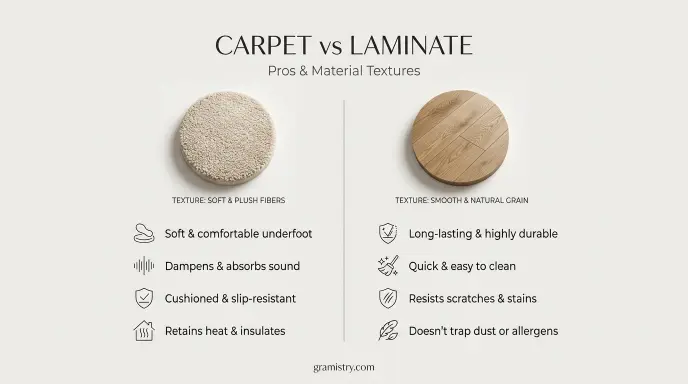
Choosing the right flooring can make a big difference in how your home looks, feels, and functions. Two popular options are carpet and laminate, but deciding between them is not always easy.
Both offer unique benefits, and each works better in certain rooms and lifestyles.
If you are comparing carpet or laminate, you probably want to know which option is more comfortable, affordable, durable, and easier to maintain.
Although they look or sound similar, they serve completely different purposes.
In this guide, we will explain what carpet and laminate flooring are, how they differ, and where each option works best.
You will also discover their advantages, disadvantages, maintenance needs, and costs so you can make a confident flooring decision.
What Is Carpet?
Carpet is a soft floor covering made from fibers attached to a backing material. It is designed to cover all or part of a floor, creating a comfortable, warm, and inviting surface.
Carpet is available in many colors, patterns, textures, and materials. Common carpet fibers include nylon, polyester, wool, and polypropylene. Each material offers different levels of softness, durability, stain resistance, and cost.
Definition and Meaning of Carpet
A carpet is a textile floor covering made from woven, tufted, or knitted fibers. It can cover an entire room or a smaller section of the floor.
Carpet is commonly used in bedrooms, living rooms, offices, hotels, and other indoor spaces where comfort and warmth are important.
Quick Definition: Carpet is a soft flooring material made from textile fibers. It provides cushioning, warmth, sound absorption, and a comfortable walking surface.
How Is Carpet Used?
Carpet is especially useful in spaces where people want a softer and warmer floor.
Common applications include:
- Bedrooms: Carpet creates a comfortable surface for walking barefoot.
- Living rooms: It adds warmth and makes seating areas feel more welcoming.
- Staircases: Carpet can provide cushioning and improve traction, depending on its installation and condition.
- Home offices: It helps reduce noise from footsteps and furniture movement.
- Hotels: Carpet is often used to create a quieter and more comfortable environment.
Carpet can also be installed over suitable underlay, which adds cushioning and may improve insulation and sound absorption.
Types and Materials of Carpet
Different carpet materials offer different benefits.
| Carpet Material | Main Characteristics |
|---|---|
| Nylon | Durable, resilient, and suitable for busy areas |
| Polyester | Soft, often available in attractive colors, and generally stain-resistant |
| Wool | Natural, comfortable, and often more expensive |
| Polypropylene | Moisture-resistant and commonly used in budget-friendly carpets |
The best choice depends on your budget, household activity, pets, and cleaning preferences.
History and Origin of Carpet
Carpets have a long history. People have used woven floor coverings for thousands of years to provide warmth, comfort, and decoration.
One of the most famous historical examples is the Pazyryk Carpet, an ancient carpet discovered in a burial site in Siberia. It is generally dated to around the fifth century BCE.
Over time, carpet-making developed into an important craft in several regions, including Persia, Central Asia, and parts of Europe.
Modern wall-to-wall carpeting became increasingly popular in homes and commercial buildings during the twentieth century.
Advantages of Carpet
Carpet offers several practical benefits:
- Comfort: Its soft surface feels pleasant underfoot.
- Warmth: It provides insulation and makes rooms feel warmer.
- Noise reduction: Carpet absorbs sound and reduces echoes.
- Design variety: It comes in countless colors, textures, and patterns.
- Cushioning: It provides a softer surface than hard flooring.
Disadvantages of Carpet
Despite its benefits, carpet also has some drawbacks:
- It can collect dust, pet hair, and other particles.
- Spills may leave stains if they are not cleaned properly.
- Some carpets require professional deep cleaning.
- Moisture can encourage mold growth if the carpet and underlying materials remain damp.
- Heavy furniture may leave permanent indentations.
- Carpet may wear down in areas with frequent foot traffic.
Helpful Tip: If you have pets or children, consider a carpet with suitable stain resistance and follow the manufacturer’s cleaning recommendations.
What Is Laminate Flooring?
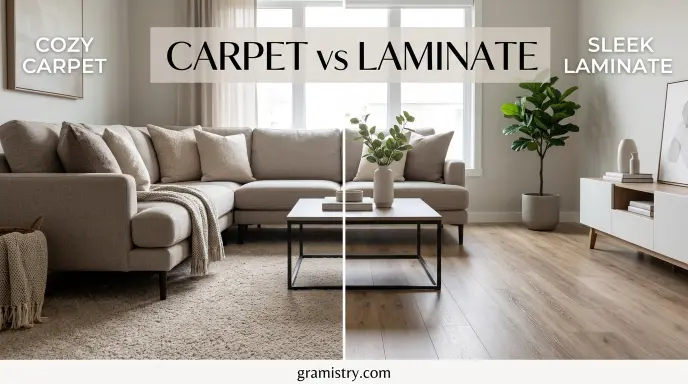
Laminate flooring is a manufactured flooring material designed to resemble natural wood, stone, or other decorative surfaces.
It usually consists of several layers pressed together to create a strong and attractive floor covering. Most traditional laminate products have a protective wear layer, a printed decorative layer, a high-density fiberboard core, and a backing layer.
Unlike carpet, laminate has a firm, smooth surface rather than a soft textile finish.
Definition and Meaning of Laminate
Laminate flooring is a multi-layer synthetic flooring product that combines a decorative image with a protective surface and a stable core.
It is commonly designed to imitate hardwood flooring, but it can also reproduce the appearance of stone, tile, and other materials.
Quick Definition: Laminate is a hard, layered flooring material that provides the appearance of natural surfaces while offering a practical and often budget-friendly flooring option.
How Is Laminate Flooring Used?
Laminate flooring is popular in residential and commercial spaces because it offers an attractive appearance and relatively simple maintenance.
Common applications include:
- Living rooms: It creates a clean, modern appearance.
- Dining rooms: Its smooth surface makes everyday cleaning easier.
- Bedrooms: It provides a practical alternative to carpet.
- Hallways: Many laminate products are designed to handle regular foot traffic.
- Home offices: It creates a neat and professional-looking floor.
However, not every laminate product is suitable for every environment. Always check the manufacturer’s moisture and installation specifications.
Main Layers of Laminate Flooring
Most laminate flooring products contain four important layers:
- Wear Layer: A transparent protective surface that helps resist everyday scratches, stains, and wear.
- Decorative Layer: A printed image that gives the flooring its wood, stone, or tile appearance.
- Core Layer: Usually made from high-density or medium-density fiberboard, providing stability and strength.
- Backing Layer: Helps support the flooring and improve dimensional stability.
These layers work together to create a durable flooring product.
History and Origin of Laminate Flooring
Modern laminate flooring has its roots in Sweden. Swedish company Perstorp developed an early form of laminate flooring in 1977. The product later became commercially available under the Pergo name.
Over the following decades, manufacturing improvements made laminate flooring more realistic, affordable, and widely available.
Today, laminate is produced in many designs, including oak, walnut, maple, marble, and stone effects.
Advantages of Laminate Flooring
Laminate flooring offers several benefits:
- Easy cleaning: Its smooth surface is generally easy to maintain.
- Affordable appearance: It can imitate expensive materials at a lower purchase price.
- Scratch resistance: Quality wear layers help protect against everyday surface damage.
- Design options: It comes in numerous colors, patterns, and finishes.
- Simple installation: Many products use click-lock systems that allow floating installation.
- No carpet fibers: It does not collect dust and pet hair in the same way carpet does.
Disadvantages of Laminate Flooring
Laminate also has some limitations:
- It can feel harder and colder than carpet.
- Water can damage the core of traditional laminate products.
- Damaged boards can be difficult to repair individually.
- Lower-quality products may show wear more quickly.
- Some laminate floors can sound hollow when installed incorrectly.
- It does not provide the same softness or sound absorption as carpet.
Helpful Tip: If you want laminate for a kitchen or another moisture-prone area, choose a product specifically rated for the expected exposure to water. Waterproof claims should be checked against the manufacturer’s warranty and installation instructions.
Key Differences Between Carpet and Laminate
Carpet and laminate differ in material, comfort, appearance, cleaning requirements, and performance.
The biggest difference is that carpet provides a soft textile surface, while laminate offers a firm surface designed to imitate natural flooring materials.
Main Differences at a Glance
- Material: Carpet is made from textile fibers, while laminate consists of multiple manufactured layers.
- Comfort: Carpet is softer and more cushioned.
- Appearance: Carpet offers textile textures, while laminate often imitates wood or stone.
- Cleaning: Laminate is generally easier to clean with regular sweeping and suitable damp cleaning.
- Maintenance: Carpet usually needs more intensive cleaning.
- Moisture: Traditional laminate can be damaged by water, while wet carpet can develop odor or mold problems.
- Noise: Carpet absorbs more sound, while laminate may create more impact noise.
- Installation: Carpet generally requires specialist fitting, while many laminate products feature click-lock installation.
- Cost: Both have budget and premium options, depending on materials, installation, and quality.
Carpet vs Laminate: Comparison Table
| Feature | Carpet | Laminate |
|---|---|---|
| Material | Textile fibers | Multiple manufactured layers |
| Surface | Soft and cushioned | Hard and smooth |
| Comfort | Generally more comfortable underfoot | Less cushioning |
| Appearance | Fabric-like texture | Wood, stone, or tile appearance |
| Cleaning | Requires regular vacuuming | Sweeping and suitable damp cleaning |
| Stain resistance | Depends on fiber and treatment | Generally easy to clean |
| Water resistance | Can absorb liquids | Varies by product |
| Durability | Depends on fiber, quality, and traffic | Depends on wear layer and core |
| Noise reduction | Excellent sound absorption | May produce more impact noise |
| Warmth | Generally warmer | Often feels colder |
| Installation | Usually requires fitting and stretching | Often uses a click-lock system |
| Pet suitability | Depends on material and household needs | Often easier to clean |
| Repair | Patching or replacement may be possible | Individual board replacement can be difficult |
| Best rooms | Bedrooms and cozy living areas | Living rooms, hallways, and suitable dining areas |
Real-Life Examples: Carpet vs Laminate
Understanding practical situations can make the decision easier.
Example 1: Choosing Flooring for a Bedroom
Ali: Should I install carpet or laminate in my bedroom?
Sara: Carpet might be better if you want a warm, soft surface when getting out of bed.
Ali: What if I prefer easy cleaning?
Sara: Then laminate could be a better option.
🎯 Lesson: Choose carpet for softness and warmth, or laminate for a firm surface that is easier to clean.
Example 2: A Home with Pets
Ahmed: I have two dogs. Which flooring should I choose?
Hina: Laminate may be easier because you can remove pet hair and wipe up many everyday spills.
Ahmed: Does that mean it is completely waterproof?
Hina: No. You should check the product’s water-resistance rating and clean spills promptly.
🎯 Lesson: Laminate can be practical for pet owners, but moisture protection still matters.
Example 3: Reducing Noise at Home
Mariam: My upstairs room makes too much noise. Would laminate help?
Usman: Carpet may be a better choice because it absorbs footsteps and reduces impact noise.
Mariam: So it can make the room quieter?
Usman: Yes, although the underlay and installation also affect sound performance.
🎯 Lesson: Carpet is generally better when sound absorption is a priority.
Example 4: Choosing Flooring on a Budget
Hamza: I want a stylish floor without spending too much.
Ayesha: Laminate may give you the appearance of hardwood at a more accessible price.
Hamza: Is it always cheaper than carpet?
Ayesha: Not necessarily. Compare the complete material and installation costs before deciding.
🎯 Lesson: Compare total project costs rather than assuming one flooring type is always cheaper.
When to Use Carpet vs Laminate
There is no single flooring option that works best for every home. Your decision should depend on the room, lifestyle, maintenance needs, and personal preferences.
When Should You Choose Carpet?
Carpet is a suitable choice when:
- You want a soft and comfortable walking surface.
- You prefer warmer floors during colder months.
- You want to reduce footsteps and room noise.
- You are decorating a bedroom or a cozy family room.
- You enjoy textile textures and traditional flooring styles.
Carpet is especially useful in bedrooms, nurseries, and other areas where comfort is more important than quick cleaning.
When Should You Choose Laminate?
Laminate is worth considering when:
- You want the appearance of hardwood without purchasing solid wood.
- You prefer easy everyday cleaning.
- You have pets and want to remove hair more easily.
- You like modern and minimalist interior designs.
- You want a firm flooring surface.
- You prefer a flooring product that many installers can fit using a click-lock system.
Laminate is often a practical option for living rooms, hallways, and other suitable areas with regular foot traffic.
Easy Memory Trick
Remember this simple rule:
- Carpet = Comfort, warmth, and softness.
- Laminate = Hard surface, easy cleaning, and decorative appearance.
This quick comparison makes it easier to remember the main difference.
US vs UK Usage
The words carpet and laminate are widely understood in both American and British English.
However, people may use slightly different expressions when discussing flooring.
| American English | British English |
|---|---|
| Carpet | Carpet |
| Laminate flooring | Laminate flooring |
| Flooring contractor | Flooring fitter or flooring contractor |
| Hardwood floor | Wooden floor or timber floor |
The terminology can vary by region and industry. The basic meaning of carpet and laminate remains the same.
Formal, Informal, and Academic Writing
Both terms are appropriate in different writing situations.
Formal Writing:
“Laminate flooring offers a practical alternative to traditional hardwood flooring.”
Informal Writing:
“I prefer carpet because it feels warmer and softer.”
Academic or Technical Writing:
“Carpet is a textile-based floor covering, whereas laminate flooring is a layered composite product with a decorative surface.”
Use the term that accurately describes the flooring material you are discussing.
Common Mistakes People Make
People sometimes misunderstand the differences between carpet and laminate, especially when comparing their performance.
Here are some common mistakes to avoid.
Mistake 1: Assuming Laminate Is Real Hardwood
Incorrect: Laminate flooring is made from solid wood.
Correct: Laminate flooring usually contains a fiberboard core with a decorative image designed to imitate wood.
Why? Laminate can look like hardwood, but its construction is different from solid wood flooring.
Mistake 2: Assuming Carpet Is Always Difficult to Clean
Incorrect: Every carpet is impossible to maintain.
Correct: Some modern carpets have stain-resistant treatments and are relatively easy to maintain with proper care.
Why? Cleaning requirements depend on fiber type, carpet construction, stains, and maintenance habits.
Mistake 3: Believing All Laminate Flooring Is Waterproof
Incorrect: Laminate can never be damaged by water.
Correct: Some laminate products offer improved water resistance, but not every product is waterproof.
Why? Water can enter joints and damage the core of traditional laminate flooring.
Mistake 4: Choosing Flooring Based Only on Appearance
Incorrect: The most attractive flooring is always the best choice.
Correct: Flooring should match your room, budget, lifestyle, and maintenance preferences.
Why? A beautiful floor may not be practical for a busy household or a moisture-prone room.
Mistake 5: Ignoring Installation Costs
Incorrect: Laminate is always cheaper because it is easier to install.
Correct: Total flooring costs include materials, underlay, preparation, labor, trims, and other installation requirements.
Why? A low material price does not always mean a low overall project cost.
Fun Facts and History About Carpet and Laminate
Here are a few interesting facts that explain how these flooring options developed.
- Carpets are thousands of years old: Ancient civilizations used woven textiles for warmth, decoration, and practical floor covering.
- The Pazyryk Carpet is remarkably ancient: This famous archaeological discovery is generally dated to the fifth century BCE and provides evidence of early carpet-making skills.
- Laminate flooring has Swedish roots: Modern laminate flooring was developed by Perstorp in Sweden in 1977.
- Laminate can imitate many materials: Modern printing and surface technologies allow manufacturers to create realistic wood, stone, and tile designs without using those materials as the main decorative surface.
These developments show how traditional textile craftsmanship and modern manufacturing have shaped today’s flooring choices.
FAQs:
1. Is carpet better than laminate flooring?
Carpet is better when comfort, warmth, and sound absorption are your main priorities. It creates a softer surface and works particularly well in bedrooms and cozy living spaces. However, laminate may be a better option if you prefer easier cleaning, a modern appearance, and less maintenance. The right choice depends on your household and the room.
2. Is laminate flooring cheaper than carpet?
Laminate can be less expensive than some premium carpets, but the total cost depends on product quality, underlay, installation, and floor preparation. Budget carpet can sometimes cost less than high-quality laminate. Always compare material prices and installation expenses together before choosing either flooring option.
3. Which flooring is better for bedrooms, carpet or laminate?
Carpet is often preferred for bedrooms because it feels soft, provides warmth, and reduces footsteps. Laminate is also a good bedroom option if you prefer a modern appearance and easy cleaning. You can add an area rug to make laminate flooring more comfortable without covering the entire room.
4. Is laminate flooring good for homes with pets?
Laminate can be a practical choice for homes with pets because pet hair is easy to remove from its smooth surface. However, claws may scratch some products, and water from pet accidents can damage unsuitable laminate if not cleaned quickly. Choose a durable product and follow its care instructions.
5. Does carpet make a room warmer than laminate?
Generally, yes. Carpet and its underlay provide more insulation and feel warmer underfoot than laminate. Laminate is a hard surface that may feel cold, especially during winter. However, room temperature also depends on insulation, heating systems, underlay, and the building’s construction.
6. Can you install laminate flooring over carpet?
No, installing laminate directly over ordinary carpet is generally not recommended. Carpet is too soft and unstable to provide the firm, level support laminate needs. The existing carpet should normally be removed, and the subfloor should be prepared according to the laminate manufacturer’s installation instructions.
7. Which flooring lasts longer, carpet or laminate?
Both flooring types can last for many years, but their lifespan depends on product quality, installation, foot traffic, and maintenance. Quality laminate may maintain its appearance for a long time, while carpet can show wear, matting, and staining. Manufacturer warranties and care recommendations are useful when comparing products.
8. Is laminate flooring easier to clean than carpet?
Yes, laminate is generally easier to clean for everyday household messes. Sweeping, vacuuming with a suitable attachment, and using a slightly damp mop can remove most surface dirt. Carpet usually requires regular vacuuming and occasional deeper cleaning. Always use cleaning products recommended for your particular flooring.
9. Which flooring is better for people with allergies?
Laminate may be easier to manage for people who want to avoid accumulated dust, pet hair, and other particles in carpet fibers. However, carpet can trap airborne particles until they are removed through cleaning. Neither flooring guarantees allergy relief. Regular cleaning, good ventilation, and individual sensitivities matter.
10. Can you combine carpet and laminate in the same house?
Absolutely. Many homeowners use laminate in living areas, hallways, and dining spaces while installing carpet in bedrooms. Combining both materials allows you to enjoy the practical benefits of hard flooring and the warmth of carpet. Proper transitions between flooring surfaces help create a neat and safe finish.
Conclusion:
Choosing between carpet or laminate depends on what matters most in your home.
Carpet offers softness, warmth, and excellent sound absorption, making it a comfortable choice for bedrooms and relaxing spaces.
Laminate provides a hard, attractive surface that is generally easier to clean and comes in many decorative designs.
Neither option is perfect for every situation, so consider your budget, lifestyle, room conditions, and maintenance preferences before making a decision.
Understanding these differences will help you select flooring that suits your needs and keeps your home comfortable.
Next time someone uses these two words, you’ll know exactly what they mean!

Alina Mark is the creative voice behind Gramistry.com, making word meanings, English expressions, and trending slang simple, clear, and interesting. Her mission is to make every word easier to understand, one meaning at a time.