
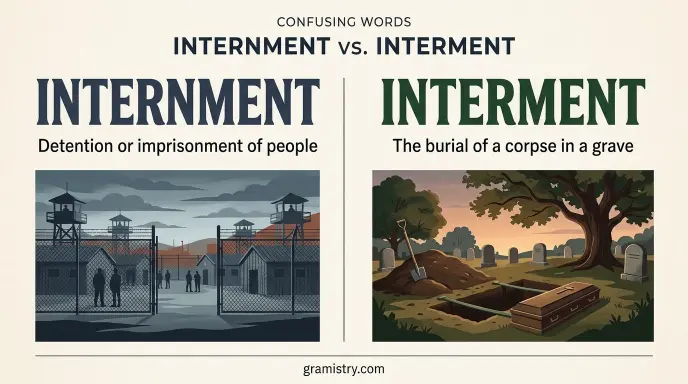
Have you ever stopped while writing and wondered whether you should use internment or interment? If so, you’re not alone.
These two words are among the most commonly confused terms in the English language because they look almost identical and sound very similar when spoken.
However, choosing the wrong one can completely change the meaning of your sentence.
Although they look similar, they serve completely different purposes.
One refers to the confinement of living people under government authority, usually during wartime or national emergencies, while the other refers to the burial or final placement of a deceased person’s remains.
Whether you’re writing a history assignment, reading an obituary, or simply improving your English vocabulary, understanding the difference between internment and interment will help you communicate with confidence.
In this complete guide, you’ll learn their meanings, correct usage, examples, historical background, and simple memory tricks so you never confuse them again.
📌 Key Takeaways
Internment means the detention or confinement of living people, typically during wartime or under government authority.
Interment means the burial or final placement of a deceased person’s remains.
The two words differ by just one letter, but their meanings are completely different.
Both American English and British English use the same spelling and definitions.
A simple memory trick: Internment = Intern = Inside, while Interment = Into the Earth = Burial.
What Is Internment?
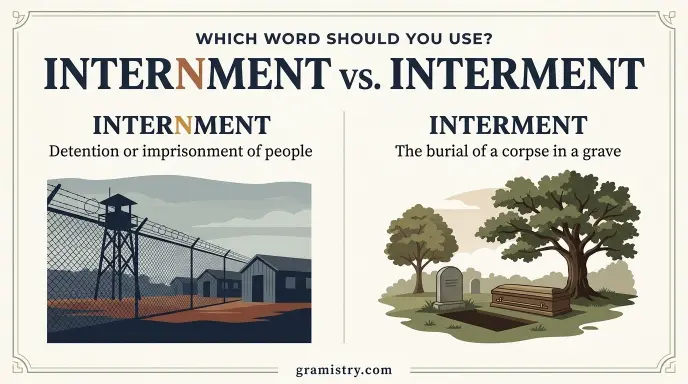
Internment is the act of detaining or confining people, usually by a government, during times of war, political unrest, or national emergencies. People who are interned are typically placed in camps or designated locations because authorities believe it is necessary for national security or legal reasons.
Unlike imprisonment after a criminal conviction, internment often occurs without the individual being found guilty of a crime. Throughout history, governments have used internment during wartime to detain civilians, foreign nationals, or groups considered potential security risks.
Meaning of Internment
The word internment is a noun that refers to:
- The confinement of civilians or enemy nationals during wartime.
- Government-ordered detention under special legal authority.
- Temporary or long-term placement in an internment camp.
The related verb is intern, meaning to confine or detain someone under these circumstances.
How Is Internment Used?
The term internment most commonly appears in discussions about:
- History
- Military affairs
- International law
- Government policies
- Human rights
- Political studies
For example, historians often discuss the internment of Japanese Americans during World War II or the internment of civilians in other wartime conflicts around the world.
Because internment has strong historical and legal associations, it is rarely used in everyday conversation unless discussing these topics.
💡 Expert Tip: When you see the word internment, think about living people who are confined, not people who have died.
Examples of Internment in Sentences
Here are several examples that show how internment is used naturally:
- The museum features an exhibit about the internment of civilians during World War II.
- Many families were deeply affected by wartime internment policies.
- Historians continue to study the long-term effects of internment on affected communities.
- The government later apologized for its internment program.
- Documents describing the internment camps have become valuable historical records.
Notice that every example relates to detention, government action, or wartime confinement, not burial.
Historical Background of Internment
The word internment comes from the French verb interner, meaning to confine within.
One of the best-known examples of internment occurred during World War II, when thousands of Japanese Americans were relocated to internment camps in the United States after the attack on Pearl Harbor. Similar policies were adopted in several countries during major conflicts.
Today, historians study internment to better understand civil liberties, constitutional rights, and the balance between national security and individual freedoms.
Grammar and Regional Usage
The meaning of internment is the same in both American English and British English. There are no regional spelling differences.
Common grammatical forms include:
| Form | Example |
|---|---|
| Verb | intern |
| Noun | internment |
| Adjective | interned |
Examples:
- The civilians were interned during the conflict.
- Their internment lasted several years.
- The interned families later returned home.
Because the word carries significant historical weight, writers should use it carefully and only when referring to detention or confinement.
Common Mistakes with Internment
Many writers mistakenly use interment when discussing wartime history because the words differ by only one letter.
The museum tells the story of Japanese American interment during World War II.
The museum tells the story of Japanese American internment during World War II.
A quick way to remember this is that internment contains “intern,” which can remind you of being kept inside a camp or secure location.
What Is Interment?
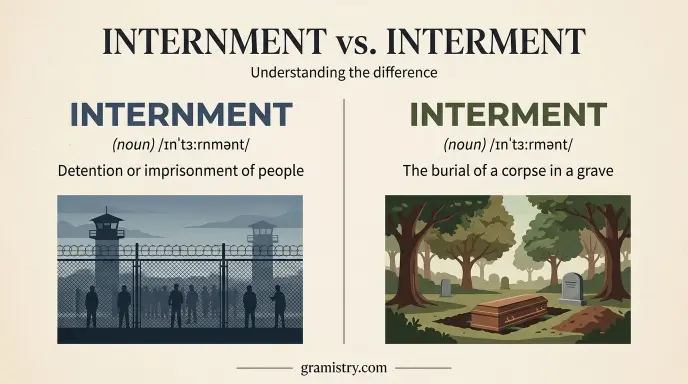
Interment refers to the burial or placement of a deceased person’s remains in a grave, tomb, mausoleum, or another final resting place. It is a respectful and formal word commonly used in funeral services, cemetery records, religious ceremonies, and legal documents.
Although many people simply say burial, interment is often preferred in official or ceremonial contexts because it sounds more formal and includes several methods of laying someone to rest.
Unlike internment, which concerns living people being confined, interment always relates to someone who has passed away.
Meaning of Interment
The noun interment means:
- The act of burying a deceased person.
- The placement of cremated ashes in a cemetery or columbarium.
- The ceremonial laying to rest of human remains.
The related verb is inter, meaning to bury or place human remains in their final resting place.
How Is Interment Used?
The word interment commonly appears in:
- Funeral announcements
- Obituaries
- Cemetery records
- Religious ceremonies
- Legal documents
- Genealogy research
- Historical biographies
Because it is a formal term, interment is more common in official documents and memorial services than in casual conversation.
💡 Expert Tip: If the sentence involves a funeral, cemetery, or burial, the correct word is almost always interment.
Examples of Interment in Sentences
- The interment took place at the family cemetery.
- Friends attended the interment after the church service.
- The obituary announced the date of the interment ceremony.
- Military honors were presented during the veteran’s interment.
- The family’s private interment was held the following morning.
Every example relates to burial or the respectful placement of human remains—not detention.
Historical Background of Interment
The word interment comes from the Latin phrase in terra, meaning “into the earth.” This origin reflects the traditional practice of burying a body in the ground.
Today, interment also includes the placement of cremated remains in urn gardens, mausoleums, and columbaria. It remains the preferred formal term in funeral services, cemetery records, and genealogy research.
Key Differences Between Internment and Interment
At first glance, internment and interment appear almost identical. However, one extra letter changes the meaning completely. Understanding the distinction is essential for clear communication, especially in academic writing, historical discussions, legal documents, and funeral-related contexts.
💡 Quick Tip:
Ask yourself one simple question:
- Is the person alive? → Use internment.
- Has the person passed away? → Use interment.
This simple check will help you choose the correct word every time.
Key Differences at a Glance
Here are the main differences between these two commonly confused words:
- Internment means the detention or confinement of living people, usually by a government during wartime or emergencies.
- Interment means the burial or final placement of a deceased person’s remains.
- Internment is commonly used in history, law, politics, military affairs, and human rights discussions.
- Interment appears in funeral services, cemetery records, obituaries, and religious ceremonies.
- Internment involves living individuals.
- Interment involves deceased individuals.
- Although they differ by only one letter, their meanings are completely unrelated.
Internment vs. Interment Comparison Table
| Feature | Internment | Interment |
|---|---|---|
| Meaning | Detention or confinement of living people | Burial or placement of human remains |
| Who is involved? | Living people | Deceased people |
| Related Verb | Intern | Inter |
| Common Contexts | War, history, politics, law | Funerals, cemeteries, memorial services |
| Purpose | Government or military detention | Final resting place after death |
| Common Documents | Historical records, military reports, legal documents | Obituaries, cemetery records, funeral notices |
| Emotional Context | Political or historical | Respectful and ceremonial |
| US & UK Usage | Same spelling and meaning | Same spelling and meaning |
| Example | The government ordered the internment of civilians. | The family attended the interment ceremony. |
⭐ Pro Tip: Save this table or bookmark this page for a quick reference whenever you’re unsure which word to use.
Real Life Conversation Examples
Understanding how these words appear in everyday conversations makes them much easier to remember.
Dialogue 1: History Class
Emma: We’re studying Japanese American interment during World War II.
Teacher: The correct word is internment because the people were detained, not buried.
Emma: That makes much more sense now!
🎯 Lesson: Use internment when discussing government detention or wartime camps.
Dialogue 2: Funeral Arrangements
David: What time does the funeral start?
Sarah: The service begins at 10 a.m., and the interment will follow at the cemetery.
David: Thanks for letting me know.
🎯 Lesson: Interment is the correct term for burial after a funeral service.
Dialogue 3: Editing an Essay
Alex: I wrote that the family’s interment lasted three years.
Editor: That should be internment because they were confined in a camp.
Alex: I’m glad you caught that mistake.
🎯 Lesson: If the people are alive and being detained, always use internment.
Dialogue 4: Family History Research
Grandmother: We finally found your great-grandfather’s place of interment.
Grandson: So we know where he’s buried now?
Grandmother: Exactly.
🎯 Lesson: Interment refers to someone’s final resting place.
Dialogue 5: Museum Visit
Visitor: Is this exhibit about military interment?
Guide: It’s actually about wartime internment camps.
Visitor: I didn’t realize those words had different meanings.
🎯 Lesson: Historical exhibits about detention camps use internment, not interment.
When to Use Internment vs. Interment
If you’re still unsure which word to choose, use these practical guidelines.
Use Internment When…
Choose internment if your sentence involves:
- Government detention
- Wartime camps
- Political confinement
- National security measures
- Historical events
- Military or legal discussions
Examples
- The documentary explored wartime internment.
- Researchers continue studying internment policies.
- Survivors shared stories about their internment experiences.
Use Interment When…
Choose interment if your sentence involves:
- Burial
- Funeral services
- Cemeteries
- Mausoleums
- Cremated remains
- Memorial ceremonies
Examples
- The interment followed the church service.
- Family members attended the private interment.
- The cemetery keeps records of every interment.
Easy Memory Tricks You’ll Never Forget
Remembering these words becomes much easier with simple associations.
🧠 Trick #1: Intern = Inside
Think of the word intern.
Someone who is interned is kept inside a camp or secure location.
Internment = Inside = Detention
🧠 Trick #2: Into the Earth
Interment comes from a Latin phrase meaning “into the earth.”
That makes it easy to remember:
Interment = Into the Earth = Burial
🧠 Trick #3: Ask One Simple Question
Before writing either word, ask yourself:
“Am I talking about living people or someone who has died?”
- Living people → Internment
- Deceased person → Interment
This simple habit prevents almost every mistake.
US vs. UK Usage
One helpful fact is that American English and British English use these words in exactly the same way.
- ✅ Internment always means detention or confinement.
- ✅ Interment always means burial or the placement of human remains.
There are no spelling or grammatical differences between the two varieties of English.
Whether you’re writing for readers in the United States, the United Kingdom, Canada, Australia, or other English-speaking countries, these definitions remain the same.
Common Mistakes to Avoid
Because both words are correctly spelled English words, grammar and spell-check tools may not detect if you’ve used the wrong one.
Here are some common mistakes:
The family’s internment was held after the memorial service.
The family’s interment was held after the memorial service.
The museum documents the interment of civilians during World War II.
The museum documents the internment of civilians during World War II.
Records of his internment are kept at the cemetery.
Records of his interment are kept at the cemetery.
Quick Decision Checklist
Before publishing your writing, ask yourself:
✔️ Is the sentence about living people being detained? → Internment
✔️ Is it about burial or a funeral? → Interment
✔️ Is the context history, war, or government policy? → Internment
✔️ Is the context cemeteries, memorials, or obituaries? → Interment
📚 Related Grammar Guides
If you enjoy learning commonly confused English words, you might also like:
- Affect vs. Effect
- Compliment vs. Complement
- Farther vs. Further
- Stationary vs. Stationery
Internal Linking Tip: Link these titles to related articles on your website. Internal links help readers discover more content, strengthen your site’s topical authority, and can improve SEO by helping search engines better understand your content structure.
Fun Facts About Internment and Interment
Learning the difference between internment and interment becomes much easier when you know the story behind these words. Here are a few interesting facts that can help you remember them for life.
1. One Letter Creates Two Completely Different Meanings
At first glance, internment and interment seem almost identical. In fact, they differ by just one letter—the “n.” Despite this tiny spelling difference, the meanings couldn’t be more different.
- Internment refers to the detention or confinement of living people.
- Interment refers to the burial or final placement of deceased people.
This is one of the best examples in English of how a single letter can completely change a word’s meaning.
2. Their Origins Tell the Story
The origins of these words make them easier to remember.
- Internment comes from the French verb interner, meaning “to confine within.”
- Interment comes from the Latin phrase in terra, meaning “into the earth.”
Knowing where these words come from provides a simple way to remember when to use each one.
FAQs:
Is internment the same as interment?
No. Although the words look similar, they have completely different meanings.
- Internment refers to the detention or confinement of living people.
- Interment refers to the burial or placement of a deceased person’s remains.
The correct word depends entirely on the context.
Which word should I use for a funeral?
Use interment.
This is the formal word commonly used in:
- Funeral announcements
- Obituaries
- Cemetery records
- Religious services
- Memorial ceremonies
Example:
The interment will take place immediately after the funeral service.
Which word is used for wartime detention?
Use internment.
It refers to the confinement of civilians or enemy nationals during wartime or under government authority.
Example:
The documentary examined the internment of civilians during World War II.
Is internment the same as imprisonment?
Not exactly.
Internment usually occurs during wartime or national emergencies and may happen without a criminal conviction.
Imprisonment, on the other hand, usually results from a court sentence after someone has been found guilty of a crime.
Do British and American English use different spellings?
No.
Both American English and British English use the same spellings and meanings.
- Internment = detention
- Interment = burial
There are no regional spelling differences.
Why do people confuse internment and interment?
The confusion happens because:
- They look almost identical.
- They sound very similar.
- Both are relatively uncommon in everyday conversation.
Focusing on the context—detention versus burial—is the easiest way to avoid mistakes.
Conclusion:
Although internment and interment differ by only one letter, they describe two completely different concepts.
Internment refers to the detention or confinement of living people, usually during wartime or under government authority, while interment refers to the respectful burial or final placement of a deceased person’s remains.
By understanding the context, using the simple memory tricks in this guide, and reviewing the real-life examples, you can confidently choose the correct word every time.
Whether you’re writing a history paper, preparing a formal document, or improving your English vocabulary, knowing this distinction will make your writing clearer, more accurate, and more professional.
Next time someone uses these two words, you’ll know exactly what they mean! 😊

Alina Mark is the creative voice behind Gramistry.com, making word meanings, English expressions, and trending slang simple, clear, and interesting. Her mission is to make every word easier to understand, one meaning at a time.