
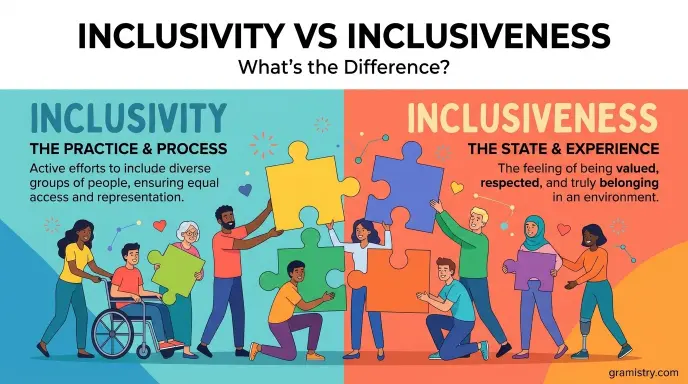
Ever found yourself typing a company update or editing a report, stopping mid-sentence, and wondering whether to write inclusivity or inclusiveness?
You are certainly not alone. Both terms flood modern workplace policies, HR handbooks, and diversity discussions daily.
Because both words share the same root, people naturally assume they are interchangeable synonyms with identical meanings.
However, using the wrong term in a formal policy or strategy document can subtly shift your intended message.
Although they look/sound similar, they serve completely different purposes.
Understanding this exact distinction sharpens your writing, strengthens your brand messaging, and ensures you communicate with true authority on modern workplace culture.
Let’s break down what inclusivity and inclusiveness really mean, how to deploy them correctly, and the simple memory hacks that keep your language sharp every single time.
What Is Inclusivity?
Inclusivity refers to the active policy, intentional strategy, or structural effort designed to include marginalized or underrepresented groups. It represents the deliberate framework an organization builds to ensure equal access, fair treatment, and complete participation for everyone. When you talk about inclusivity, you focus on the intentional architecture, rules, and system design that make equal opportunities possible.
Instead of treating it as a passive description, modern English treats inclusivity as an actionable directive. You will regularly find it paired with tactical nouns to form phrases like “building an inclusivity framework” or “executing an inclusivity campaign.”
How and Where It’s Used
You will spot inclusivity primarily in executive boardrooms, corporate handbooks, digital product guidelines, and academic papers. Grammatically, it functions as an abstract noun created from the adjective inclusive. While standard dictionaries list it globally, North American corporate and academic circles have adopted inclusivity as the preferred industry standard over the past two decades.
Sentence Examples
- The leadership board launched a new corporate inclusivity initiative to overhaul our hiring practices.
- Software developers must prioritize product inclusivity so that visually impaired users navigate easily.
- Our university updated its inclusivity guidelines to better support international students on campus.
Historical and Usage Note
While the root adjective inclusive stretches back centuries, the specific noun inclusivity skyrocketed in popular usage during the late 20th century. Its popularity grew alongside the formalization of Diversity, Equity, and Inclusion (DEI) frameworks in corporate environments. Today, writers prefer inclusivity when referring to concrete policies, deliberate strategies, and technical standards.
What Is Inclusiveness?
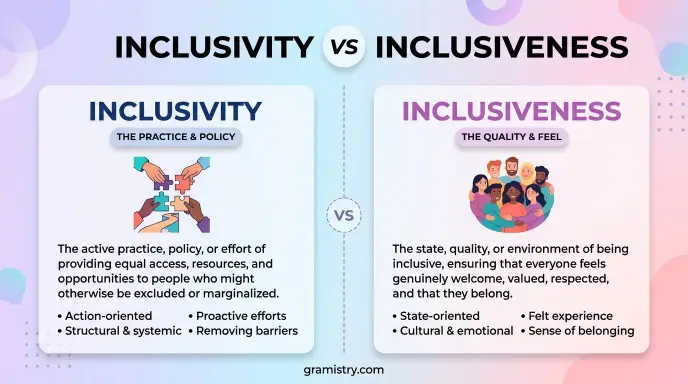
Inclusiveness refers to the quality, state, or felt experience of being inclusive. While inclusivity represents the strategy, inclusiveness describes the outcome—the actual atmosphere, mood, or environment created by that strategy. It measures how welcoming, warm, and secure people feel when participating in a group or entering a space.
Grammatically, inclusiveness follows classic English morphology by adding the suffix -ness to the base adjective inclusive. The -ness suffix converts adjectives directly into nouns describing a condition or state of being (much like turning kind into kindness or aware into awareness).
How and Where It’s Used
Writers use inclusiveness when describing interpersonal dynamics, social environments, team morale, and lived experiences. It is fully recognized and used across all international English dialects. In British and Commonwealth English, authors often choose inclusiveness in general descriptive literature to depict the overall tone or character of a community.
Sentence Examples
- New team members immediately noticed the genuine inclusiveness of our morning coffee chats.
- Measuring the true inclusiveness of a workplace requires analyzing honest feedback from employees.
- The community center thrives because its overall inclusiveness makes every resident feel valued.
Regional and Grammatical Notes
Unlike inclusivity, which carries a structured and corporate tone, inclusiveness feels organic and observational. You measure inclusiveness through human emotions and cultural vibes rather than auditing an HR compliance checklist.
Key Differences Between Inclusivity and Inclusiveness
To select the precise word every time, remember that inclusivity is about action and design, whereas inclusiveness is about feeling and experience.
- Inclusivity is strategic, structural, and policy-driven.
- Inclusiveness is observational, environmental, and atmospheric.
- Choose inclusivity when referring to corporate strategies, formal programs, or design choices.
- Choose inclusiveness when describing team culture, social warmth, or community spirit.
- Inclusivity acts as a modern industry term inside business and policy sectors.
- Inclusiveness functions as a classic descriptive noun denoting a human condition or state of being.
Clean Comparison Table
| Feature / Attribute | Inclusivity | Inclusiveness |
| Core Definition | The policy, system, or strategy of including people. | The state, feeling, or environment of being inclusive. |
| Grammatical Suffix | -ity (denotes form, function, or practice) | -ness (denotes state, quality, or condition) |
| Primary Context | HR handbooks, software design, DEI strategy, public policy. | Team dynamics, community events, corporate culture, social tone. |
| Focus Area | What you build and execute (the structural input). | What people feel and experience (the atmospheric output). |
| Tone | Formal, actionable, strategic, administrative. | Warm, descriptive, observational, human-centered. |
| Best Usage Example | “We drafted a new inclusivity strategy.” | “Employees praise the inclusiveness of our culture.” |
Real-Life Conversation Examples
Examining brief real-life conversations highlights how people confuse inclusivity or inclusiveness during daily interactions.
1: The HR Planning Meeting
Alex: “We need to work on the overall inclusivity of our team lunch events.”
Maya: “Do you mean we need a written company policy for lunches, or do you want the lunches to feel friendlier?”
Alex: “You’re right, I meant the feeling! We want better team inclusiveness.”
🎯 Lesson: Use inclusiveness to describe the friendly atmosphere of a social event rather than the formal rule governing it.
2: Building an Accessibility Feature
Jordan: “Our web developers are auditing the app to ensure maximum inclusiveness for screen readers.”
Sam: “Since you are auditing technical standards and structural features, the exact term is inclusivity.”
Jordan: “Got it! We design for inclusivity so our users experience total digital inclusiveness.”
🎯 Lesson: Technical standards require inclusivity, while the user’s ultimate comfort represents inclusiveness.
3: Discussing Company Culture
Taylor: “I applied here because your website highlights a strong commitment to inclusivity.”
Chris: “That’s great! How has your experience been so far?”
Taylor: “The policies are clear, but the daily inclusiveness in team meetings still needs work.”
🎯 Lesson: An organization can publish inclusivity policies on paper without automatically creating daily inclusiveness in practice.
When to Use Inclusivity vs Inclusiveness
Applying these simple practical rules guarantees your writing remains clear, accurate, and professional across every medium.
Practical Usage Rules
- Writing about a framework, program, or rule? Use inclusivity.
- Correct: “The committee introduced a comprehensive inclusivity plan.”
- Describing a mood, feeling, or environment? Use inclusiveness.
- Correct: “The warmth and inclusiveness of the town made us stay.”
- Drafting technical specs or product features? Use inclusivity.
- Correct: “Architects prioritized universal inclusivity while constructing the entrance.”
Simple Memory Tricks
- Inclusivi-TY = Strategy & Policy. Both words focus on intentional structure. Think of inclusivity as the activity you organize.
- Inclusive-NESS = Feeling & Awareness. Suffixes ending in -ness measure a state of mind or environment (like kindness, calmness, or fairness). Think of inclusiveness as the openness of the room.
Writing for US vs UK Audiences
- US English: Strongly favors inclusivity, particularly within corporate management, tech documentation, and educational institutions.
- UK / Commonwealth English: Accepts both terms freely, maintaining a higher frequency of inclusiveness in general descriptive literature and editorial prose.
Fun Facts and History
- Etymological Origins: The suffix -ness originates from Old English, giving inclusiveness deep, traditional roots in the language. Conversely, -ity entered English through Latin via Old French, giving inclusivity its distinctly formal and technical cadence.
- Search Trends: Global online search volume for inclusivity surpassed inclusiveness around 2015, driven largely by the rise of corporate social responsibility frameworks and modern accessibility design standards.
FAQs:
Is it wrong to use inclusivity and inclusiveness as synonyms?
While many dictionaries list them as broad synonyms, substituting one for the other in professional writing reduces precision. Inclusivity refers to systems and strategies, while inclusiveness refers to environments and feelings.
Which term is preferred in corporate DEI policies?
Corporate DEI handbooks almost universally prefer inclusivity when referring to official initiatives, training programs, hiring practices, and policy guidelines.
Can a workplace have inclusivity without inclusiveness?
Yes. An organization can institute formal inclusivity policies on paper, but if employees still feel left out or ignored during daily work, the environment lacks actual inclusiveness.
How do I use these terms in academic writing?
In academic contexts, use inclusivity when discussing structural frameworks, methodological designs, or policy models. Reserve inclusiveness when describing observed social climate, participant responses, or qualitative experiences.
Does accessibility fall under inclusivity or inclusiveness?
Accessibility guidelines and structural accommodations fall under inclusivity. The resulting ease of access and sense of belonging experienced by disabled users represents inclusiveness.
Conclusion:
Mastering the difference between inclusivity or inclusiveness comes down to recognizing cause versus effect.
Inclusivity is your deliberate strategy, your formal policy, and your structural system.
Inclusiveness is the lived experience, the welcoming atmosphere, and the human feeling that results from those efforts.
Aligning each word with its precise context adds clarity, authority, and professional polish to your communication.
Next time someone uses these two words, you’ll know exactly what they mean!

Alina Mark is the creative voice behind Gramistry.com, making word meanings, English expressions, and trending slang simple, clear, and interesting. Her mission is to make every word easier to understand, one meaning at a time.