
Taking charge of your preventive health can feel overwhelming, especially when faced with complex medical choices.
When scheduling routine colorectal cancer screenings, patients frequently ask whether they should choose Cologuard or colonoscopy options for their health journey.
People often mix up these two terms because both refer to essential screening methods aimed at catching bowel abnormalities early.
Although they look or sound similar when discussed in medical conversations, they serve completely different purposes.
One is an at-home non-invasive stool DNA screening test designed solely for average-risk individuals, while the other is an invasive visual procedure that both diagnoses and actively removes precancerous polyps.
In this complete guide from Gramistry, your trusted educational language and clear concepts resource, we break down the medical definitions, linguistic roots, spelling rules, procedural differences, and practical contexts of both terms so you always know which one fits your needs.
What Is “Cologuard”?
Meaning and Definition
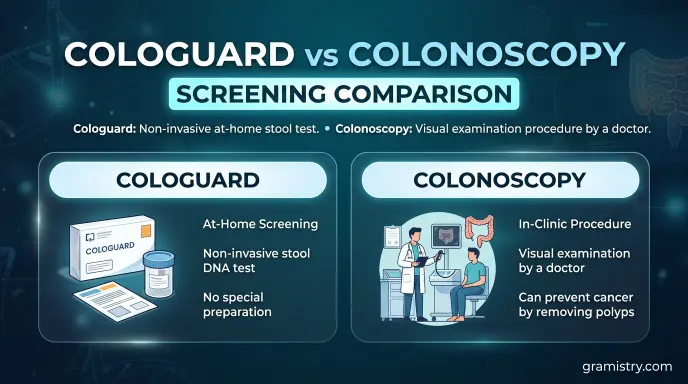
Cologuard is a proprietary brand name for a non-invasive, at-home stool DNA and fecal immunochemical screening test (multi-target stool DNA test). Manufactured by Exact Sciences, it detects altered DNA markers and microscopic traces of hemoglobin (blood) passed in stool, which can indicate the presence of colorectal cancer or advanced precancerous polyps.
Pronunciation and Grammar Role
- Pronunciation: /ˈkoʊ.lə.ɡɑːrd/ (KOH-luh-gard).
- Grammar Role:
- Proper Noun: Cologuard (a trademarked brand name). Always capitalize it in formal writing.
- Medical Noun: Used to specify a non-invasive sDNA screening method.
How It Is Used and Grammar Context
Because Cologuard is a specific product name, it is treated grammatically as a proper noun. You order a Cologuard kit, complete a Cologuard test, or receive Cologuard results. It cannot be used as a general verb (e.g., saying “I was Cologuarded” is informal slang, not standard English).
Country Usage and History
Cologuard received official approval from the U.S. Food and Drug Administration (FDA) in August 2014. It is widely used across the United States for average-risk adults aged 45 and older. While non-invasive stool DNA testing concepts exist globally, the brand name Cologuard specifically dominates U.S. medical terminology and healthcare discussions.
Etymologically, the name combines colo- (referring to the colon or large intestine, from the Greek kolon) and guard (meaning to protect or keep safe).
Common Mistakes
A frequent mistake is assuming Cologuard is a full diagnostic tool or a substitute for high-risk individuals. Cologuard cannot remove polyps or confirm cancer on its own. If a Cologuard result returns positive, the patient must undergo a follow-up diagnostic procedure.
Real Examples and Sentences
- “My physician prescribed Cologuard because I turned 45 and have no family history of colon cancer.”
- After collecting the sample at home, she mailed the Cologuard kit back to the laboratory for analysis.
- “A positive Cologuard test requires a follow-up optical screening to inspect the tissue directly.”
What Is “Colonoscopy”?
Meaning and Definition
A colonoscopy is a outpatient endoscopic medical procedure during which a board-certified gastroenterologist uses a flexible, illuminated tube equipped with a camera (a colonoscope) to visually inspect the inner lining of the large intestine (colon) and rectum.
Unlike simple screening tests, a colonoscopy is both diagnostic and therapeutic—meaning the physician can identify tissue changes, take biopsies, and remove precancerous polyps during the exact same procedure.
Pronunciation and Grammar Role
- Pronunciation: /ˌkoʊ.ləˈnɑː.skə.pi/ (koh-luh-NOS-kuh-pee).
- Grammar Role:
- Common Noun: colonoscopy (plural: colonoscopies).
- Modifier/Adjective: “He underwent a colonoscopy procedure.”
History and Linguistic Note
The word colonoscopy combines two ancient Greek roots: kolon (the large intestine) and -skopia (from skopein, meaning to look at, observe, or examine).
The modern flexible colonoscope was pioneered in the late 1960s by Dr. Hiromi Shinya and Dr. William Wolff, revolutionizing preventive medicine by allowing non-surgical polyp removal (polypectomy).
Country Usage and Spelling Explanation
The term is universally recognized across global healthcare systems, including the U.S., UK, Canada, Australia, and international medical boards.
- Spelling Note: Do not confuse colonoscopy with related terms like colonoscope (the actual instrument used) or colposcopy (a completely different gynecological procedure examining the cervix).
Common Mistakes
A major clinical and linguistic mistake is treating a colonoscopy as just a “test.” It is an invasive endoscopic procedure that requires specialized dietary preparation (bowel prep) and sedation.
Real Examples and Sentences
- “Dr. Vance recommended a preventive colonoscopy to screen for colorectal abnormalities.”
- “The gastroenterologist removed two benign polyps during the colonoscopy.”
- “Proper bowel prep the night before is critical for a clear view during your colonoscopy.”
Key Differences Between Cologuard and Colonoscopy
Understanding the distinct roles of these medical options helps patients and writers communicate clearly.
Summary of Differences
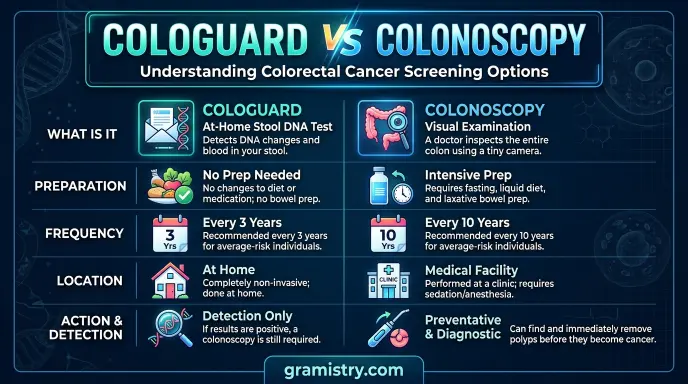
- Meaning & Scope: Cologuard is a non-invasive at-home stool collection kit; a colonoscopy is a direct, invasive visual examination performed in a clinical setting.
- Function & Capability: Cologuard only detects abnormal DNA markers and blood traces. A colonoscopy detects, diagnoses, biopsies, and physically removes polyps.
- Grammar & Capitalization: Cologuard is a proper noun (brand name, capitalized). Colonoscopy is a common noun (general medical procedure, lowercase unless starting a sentence).
- Target Audience: Cologuard is strictly for average-risk individuals with no symptoms. A colonoscopy is suitable for both average-risk and high-risk individuals (or those experiencing symptoms).
- Frequency: Cologuard is typically repeated every 3 years if clear; a normal screening colonoscopy is usually repeated every 10 years.
Comparison Table
| Feature | Cologuard | Colonoscopy |
| Primary Category | Non-invasive at-home sDNA test | Invasive endoscopic clinical procedure |
| Grammar Type | Proper Noun (Brand Name) | Common Noun (Medical Term) |
| Preparation Needed | None (no dietary restrictions or laxatives) | Full liquid diet & laxative bowel prep |
| Sedation Required | No | Yes (Monitored Anesthesia / Sedation) |
| Polyp Removal | No (Detection only) | Yes (Immediate removal during procedure) |
| Recommended Frequency | Every 3 years (for clear results) | Every 10 years (for clear average-risk) |
| Patient Eligibility | Average-risk only (45+ years old) | Average-risk AND High-risk individuals |
| Follow-up Requirement | Positive result requires a colonoscopy | Serves as the definitive gold standard |
Real-Life Conversation Examples
These natural dialogues illustrate how these terms appear in everyday healthcare and social conversations:
Scenario 1: Discussing Routine Preventive Care
Mark: “I just turned 45, and my doctor brought up colorectal screening. I really want to avoid hospital visits.”
Sarah: “You might ask about Cologuard. It’s an at-home kit you mail back, provided you’re at average risk.”
Mark: “That sounds much easier than taking a day off work.”
🎯 Lesson: Cologuard is an at-home non-invasive option suitable for average-risk adults seeking convenient initial screening.
Scenario 2: Addressing Family History and High Risk
Elena: “My mother had colon polyps, so my doctor advised against the at-home tests.”
David: “That makes sense. With a family history, a colonoscopy is the safest option because they can find and remove polyps immediately.”
Elena: “Right, it gives me peace of mind knowing it’s comprehensive.”
🎯 Lesson: A colonoscopy is necessary for individuals with high-risk factors or family histories of gastrointestinal conditions.
Scenario 3: Understanding a Follow-up Result
James: “My Cologuard test came back positive last week. Should I be worried?”
Dr. Lee: “A positive result isn’t a definitive cancer diagnosis. It simply means we now need to perform a diagnostic colonoscopy to look inside directly.”
James: “Got it. So the second procedure will find out what’s actually going on.”
🎯 Lesson: A positive Cologuard screening always requires a follow-up colonoscopy to evaluate the colon visually.
When to Use Cologuard vs. Colonoscopy
Choosing between these options depends on medical history, doctor recommendations, and health guidelines.
1. Medical Guidelines and Eligibility
- Use Cologuard if: You are 45 years or older, at average risk for colorectal cancer, have no personal or family history of polyps or bowel cancer, and have no symptoms like unexplained bleeding or abdominal pain.
- Use Colonoscopy if: You have a personal or family history of colorectal cancer or polyps, suffer from inflammatory bowel disease (IBD), have visible symptoms, or received a positive result on an initial stool test.
2. Memory Tricks for Language and Usage
- Cologuard = Colon + Guard (At-Home Guard): Think of it as an at-home sentinel that guards your schedule by screening without hospital visits.
- Colonoscopy = Colon + Scope (Direct Visual): Think of the -oscopy suffix, which means using a physical scope to view tissue directly inside the body.
3. Formal, Medical, and Academic Writing Rules
In professional healthcare writing, research articles, or academic essays:
- Always capitalize Cologuard because it is a registered trademark of Exact Sciences Corporation.
- Use lowercase for colonoscopy as it is a general medical term, unless it appears at the start of a sentence or in a formal title.
- Avoid using “Cologuard” as a generic synonym for all stool-based screening tests (such as FIT or gFOBT).
Common Mistakes People Make
Mixing up these terms can lead to medical misunderstandings or grammatical errors. Here are the most frequent pitfalls:
1: Treating Cologuard as a Final Diagnostic Tool
- Incorrect: “The Cologuard test removed my polyps last week.”
- Correct: “The gastroenterologist removed my polyps during my colonoscopy last week.”
- Why it’s incorrect: Cologuard is purely an analytical laboratory test performed on stool. It lacks any mechanical or surgical ability to physically touch or remove tissue.
2: Capitalizing “colonoscopy” in Regular Text
- Incorrect: “I need to schedule my Colonoscopy for next month.”
- Correct: “I need to schedule my colonoscopy for next month.”
- Why it’s incorrect: Colonoscopy is a common noun, not a brand name. Capitalize it only at the beginning of a sentence.
3: Assuming a Clear Cologuard Result Lasts 10 Years
- Incorrect: “My Cologuard was negative, so I am good for the next decade.”
- Correct: “My Cologuard was negative, so I will need another screening in 3 years.”
- Why it’s incorrect: Medical guidelines specify that a negative Cologuard test should be repeated every 3 years, whereas a clear screening colonoscopy often covers a 10-year window for average-risk individuals.
Fun Facts and Medical History
- Greek Linguistic Roots: The root word -oscopy comes from the ancient Greek word skopein, which also gives us modern everyday words like telescope, microscope, and kaleidoscope.
- The First Modern Endoscope: Before flexible fiber-optic systems were developed in the late 20th century, early internal examinations relied on rigid metal tubes that offered very limited visibility and caused significant patient discomfort.
- DNA Technology in Stool: Cologuard was revolutionary upon its release because it isolates human DNA from epithelial cells shed naturally by the lining of the colon as stool passes through, detecting subtle genetic mutations linked to neoplasia.
- Gold Standard Status: Despite advancements in virtual imaging and stool biomarker technology, the colonoscopy remains the undisputed “gold standard” in colorectal health because of its unique ability to prevent cancer by removing precancerous lesions on the spot.
FAQs:
1. Is Cologuard as accurate as a colonoscopy?
A colonoscopy remains the most accurate screening method because it offers direct visual inspection. Cologuard is highly sensitive at detecting colorectal cancer (around 92%), but it is less sensitive at finding smaller precancerous polyps compared to a colonoscopy.
2. What happens if my Cologuard test comes back positive?
A positive Cologuard test means abnormal DNA or blood markers were detected. It is not a confirmation of cancer, but it requires a follow-up diagnostic colonoscopy to visually evaluate your colon and remove any polyps.
3. Does Cologuard require dietary prep or laxatives?
No. Cologuard requires no dietary changes, no fasting, and no laxative bowel preparation. You simply collect a stool sample using the provided kit and send it to the lab.
4. How often do you need a Cologuard test versus a colonoscopy?
For average-risk individuals with normal results, Cologuard is recommended every 3 years. A normal screening colonoscopy is typically recommended once every 10 years.
5. Can someone with a family history of colon cancer use Cologuard?
No. Guidelines specify that Cologuard is intended only for individuals at average risk. If you have a personal or family history of polyps or colorectal cancer, a screening colonoscopy is recommended.
6. Are Cologuard and colonoscopy covered by insurance?
Most major health insurance plans and Medicare cover both screening options for eligible adults aged 45 and older. However, if a Cologuard test is positive, check with your insurer regarding coverage for the follow-up colonoscopy.
7. Why is Cologuard capitalized while colonoscopy is not?
Cologuard is a brand name (a proper noun owned by Exact Sciences), so it is capitalized. Colonoscopy is a generic medical procedure (a common noun), so it remains lowercase.
8. Can a colonoscopy prevent cancer from developing?
Yes. A colonoscopy is one of the few medical procedures that can actively prevent cancer. By identifying and removing precancerous polyps before they turn malignant, it eliminates potential cancer sources.
Conclusion:
Navigating the choice between Cologuard or colonoscopy comes down to understanding your personal medical history, risk profile, and healthcare goals.
Cologuard provides an accessible, non-invasive, at-home screening option for average-risk individuals every three years.
In contrast, a colonoscopy remains the comprehensive gold standard capable of both diagnosing abnormalities and actively removing precancerous polyps in a single visit.
By understanding the distinct linguistic rules and medical applications of both options, you can communicate clearly with your healthcare provider.
Next time someone uses these two words, you’ll know exactly what they mean!

Alina Mark is the creative voice behind Gramistry.com, making word meanings, English expressions, and trending slang simple, clear, and interesting. Her mission is to make every word easier to understand, one meaning at a time.