
Two colorful bottles. Two bold claims. One big question: Prime or Gatorade? It’s no surprise people get these confused.
Both come in bright packaging, both promise hydration, and both are endorsed by famous athletes.
But here’s the thing: although they look or sound similar, they serve completely different purposes.
In this guide, I’ll break down exactly what each drink is, how they’re made, who should drink them, and when one beats the other.
By the time you finish, you’ll know the difference between Prime and Gatorade like a hydration expert and you’ll never stare blankly at those shelves again.
What Is Prime?
Prime is a hydration and sports drink brand that exploded onto the scene in 2022. Founded by YouTube stars Logan Paul and KSI, it quickly became one of the most talked-about beverages in the world — thanks to massive social media buzz and celebrity endorsements.
Meaning and Definition
Prime is a beverage line that includes Prime Hydration (a sports drink) and Prime Energy (a caffeinated energy drink). The “Prime Hydration” version is the one most people compare to Gatorade. It’s marketed as a better-for-you sports drink with added electrolytes, B vitamins, and coconut water.
How It’s Used
The brand positions it as a modern, premium alternative to traditional sports drinks — one that tastes great and looks good on social media.
Grammar Role
In terms of language, “Prime” here is a proper noun — it’s a brand name. You’d say “a bottle of Prime” or “some Prime.”
Pronunciation
Prime is pronounced exactly how it looks: prahy-m (one syllable). It rhymes with “time” and “climb.”
Country Usage
Prime is sold globally, including in the US, UK, Australia, and many other countries. However, in the UK, the Prime Energy version is not sold to under-16s due to its high caffeine content. This makes country regulations a big part of the Prime story.
History and Origin
Prime was founded in 2022 by Logan Paul and KSI. The two internet personalities launched it after noticing a gap in the market for a sports drink that combined performance with lifestyle appeal. Within months, it became a viral phenomenon, with people lining up outside stores just to grab a bottle.
Common Mistakes
- Thinking Prime is “healthier” just because it has coconut water. It’s still a processed drink with sugar alternatives.
- Confusing Prime Hydration with Prime Energy. One has caffeine; one doesn’t. This is a big mix-up.
- Assuming all Prime products are suitable for kids. The energy versions are not.
Real Examples
When people say “I grabbed a Prime after my workout,” they almost always mean Prime Hydration. When they say “Prime keeps me awake,” they mean Prime Energy.
Example Sentences
- “I picked up a bottle of Prime after my gym session, and it tasted like a fruity popsicle.”
- “My son asked for Prime, but I checked the label first to make sure it wasn’t the energy version.”
What Is Gatorade?

Gatorade is the original sports drink.
Meaning and Definition
The classic formula contains water, sugar, sodium, and potassium — the key ingredients for rehydration.
Grammar Role
Like Prime, “Gatorade” is a proper noun — a brand name. But officially, it’s a specific brand.
Country Usage
Gatorade is widely available in the US, Latin America, and parts of Europe and Asia.
History and Origin
Gatorade was invented in 1965 at the University of Florida. Researchers were trying to solve a big problem: why were Florida Gators football players struggling in the Florida heat? The answer was dehydration. They created a drink with the right balance of carbs and electrolytes, named it after the team, and the rest is history. The university reportedly earns millions in royalties from the brand even today.
Spelling Explanation
Gatorade comes from “Gator” (short for the Gators, the University of Florida mascot) plus “-ade,” meaning a sweetened drink. That’s why it’s spelled with an “a” — G-A-T-O-R-A-D-E.
Common Mistakes
- It’s Gatorade.
- Assuming Gatorade is only for pro athletes. Anyone doing prolonged exercise can use it, but casual water-drinkers might be better off with plain water.
- Thinking all Gatorade is the same. There’s Gatorade Thirst Quencher, Gatorade Zero (sugar-free), Gatorade G2 (low sugar), and Gatorade Endurance.
Example Sentences
- “After the marathon, I grabbed a cold Gatorade to get my electrolytes back.”
- “Our coach always keeps Gatorade on the sideline during summer practices.”
Key Differences Between Prime and Gatorade
Here are the main differences at a glance:
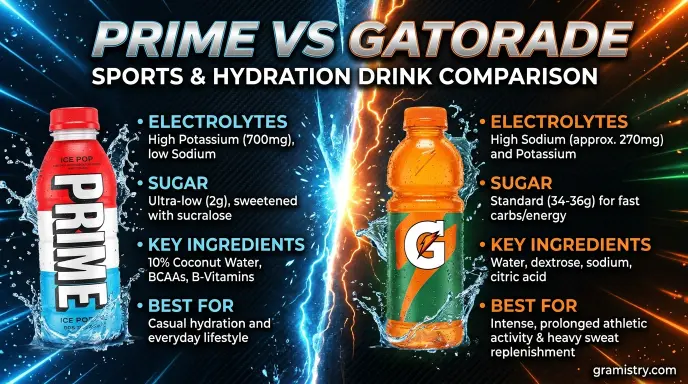
- Prime Hydration is more of a general hydration drink with a lifestyle twist.
- Sugar content: Regular Gatorade has real sugar for quick energy.
- Caffeine: Regular Gatorade has zero caffeine.
- Electrolytes: Both contain sodium and potassium. Gatorade’s profile is designed specifically for endurance athletes.
- Taste profile: Gatorade is sweet and slightly salty. Prime is designed to be smoother and more dessert-like.
- Target audience: Gatorade targets athletes of all levels. Prime targets younger, social-media-savvy consumers.
- History and trust: Gatorade has six decades of scientific backing. Prime is relatively new and less studied long-term.
Comparison Table
| Feature | Prime (Hydration) | Gatorade (Thirst Quencher) |
|---|---|---|
| Year introduced | 2022 | 1965 |
| Main purpose | Hydration + lifestyle | Exercise performance |
| Sugar | Sugar-free (artificial sweeteners) | Contains real sugar |
| Caffeine | 0 mg (Energy has 200 mg) | 0 mg |
| Electrolytes | Sodium, potassium | Sodium, potassium |
| Added B vitamins | Yes | No |
| Coconut water | Yes | No |
| Best for | Everyday hydration, light workouts | Prolonged, intense exercise |
| Target audience | Younger, lifestyle-focused | Athletes of all levels |
| Scientific history | New, less researched | Decades of sports science |
Real-Life Conversation Examples
Conversation 1:
Marcus: “What are you drinking before the gym — Prime or Gatorade?”
Lena: I need the carbs for energy.”
Marcus: “Makes sense. I just have Prime in my bag for after.”
🎯 Lesson: Match your drink to your activity. Intense workouts often need Gatorade’s carbs; lighter days might call for Prime.
Conversation 2: Parents in the Store
Mom: “Can I get Prime like everyone else at school?”
Dad: “Check the label first. Is this the energy one with caffeine?”
Mom: “No, it’s the clear one. No caffeine. Let’s get it.”
🎯 Lesson: Always check the label — Prime has different versions, and only the caffeine-free kind is okay for kids.
Conversation 3: A Trainer’s Advice
Coach: “Why is Gatorade still on our bench after all these years?”
Player: “Because it works?”
Coach: “Exactly. Don’t fix what isn’t broken.”
🎯 Lesson: Gatorade’s long history of research gives it a trust advantage in serious performance settings.
Conversation 4: The Marathon Finish
Runner: “I’m out of energy, and my stomach is cramping.”
Friend: “Here — sip this Gatorade slowly. It’ll replace your electrolytes.”
Runner: “Thanks. I think I overdid it today.”
🎯 Lesson: For long endurance events, electrolyte and carb replacement (Gatorade-style) matters most.
When to Use Prime vs Gatorade
Practical Rules
- Use Gatorade when you’re exercising for more than 60 minutes, sweating heavily, or playing competitive sports — your body needs the carbs and electrolytes.
- Use Prime Hydration when you want a refreshing, low-sugar drink, or you’re doing light activity, daily hydration, or just like the taste.
- Avoid Prime Energy if you’re sensitive to caffeine, under 18, or drinking it late in the day.
Easy Memory Tricks
Think of it this way: “Gatorade = Game Day” and “Prime = Prime Time basics.” Gatorade is for the field. Prime is for everyday vibes.
Gatorade = energy for performance. Prime = hydration without the extra sugar.
US vs UK Usage
In the US, both drinks are everywhere. Gatorade is the classic; Prime became a trend.
Formal Writing
In formal or academic writing, you’d almost never mention these brands by name.
Informal Writing
In casual conversation, blog posts, or social media, brand names are totally fine: “Let’s grab a Gatorade” or “I love Prime.”
Academic Writing
That’s how you stay objective.
Common Mistakes People Make
Let’s clear up a few big ones:
1
- ❌ Wrong: “I only drink Gatorade all day because water is boring.”
- ✅ Correct: “I drink water most of the day and save sports drinks for workouts.”
- Why: Plain water is best for daily hydration.
2
- ❌ Wrong: “I gave my 8-year-old a Prime — it’s fine, it’s a sports drink.”
- ✅ Correct: “I checked that my 8-year-old gets the caffeine-free Prime Hydration.”
- Why: Only Prime Hydration is caffeine-free. Prime Energy has 200mg of caffeine per can — way too much for a child.
3
- ❌ Wrong: “Prime has coconut water, so it must be better than Gatorade.”
- ✅ Correct: “Prime and Gatorade each have pros and cons, so I read the label before choosing.”
- Why: Coconut water doesn’t automatically make a drink healthier.
Fun Facts and History
- The University of Florida invented Gatorade by accident. It was created in 1965 to fight dehydration among football players — and today, the university reportedly earns royalties still.
- Gatorade named itself after a mascot. The drink was named for the Florida Gators, and that’s why it’s “Gator” + “ade.”
- Prime sold out spectacularly. When Prime launched in the UK in 2022, stores faced literal riots and shortages — some resellers flipped bottles online for far more than retail price.
- Both drinks changed how athletes hydrate. Gatorade pioneered sports nutrition science, while Prime sparked a global conversation about sports drinks among young people who’d never bought one before.
FAQs:
1. Is Prime healthier than Gatorade?
It depends on your goals. For everyday hydration, either is fine in moderation; for intense workouts, Gatorade’s carbs may help more.
2. Can kids drink Prime?
Only the caffeine-free Prime Hydration version is appropriate for children. Prime Energy contains 200mg of caffeine per can and is not safe for kids, teens, or anyone sensitive to caffeine.
3. Does Prime have caffeine?
Prime Hydration does not contain caffeine.
4. Is Gatorade good for you?
Water is better for everyday hydration.
5. Which is better for a morning workout?
For a longer or more intense session, Gatorade’s carbohydrates give you quick energy to push through. Choose based on duration and intensity.
6. Can I drink Prime and Gatorade together?
You can, but it’s usually unnecessary. Drinking both adds extra calories and sugar. Pick one based on your needs — Gatorade for performance, Prime for low-sugar hydration — rather than mixing them.
7. Why is Prime so expensive?
Prime’s high price comes from its premium branding, massive marketing campaigns, celebrity endorsements, and limited supply that drove up demand.
8. Does Gatorade contain caffeine?
No. The classic Gatorade Thirst Quencher contains zero caffeine.
9. What does “electrolytes” actually mean?
Electrolytes are minerals like sodium, potassium, and chloride that help your body balance fluids and support muscle and nerve function. You lose them through sweat, which is why intense exercisers need to replace them.
10. Is one drink better for diabetics?
Both have caveats. Gatorade is high in sugar, which can spike blood sugar. Anyone with diabetes should talk to a doctor about the best hydration option for their specific needs.
Conclusion:
So, Prime or Gatorade? The short answer: Gatorade is your performance partner for hard exercise, while Prime is your modern, low-sugar hydration choice for everyday life.
Gatorade brings six decades of sports science and real sugar for energy.
Prime brings a fresh, trendy look with zero sugar and added vitamins. Neither is universally better it all depends on what your body is doing and what you’re trying to achieve.
Next time someone uses these two words, you’ll know exactly what they mean!

Alina Mark is the creative voice behind Gramistry.com, making word meanings, English expressions, and trending slang simple, clear, and interesting. Her mission is to make every word easier to understand, one meaning at a time.