
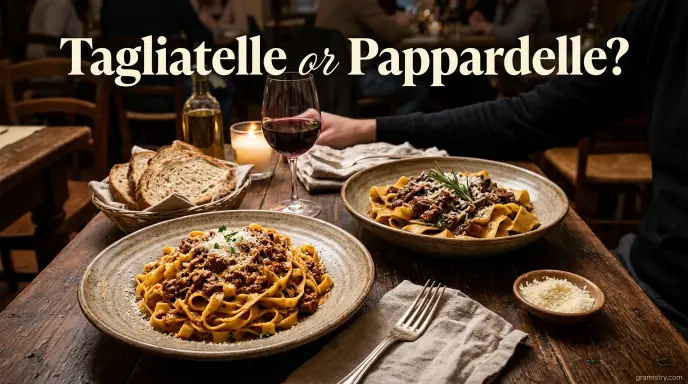
If you have ever looked at an Italian pasta menu and wondered whether to order tagliatelle or pappardelle, you are not alone.
Both are long, flat, ribbon-shaped pastas, and both are often made with egg-based dough.
They can also be served with rich meat sauces, mushrooms, cheese, or other hearty toppings.
So, what actually separates them?
The biggest difference is width. Traditional Bolognese tagliatelle is relatively narrow, while pappardelle is much wider.
Their regional identities and classic sauce pairings also differ. Although they look or sound similar, they serve completely different purposes.
In this guide, you will learn what tagliatelle and pappardelle mean, where they come from, how wide they are, what sauces work best with each, common mistakes to avoid, and how to choose the right pasta for your dish.
What Is Tagliatelle?
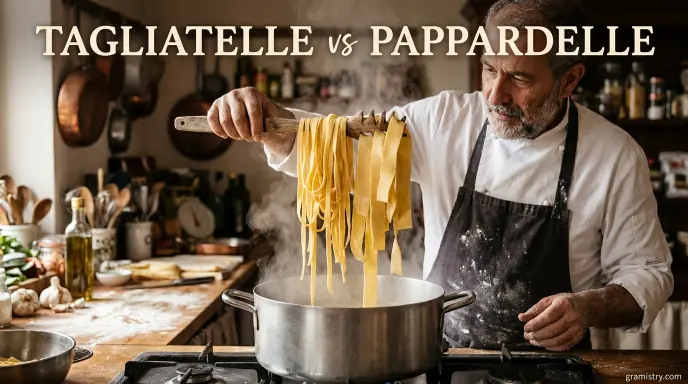
Tagliatelle is a long, flat Italian ribbon pasta traditionally associated with Bologna and the Emilia-Romagna region. It is commonly made from a simple fresh pasta dough containing soft wheat flour and eggs, although recipes and commercial versions can vary.
The word tagliatelle is related to the Italian verb tagliare, meaning “to cut.” The name reflects how the pasta is made: a thin sheet of pasta, called sfoglia, is rolled or folded and then cut into long ribbons.
Quick Definition
Tagliatelle is a relatively narrow, flat ribbon pasta, strongly associated with Bologna and traditionally served with rich sauces such as ragù.
One of the most interesting facts about tagliatelle is that the traditional Bolognese version has a remarkably precise official measurement.
In 1972, the Bologna delegation of the Accademia Italiana della Cucina and the Confraternita del Tortellino deposited a specification for tagliatelle alla bolognese with the Bologna Chamber of Commerce. The traditional cooked width is 8 mm, linked symbolically to the height of Bologna’s Torre degli Asinelli.
That does not mean every piece of pasta sold as tagliatelle worldwide will measure exactly 8 mm. Handmade pasta varies, and different regions and manufacturers use slightly different dimensions. However, the 8 mm measurement is an important part of the Bolognese tradition.
What Does Tagliatelle Look Like?
Tagliatelle is:
- Long and flat
- Ribbon-shaped
- Usually narrower than pappardelle
- Commonly made as fresh egg pasta
- Designed to hold substantial sauces
- Often around 6–7 mm wide before cooking in the Bolognese tradition
- Traditionally about 8 mm wide when cooked
The Accademia Italiana della Cucina specifically describes tagliatelle as a traditional egg pasta closely connected with Bolognese cuisine and ragù.
What Is Tagliatelle Used For?
Tagliatelle works especially well with sauces that need a broad, flat surface to cling to.
Classic examples include:
- Ragù alla bolognese
- Mushroom sauces
- Butter and sage
- Truffle sauces
- Creamy cheese sauces
- Meat-based sauces
- Vegetable sauces with substantial texture
The classic pairing is tagliatelle al ragù, rather than the popular international idea of “spaghetti bolognese.” The Accademia Italiana della Cucina identifies tagliatelle as a traditional partner for Bolognese ragù.
Tagliatelle Example Sentences
- “We ordered tagliatelle with a traditional meat ragù.”
- “Fresh tagliatelle cooks quickly because it is made from a thin sheet of pasta.”
- “Tagliatelle is one of the classic pasta shapes associated with Bologna.”
- “I prefer tagliatelle when I am making a rich mushroom sauce.”
- “The restaurant served homemade tagliatelle with Parmesan.”
What Is Pappardelle?

Pappardelle is a broad, flat ribbon pasta traditionally associated with Tuscany.
It looks very similar to tagliatelle, but the most obvious difference is its width. Pappardelle is much broader, often around 2 cm wide. Visit Tuscany describes pappardelle as wide strips measuring approximately 2 cm and notes their popularity throughout Tuscany.
Quick Definition
Pappardelle is a very wide, flat ribbon pasta associated with Tuscany and especially suited to rich, hearty sauces such as wild-boar or hare ragù.
The name is commonly connected with the Italian verb pappare, meaning roughly “to gobble up” or “to eat heartily.” Visit Tuscany gives this explanation for the name and highlights the pasta’s traditional relationship with robust meat sauces.
What Does Pappardelle Look Like?
Pappardelle is:
- Long and flat
- Much wider than traditional tagliatelle
- Ribbon-shaped
- Often about 2 cm wide
- Frequently made from fresh pasta dough
- Particularly good with thick and chunky sauces
The exact width can vary depending on the region, recipe, and producer. Some handmade versions can be wider or narrower than the commonly cited 2 cm measurement.
What Is Pappardelle Used For?
Pappardelle is especially effective with heavy, rustic sauces.
Popular pairings include:
- Wild boar ragù
- Hare ragù
- Duck sauces
- Mushroom ragù
- Beef ragù
- Sausage-based sauces
- Rich tomato and meat sauces
- Seasonal forest-mushroom sauces
Tuscany’s official tourism site specifically highlights pappardelle with hare and explains that its wide surface works well with meat sauces because it can carry plenty of sauce.
The Accademia Italiana della Cucina also lists traditional pappardelle dishes with hare and wild boar in Tuscany.
Pappardelle Example Sentences
- “The chef served pappardelle with a slow-cooked wild-boar ragù.”
- “Pappardelle is wider than tagliatelle.”
- “I chose pappardelle because the mushroom sauce was thick and hearty.”
- “Fresh pappardelle makes a beautiful rustic Italian pasta dish.”
- “The Tuscan restaurant served pappardelle with hare.”
Tagliatelle or Pappardelle: Key Differences
The simplest way to remember the difference is this:
Tagliatelle = narrower ribbon.
Pappardelle = wider ribbon.
But width is not the only distinction.
Main Differences
- Width: Pappardelle is considerably wider than tagliatelle.
- Regional identity: Tagliatelle is strongly associated with Bologna and Emilia-Romagna, while pappardelle is strongly associated with Tuscany.
- Classic sauces: Tagliatelle is famously paired with Bolognese ragù; pappardelle is particularly associated with hearty Tuscan game sauces.
- Appearance: Both are long, flat ribbons, but pappardelle looks noticeably broader.
- Texture and sauce coverage: Their broad surfaces make both useful for substantial sauces, but the extra width of pappardelle gives it an especially substantial bite.
- Traditional measurement: Bolognese tagliatelle has a documented 8 mm cooked-width specification; pappardelle does not have the same single universally recognized measurement.
- Cuisine: Tagliatelle points you toward northern Italian and Bolognese traditions, while pappardelle often points toward Tuscan cooking.
Comparison Table
| Feature | Tagliatelle | Pappardelle |
|---|---|---|
| Shape | Flat ribbon | Flat ribbon |
| Typical appearance | Narrow ribbon | Very wide ribbon |
| Traditional association | Bologna, Emilia-Romagna | Tuscany |
| Traditional Bolognese width | 8 mm cooked | Not applicable |
| Common approximate width | Around 6–8 mm | Around 2 cm |
| Dough | Often fresh egg pasta | Often fresh egg pasta |
| Classic pairing | Ragù alla bolognese | Wild boar, hare, and other rich ragùs |
| Sauce style | Rich, substantial sauces | Very rich, hearty sauces |
| Italian name type | Plural noun | Plural noun |
| Main distinction | Narrower | Wider |
The width figures should be treated as traditional reference points rather than a rule that every modern pasta maker must follow. For Bolognese tagliatelle, however, the 8 mm cooked measurement has a particularly strong traditional status.
Tagliatelle vs Pappardelle: Real-Life Conversation Examples
Conversation 1: Ordering at an Italian Restaurant
Sara: What is the difference between tagliatelle and pappardelle?
Marco: Pappardelle is much wider. Tagliatelle is narrower and is famous with Bolognese ragù.
Sara: Which one should I choose with wild-boar sauce?
Marco: Pappardelle. The wide ribbons work beautifully with that kind of sauce.
🎯 Lesson: Choose pappardelle when you want a particularly wide ribbon for a hearty sauce.
Conversation 2: Cooking at Home
Ali: I only have pappardelle. Can I use it instead of tagliatelle?
Emma: Sure. The shapes are different, but they are both flat ribbon pastas.
Ali: Will the dish taste completely different?
Emma: Not necessarily. The wider pasta will change the texture and how much sauce you get in each bite.
🎯 Lesson: Tagliatelle and pappardelle can sometimes substitute for each other, but the eating experience will change.
Conversation 3: Choosing Pasta for Ragù
David: I am making a slow-cooked beef ragù. Should I use tagliatelle or pappardelle?
Luca: Either can work.
David: Which is more traditional?
Luca: Tagliatelle is the classic choice for Bolognese-style ragù. Pappardelle is excellent when you want a wider, more rustic ribbon.
🎯 Lesson: The best choice depends on the regional style and the texture you want.
Conversation 4: Comparing the Shapes
Mia: They look almost identical on the menu.
Chef: They are both ribbon pastas, but look at the width.
Mia: Oh, the pappardelle is much wider!
Chef: Exactly. That’s the easiest way to tell them apart.
🎯 Lesson: When in doubt, compare the width of the ribbons.
When to Use Tagliatelle vs Pappardelle
Choosing between the two does not need to be complicated.
Choose Tagliatelle When:
Use tagliatelle when you want:
- A classic Bolognese-style pasta.
- A narrower ribbon that still handles rich sauces well.
- A traditional pairing with ragù.
- A pasta associated with Bologna and Emilia-Romagna.
- A balanced ribbon-to-sauce ratio.
Easy memory trick:
Think “taglia = cut” and picture a neatly cut ribbon that is broad but not extremely wide.
Choose Pappardelle When:
Choose pappardelle when you want:
- A much wider pasta ribbon.
- A rustic Tuscan-style dish.
- A pasta for wild boar or hare ragù.
- A substantial mushroom sauce.
- A more dramatic, hearty pasta shape.
Easy memory trick:
Think “pappardelle = big ribbons.”
You can also remember the visual difference:
Tagliatelle → narrow ribbon
Pappardelle → wide ribbon
What About US vs UK English?
There is no major US-versus-UK spelling difference for tagliatelle and pappardelle. Both English-speaking countries generally use the Italian names.
Unlike words such as color/colour or license/licence, these pasta names do not change spelling simply because you are writing for an American or British audience.
The regional distinction is instead Italian culinary tradition, not English grammar.
Formal vs Informal Writing
The words tagliatelle and pappardelle are nouns.
In both formal and informal writing, you can write:
- “Tagliatelle is traditionally associated with Bologna.”
- “Pappardelle is commonly associated with Tuscany.”
For a food article, menu, recipe, or culinary guide, it is best to preserve the original Italian spelling.
Common Mistakes People Make
Mistake 1: Thinking They Are the Same Pasta
Incorrect idea:
“Tagliatelle and pappardelle are exactly the same.”
Better explanation:
They belong to the same broad family of flat ribbon pastas, but their traditional widths and regional identities differ.
Mistake 2: Saying Pappardelle Is Just Another Name for Tagliatelle
Incorrect:
“Pappardelle is simply the Tuscan word for tagliatelle.”
Correct:
Pappardelle is a distinct pasta shape, generally much wider than tagliatelle.
Mistake 3: Assuming Every Tagliatelle Is Exactly 8 mm
The 8 mm cooked width is the traditional specification for Bolognese tagliatelle. It should not be interpreted as a universal measurement for every tagliatelle product made everywhere.
Commercial and handmade versions can differ.
Mistake 4: Choosing Pasta Only by Sauce Color
It is easy to think red sauce belongs with one pasta and white sauce belongs with another. Pasta pairing is more nuanced.
Consider:
- Sauce thickness
- Ingredients
- Texture
- Regional tradition
- How well the sauce clings to the pasta
A rich mushroom sauce, for example, can work with either tagliatelle or pappardelle.
Mistake 5: Believing Wider Always Means Better
Pappardelle is not automatically “better” than tagliatelle because it is wider.
The right choice depends on the dish.
For a traditional Bolognese ragù, tagliatelle is the classic choice. For a rustic wild-boar ragù, pappardelle is a natural fit.
Fun Facts and History
1. Tagliatelle Has a Famous Bologna Measurement
The traditional Bolognese tagliatelle specification was deposited in 1972, with a cooked width of 8 mm. The measurement was connected to the height of Bologna’s Torre degli Asinelli.
That is an unusually precise detail for a pasta shape.
2. Pappardelle Is Strongly Linked to Tuscany
Pappardelle is widely associated with Tuscany, where it is commonly served with robust meat sauces. Tuscan culinary traditions include pappardelle with hare and wild boar.
3. The Names Tell Part of the Story
Tagliatelle is connected to tagliare, “to cut,” reflecting the process of cutting pasta sheets into ribbons.
Pappardelle is commonly explained as coming from pappare, meaning to eat or gobble up heartily.
4. Pasta Names Can Change Across Regions
Italian pasta culture has a huge regional vocabulary. The Accademia Italiana della Cucina notes that related ribbon forms have different names across Italy, including narrower forms such as taglierini and regional uses of pappardelle.
This is one reason pasta terminology can seem confusing: Italian cuisine often reflects local history and dialect as much as shape.
Tagliatelle or Pappardelle: A Quick Answer
If you only remember one thing, remember this:
Tagliatelle is narrower and strongly associated with Bologna, while pappardelle is much wider and strongly associated with Tuscany.
For a classic ragù alla bolognese, tagliatelle is the traditional choice.
For wild boar, hare, or other hearty Tuscan-style sauces, pappardelle is an excellent traditional match.
Both are delicious. The important thing is understanding that they are related but not identical pasta shapes
FAQs:
Is pappardelle wider than tagliatelle?
Yes. Pappardelle is much wider than traditional tagliatelle. A common reference for pappardelle is about 2 cm wide, while traditional Bolognese tagliatelle is specified at 8 mm when cooked. Exact dimensions can vary among recipes and producers.
Which is better for Bolognese sauce, tagliatelle or pappardelle?
Tagliatelle is the classic traditional choice for Bolognese ragù. The Accademia Italiana della Cucina identifies tagliatelle as a traditional partner for ragù alla bolognese. Pappardelle can still work well, but it is wider and gives the dish a different texture.
Can I substitute pappardelle for tagliatelle?
Yes, in many recipes you can substitute one for the other. Both are long, flat ribbon pastas, so they can handle many of the same sauces. However, pappardelle is wider, so each bite will contain a different balance of pasta and sauce.
Which pasta is wider: fettuccine, tagliatelle, or pappardelle?
As a general rule, pappardelle is the widest of these three, while tagliatelle sits in the middle. Fettuccine is commonly narrower than tagliatelle, although pasta terminology and measurements can vary by region and producer.
Are tagliatelle and pappardelle made from the same dough?
They can be. Both are commonly made from fresh pasta dough, and egg-based versions are particularly traditional in central and northern Italy. However, recipes vary, so you should not assume every commercial or regional version uses exactly the same flour, egg ratio, or preparation method.
Is tagliatelle from Bologna?
Tagliatelle is strongly associated with Bologna and Emilia-Romagna, especially the traditional egg-pasta cuisine of Bologna. The Bolognese version has a documented traditional width of 8 mm when cooked. Related ribbon pastas are found in other parts of Italy as well.
Is pappardelle from Tuscany?
Pappardelle is strongly associated with Tuscany. Visit Tuscany describes it as a popular Tuscan pasta shape and highlights classic preparations with hare. Tuscan cooking also has well-known pappardelle dishes featuring wild boar and other game.
Why is pappardelle good with wild boar?
Pappardelle’s broad, flat surface works particularly well with thick and substantial sauces. Wild-boar ragù is a classic Tuscan-style pairing because the hearty sauce complements the pasta’s substantial shape. The combination is also well established in Tuscan culinary tradition.
Is pappardelle the same as wide tagliatelle?
Not exactly. They are closely related flat ribbon pastas, and width is the most obvious physical difference. Calling pappardelle simply “wide tagliatelle” may help someone visualize it, but the two shapes have their own traditional names, regional identities, and culinary associations.
Which should I buy for a homemade Italian dinner?
Choose tagliatelle if you are making a Bolognese-style ragù or want a classic Bologna-inspired dish. Choose pappardelle if you are preparing wild boar, hare, mushrooms, duck, or another hearty sauce and want a much wider ribbon. If the recipe specifies one, following the recipe is usually the simplest choice.
Conclusion:
Tagliatelle and pappardelle belong to the same family of long flat Italian ribbon pastas but they have clear differences
Once you focus on width and regional tradition, the choice becomes easy.
Gramistry can help make confusing language and terminology easier to understand, one useful explanation at a time.
Next time someone uses these two words, you’ll know exactly what they mean!

Alina Mark is the creative voice behind Gramistry.com, making word meanings, English expressions, and trending slang simple, clear, and interesting. Her mission is to make every word easier to understand, one meaning at a time.