
Have you ever noticed a small bump or dark spot on your skin and wondered, “Is this a mole or pimple?”
At first glance, the two can sometimes look surprisingly similar, especially when a mole is raised or a pimple is darker than usual.
The good news is that moles and pimples are very different types of skin changes.
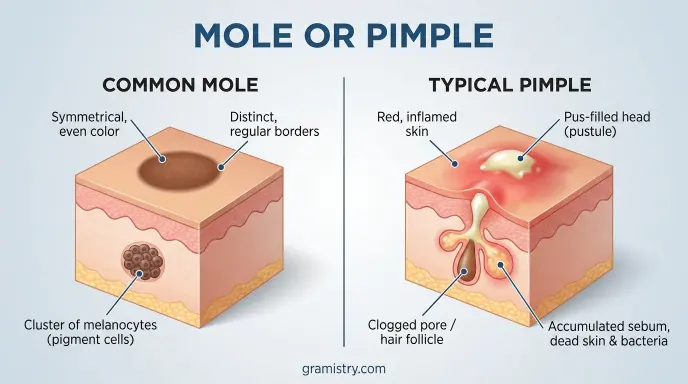
A pimple is usually related to a clogged or inflamed pore, while a mole is a collection of pigment-producing cells that forms a spot or growth on the skin.
Pimples often change or clear over time, whereas ordinary moles tend to remain relatively stable.
Although they look or sound similar, they serve completely different purposes.
In this guide, you’ll learn how to tell a mole from a pimple, what each one means, how they behave, common mistakes to avoid, and which changes deserve professional attention.
Quick answer: A pimple is usually a temporary acne blemish caused by a clogged and inflamed pore. A mole is a usually benign skin growth or spot formed by a collection of melanocytes, the cells that produce pigment. A changing, bleeding, itching, or unusual mole should be checked by a healthcare professional.
What Is a Mole?
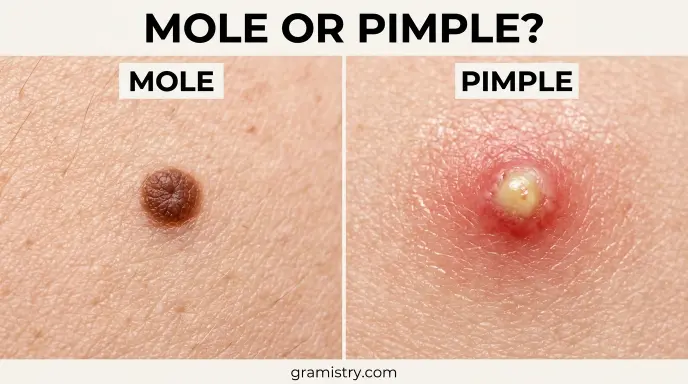
A mole is a common type of skin growth. Moles can be flat or raised and may be brown, black, pink, red, or close to your natural skin color. Many are harmless and remain unchanged for years.
Moles are medically called nevi (singular: nevus). They develop when melanocytes, the cells responsible for producing the skin pigment melanin, grow together in a localized area.
Moles can appear anywhere on the body. Some are present at birth, while others develop during childhood or adolescence. New moles can also appear later in life. The NHS notes that it is normal for new moles to develop, particularly during childhood and the teenage years, and some moles may fade as a person gets older.
What Does a Mole Look Like?
A typical mole may have:
- A round or oval shape
- A smooth, fairly regular border
- One relatively consistent color
- A flat or raised surface
- A stable appearance over time
Not every mole looks exactly the same. Some are very small and flat, while others are raised enough to feel when you touch them.
A mole can also have hair growing from it. The presence of hair by itself does not mean that a mole is dangerous.
Pronunciation and Grammar
The word mole is pronounced approximately “mohl.”
In everyday English, mole is a noun when it refers to a skin mark:
- “She has a small mole on her cheek.”
- “The doctor examined the mole.”
The word mole has other meanings in English, including a small burrowing animal and a unit of measurement in chemistry. Context tells you which meaning is intended.
Is “Mole” Used Differently in the US and UK?
There is no major US-versus-UK spelling difference for the skin-related word mole. The spelling is the same in American and British English.
Medical terminology can vary slightly between healthcare systems, but mole and nevus are widely understood.
Do Moles Usually Go Away?
Most ordinary moles do not suddenly disappear like pimples. Some can become lighter or fade with age, but a stable mole generally remains on the skin.
If a mole starts changing noticeably in size, shape, or color, it should not simply be assumed to be a normal part of the aging process. A healthcare professional can examine it properly.
When Can a Mole Be Concerning?
Most moles are harmless. However, a new or changing mole can sometimes be a warning sign of melanoma, a type of skin cancer.
Pay attention to the ABCDE pattern:
- A — Asymmetry: One half does not look like the other.
- B — Border: The edges are irregular, uneven, or poorly defined.
- C — Color: The mole contains several colors or develops an unusual color.
- D — Diameter: It becomes larger, although melanoma can sometimes be smaller than 6 mm.
- E — Evolving: The mole changes in size, shape, color, or appearance.
The “E” is particularly important because a changing mole deserves attention. Other warning signs can include itching, pain, bleeding, inflammation, or crusting.
Important: The ABCDE checklist is a useful warning guide, not a way to diagnose melanoma at home. If a mole looks unusual or is changing, a dermatologist or other qualified healthcare professional should evaluate it.
What Is a Pimple?
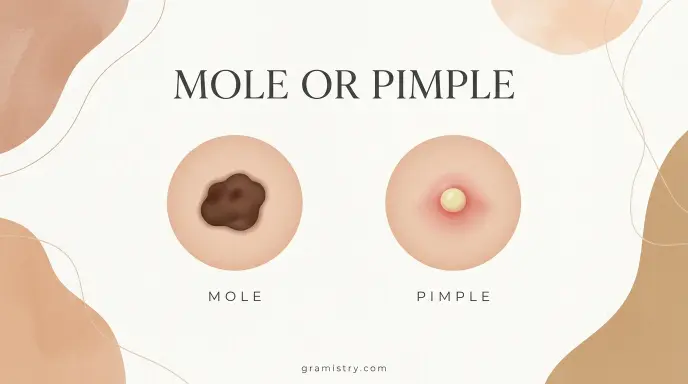
A pimple is an acne blemish that develops when a pore becomes clogged and inflamed.
Pores contain hair follicles and oil-producing glands. When excess oil, dead skin cells, and other material build up inside a pore, the pore can become blocked. Bacteria normally present on the skin can multiply in this environment, and inflammation can develop. The result may be a pimple.
Pimples are one of several types of acne lesions. Acne can also include blackheads, whiteheads, papules, pustules, nodules, and cysts.
What Does a Pimple Look Like?
A pimple may appear as:
- A small red bump
- A swollen or tender spot
- A white-tipped bump containing pus
- A flesh-colored or pink bump
- A deeper, painful lump in more severe acne
A pimple can change considerably over several days. It may become redder, develop a white head, flatten, or eventually disappear.
Grammar Role
Pimple is a noun.
Examples:
- “I have a pimple on my forehead.”
- “This pimple is painful.”
- “The dermatologist treated the pimple.”
Unlike mole, the word pimple specifically refers to a skin blemish rather than a biological cell growth.
Why Do Pimples Develop?
Several factors can contribute to acne, including:
- Excess oil production
- Dead skin cells blocking pores
- Bacteria inside clogged pores
- Inflammation
- Hormonal changes
- Certain skin and hair-care products
- Genetic factors
Adult acne can occur too. The American Academy of Dermatology notes that some adults develop acne for the first time, while others continue experiencing acne beyond their teenage years.
Hair and skin products can also contribute to breakouts. Oil-containing hair products, for example, can clog pores around the hairline and forehead in some people.
How Long Does a Pimple Last?
Unlike a mole, a pimple is generally temporary.
The exact duration varies depending on the type and severity of the acne lesion. Some minor pimples settle relatively quickly, while deeper nodules and cysts can take much longer.
If acne repeatedly returns, becomes painful, leaves scars, or does not improve with appropriate treatment, a dermatologist can help determine the best approach.
Mole or Pimple: Key Differences
The easiest way to distinguish them is to look at how the spot behaves over time, rather than relying on color alone.
Main differences
- Cause: A mole develops from a localized collection of melanocytes; a pimple develops from a clogged and inflamed pore.
- Duration: Moles can remain for years, while pimples are usually temporary.
- Texture: A mole may be flat or consistently raised. A pimple is often swollen or inflamed.
- Color: Moles can be brown, black, pink, red, or skin-colored. Pimples are commonly red, pink, flesh-colored, or white-tipped.
- Pus: A pimple may contain pus. A normal mole does not.
- Change: Pimples often change during their short life cycle. A mole that unexpectedly changes in size, shape, or color deserves attention.
- Treatment: Acne can often be treated with acne-specific products or medication. A mole generally does not need treatment unless it is bothersome, suspicious, or being removed for another reason.
- Popping: Squeezing a pimple can increase inflammation, infection risk, and scarring. A mole should never be treated like a pimple and squeezed at home.
Mole vs Pimple Comparison Table
| Feature | Mole | Pimple |
|---|---|---|
| Basic meaning | A skin growth or spot, often made up of clustered melanocytes | An acne blemish caused by a clogged and inflamed pore |
| Typical appearance | Flat or raised; may be brown, black, pink, red, or skin-colored | Often red, swollen, flesh-colored, or white-tipped |
| Usual duration | Can remain for years | Usually temporary |
| Pus | Not typical of an ordinary mole | May contain pus |
| Inflammation | Usually not inflamed | Commonly inflamed |
| Pain | Usually painless | Can be tender or painful |
| Changes over time | Usually relatively stable | Often changes as it develops and heals |
| Common location | Anywhere on the body | Often face, chest, shoulders, or back |
| Main concern | A changing mole may require medical evaluation | Persistent or severe acne may need treatment |
| Can you squeeze it? | No | Avoid squeezing; it can cause scarring or infection |
Real-Life Conversation Examples
Conversation 1: A New Red Bump
Sam: “I found a red bump on my cheek. I think it’s a mole.”
Alex: “Has it appeared recently and does it look inflamed?”
Sam: “Yes, and it hurts when I touch it.”
Alex: “That sounds more consistent with an inflamed pimple, but a healthcare professional would need to examine it to know for sure.”
🎯 Lesson: A recent, tender, inflamed bump may be an acne lesion, but appearance alone cannot provide a definite diagnosis.
Conversation 2: A Long-Standing Dark Spot
Mia: “I’ve had this small brown spot on my shoulder for years.”
Sara: “Has it recently changed?”
Mia: “No. It looks the same as it always has.”
🎯 Lesson: A stable spot that has remained unchanged for a long time may be a mole, although only a professional examination can confirm what a particular skin lesion is.
Conversation 3: A Spot That Is Changing
James: “My mole looks darker than it did a few months ago.”
Tom: “Have you noticed any other changes?”
James: “The shape seems different too.”
Tom: “You should have it checked rather than assuming it’s just a pimple.”
🎯 Lesson: A changing mole should be professionally evaluated, especially when changes involve size, shape, or color.
Conversation 4: The Temptation to Pop
Nina: “This bump looks like a pimple, so I’m going to squeeze it.”
Emma: “Be careful. Squeezing acne can make inflammation worse and increase the risk of scarring.”
🎯 Lesson: Avoid popping pimples whenever possible. Dermatologists warn that squeezing can cause infection, more noticeable acne, pain, and permanent scarring.
When to Use “Mole” vs “Pimple”
If you’re simply trying to choose the correct English word, use this easy rule:
Use “mole” when:
- You are talking about a persistent skin mark or growth.
- The spot may be flat or raised.
- It is often brown, black, pink, red, or skin-colored.
- It has remained on the skin for a long period.
- You are discussing a nevus in medical or everyday language.
Example:
“She has a small mole near her eye.”
Use “pimple” when:
- You are talking about an acne breakout.
- The spot is associated with a clogged or inflamed pore.
- It is red, swollen, tender, or white-tipped.
- It develops and changes over a relatively short period.
Example:
“I woke up with a pimple on my chin.”
Easy Memory Trick
Think:
Mole = a lasting mark.
Pimple = a temporary breakout.
This is not a diagnostic rule, but it is a useful language shortcut.
US vs UK Usage
There is no major spelling difference between American and British English for these words.
Both varieties use:
- mole
- pimple
For example:
US English: “I have a pimple on my forehead.”
UK English: “I have a pimple on my forehead.”
Likewise:
US English: “The doctor checked my mole.”
UK English: “The doctor checked my mole.”
The important distinction is therefore not regional spelling. It is the meaning of the two words.
Formal, Informal, and Academic Writing
Informal writing
In everyday conversation, mole and pimple are both natural words.
“I have a pimple on my nose.”
“That mole has been there since I was a child.”
Formal writing
In healthcare contexts, you may see more precise terms such as nevus, acne lesion, papule, or pustule, depending on what is being described.
Academic writing
Academic or medical writing should use the most precise terminology appropriate to the subject. A writer should not call every skin bump a “pimple” simply because it is small or raised.
Common Mistakes People Make
Mistake 1: Calling every dark spot a mole
Wrong assumption:
“That spot is dark, so it must be a mole.”
Why it is incorrect:
Color alone does not determine whether a skin lesion is a mole, pimple, or something else.
Better approach:
Consider the spot’s history, shape, texture, and changes over time.
Mistake 2: Calling every raised bump a pimple
Wrong assumption:
“It is raised, so I’ll pop it.”
Why it is incorrect:
Many skin growths can be raised. A mole should not be squeezed like acne.
Better approach:
If you are uncertain what a persistent bump is, have it assessed rather than trying to remove it yourself.
Mistake 3: Assuming a painful spot must be a pimple
Wrong assumption:
“It hurts, so it cannot be a mole.”
Why it is incorrect:
Pain or tenderness is not enough to identify a skin lesion.
Better approach:
A painful, itchy, bleeding, crusty, inflamed, or changing mole should be professionally evaluated.
Mistake 4: Trying to remove a mole at home
Wrong assumption:
“I can treat this mole with an acne product or remove it myself.”
Why it is incorrect:
Moles and acne require different approaches. Attempting to remove a mole yourself can injure the skin and may delay appropriate medical evaluation.
Better approach:
A dermatologist can assess the mole and, when appropriate, remove it safely.
Mistake 5: Popping every pimple
Wrong assumption:
“Squeezing it will make it disappear faster.”
Why it is incorrect:
Popping can push material deeper into the skin and increase inflammation, infection risk, and scarring.
How Are Moles and Pimples Treated?
Treatment depends on what the skin lesion actually is.
Treating pimples
Mild acne may respond to appropriate over-the-counter acne products. Commonly used ingredients include benzoyl peroxide, salicylic acid, adapalene, and azelaic acid, depending on the type of acne and individual circumstances. The American Academy of Dermatology’s acne guidance supports several topical treatments for acne, including benzoyl peroxide and topical retinoids.
Treatment takes time. Dermatologists generally advise giving an acne treatment several weeks to work rather than constantly changing products.
Treating moles
Most ordinary moles do not need treatment. If a mole is bothersome, suspicious, or being removed for cosmetic reasons, a dermatologist can determine whether removal is appropriate.
A suspicious mole may require further examination or testing.
When Should You See a Doctor?
You should consider professional medical evaluation if you notice a mole that:
- Changes size
- Changes shape
- Changes color
- Develops multiple unusual colors
- Has an irregular border
- Becomes painful or itchy
- Bleeds
- Becomes crusty
- Looks noticeably different from your other moles
- Is a new or unusual mark that does not go away
The NHS specifically recommends seeking medical advice for a mole that changes in size, shape, or color, as well as one that becomes painful, itchy, inflamed, bleeding, or crusty.
A persistent or unusual skin mark should not automatically be labeled a pimple simply because it resembles one.
Fun Facts and History
1. “Mole” has several meanings
The English word mole does not only describe a skin mark. It can also refer to a small burrowing mammal and, in chemistry, a unit used to measure the amount of a substance.
2. Moles can appear at different stages of life
Some people are born with moles, while others develop them during childhood and adolescence. New moles can also appear later.
3. Pimples are part of acne
A pimple is not the same thing as acne as a whole. Acne is the skin condition, while pimples are one of the types of lesions that acne can produce.
4. Blackheads are not dirt
A blackhead may look like dirt, but the dark color results from a chemical reaction involving material in an open pore and oxygen. Scrubbing aggressively does not solve the underlying problem and may irritate the skin.
FAQs:
1. How can I tell if a bump is a mole or a pimple?
A pimple is usually related to a clogged, inflamed pore and may be red, swollen, tender, or filled with pus. A mole is usually a stable skin mark that can be flat or raised and may be brown, black, pink, red, or skin-colored. However, appearance alone cannot reliably diagnose every skin lesion.
2. Can a mole look like a pimple?
Yes. Some moles are raised and can resemble small pimples, especially when viewed quickly. However, a mole usually does not behave like an ordinary acne lesion. If a bump remains for a long time, keeps changing, bleeds, itches, or otherwise looks unusual, do not assume it is acne. Have it evaluated by a qualified healthcare professional.
3. Can a pimple turn into a mole?
A normal pimple does not simply transform into a mole. Pimples and moles develop through different biological processes. A pimple is an acne lesion associated with a clogged and inflamed pore, while a mole is a localized collection of melanocytes. If a spot persists after you expect a pimple to disappear, it is worth having it assessed.
4. Should I pop a mole if it looks like a pimple?
No. You should not squeeze or attempt to remove a mole at home. A mole is not an ordinary acne blemish, and manipulating it can injure the skin. If you are unsure whether a raised spot is a pimple, mole, or another type of lesion, a dermatologist can examine it and recommend the appropriate next step.
5. Can a mole have a white head like a pimple?
A typical mole does not develop a pus-filled whitehead in the same way an acne pimple does. A raised skin lesion can sometimes be difficult to identify by appearance alone, though. If a spot has developed new swelling, drainage, bleeding, crusting, or other changes, professional evaluation is safer than trying to squeeze it.
6. What does a suspicious mole look like?
A suspicious mole may have asymmetry, an irregular border, multiple colors, or noticeable changes in size, shape, or color. It may also become itchy, painful, inflamed, crusty, or bleed. These signs do not automatically mean cancer, but they are reasons to seek medical evaluation rather than trying to diagnose the spot yourself.
7. Do pimples disappear faster than moles?
Usually, yes. Pimples are generally temporary acne lesions and often change as they heal. Moles can remain on the skin for many years. Some moles may fade with age, but a persistent mole should not be expected to disappear like an ordinary pimple. A changing or unusual mole should be assessed by a healthcare professional.
8. Is a black spot more likely to be a mole or pimple?
A black or dark spot could have several possible explanations, so color alone is not enough to identify it. Moles can be brown or black, while acne can also leave dark marks after inflammation. If the spot is new, changing, irregular, bleeding, or otherwise unusual, seek professional advice instead of relying on color alone.
9. When should I see a dermatologist about a mole?
Consider seeing a dermatologist when a mole changes in size, shape, or color, develops irregular edges or multiple colors, or becomes itchy, painful, crusty, inflamed, or bloody. A new unusual mark that does not disappear after several weeks can also warrant assessment. Early evaluation is important when a lesion has potentially concerning changes.
10. What is the easiest way to remember mole vs pimple?
Use the simple memory aid: mole = usually a lasting skin mark; pimple = usually a temporary acne breakout. A pimple commonly develops from a clogged and inflamed pore, while a mole is a localized collection of pigment-producing cells. This shortcut helps with everyday language, but it should not be used to diagnose an unfamiliar skin lesion.
Conclusion:
Understanding mole or pimple becomes much easier when you focus on what the spot is and how it behaves.
A pimple is an acne lesion that usually develops from a clogged and inflamed pore, while a mole is a usually benign skin growth or mark that can remain stable for years.
The two can sometimes look alike, so avoid squeezing or treating an unfamiliar spot based only on appearance.
Most moles are harmless, but a mole that changes in size, shape, or color or becomes itchy, painful, crusty, or bloody should be professionally checked.
Next time someone uses these two words, you’ll know exactly what they mean!

Alina Mark is the creative voice behind Gramistry.com, making word meanings, English expressions, and trending slang simple, clear, and interesting. Her mission is to make every word easier to understand, one meaning at a time.
2 thoughts on “Mole vs Pimple: Key Differences, Causes, and How to Tell Them Apart”