
When people encounter the terms kink and fetish, they often assume they mean the same thing.
That is understandable because the two words can overlap in everyday conversations about sexuality, and people sometimes use them interchangeably.
However, they are not exact synonyms.
Although they look or sound similar, they serve completely different purposes.
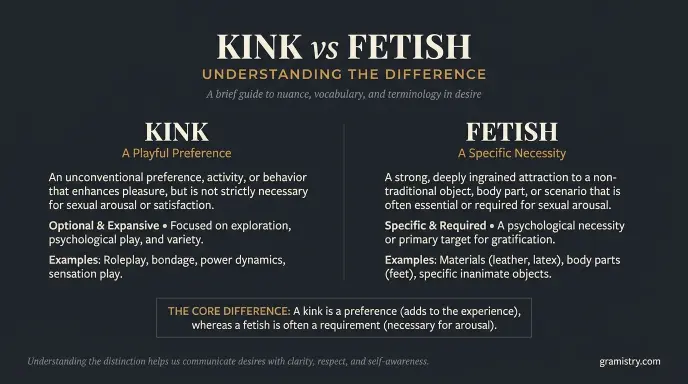
In simple terms, kink is a broad term for sexual interests, preferences, or activities that fall outside what a person considers conventional.
A fetish is generally more specific and involves a strong sexual focus on a particular object, material, body part, or other specific stimulus.
This guide explains the difference between kink or fetish in clear language.
You will learn what each word means, how the terms developed, how they overlap, common mistakes, and when each term is appropriate.
The goal is to understand the vocabulary accurately without treating every unusual sexual interest as a medical problem.
What Is “Kink”?

Kink meaning and definition
Kink is a broad, informal term for an unconventional sexual interest, preference, fantasy, or practice. Merriam-Webster defines the sexual sense of kink as an “unconventional sexual taste or behavior.”
The important word here is broad.
Kink can describe an interest in a particular activity, role, dynamic, fantasy, sensation, or form of sexual expression. It is an umbrella term rather than the name of one specific type of interest.
Planned Parenthood similarly uses kink/kinky as a broad category that can include BDSM, sexual fetishes, fantasies, role-playing, and other sexual interests or activities.
Pronunciation
Kink is pronounced:
/kɪŋk/
It sounds like “kink,” with a short i sound, similar to the vowel sound in think.
Grammar and word forms
Kink can function as a noun:
- “They discussed whether the preference was a kink.”
- “The term kink can cover many different interests.”
The adjective kinky is also common:
- “The article discusses kinky preferences.”
- “The couple described their relationship as sexually adventurous.”
The word kink also has completely unrelated meanings. For example, it can describe a twist in a rope, hose, or similar material. Merriam-Webster traces the word to Dutch and records its first known use as a noun in 1663.
Where is “kink” used?
The sexual meaning of kink is common in modern informal English, particularly in discussions of relationships, sexuality, online communities, and popular culture.
Unlike words tied to a particular national spelling system, kink is spelled the same in American and British English.
There is therefore no meaningful US-versus-UK spelling difference such as the one found with words like color/colour or license/licence.
What can “kink” refer to?
The term can be used broadly for interests involving things such as:
- Particular relationship dynamics
- Role-play or fantasy
- BDSM-related interests
- Specific sensations or forms of stimulation
- Unconventional scenarios
- Particular preferences or rituals
These examples illustrate the breadth of the word rather than providing a complete definition.
A person may describe something as a kink without suggesting that it is necessary for sexual satisfaction.
Common mistake with “kink”
One common mistake is assuming that every kink is a fetish.
That is not necessarily true.
A kink can involve an activity, dynamic, fantasy, or preference without being centered on one particular object or body part.
Quick tip: Think of kink as the larger category.
What Is “Fetish”?
Fetish meaning and definition
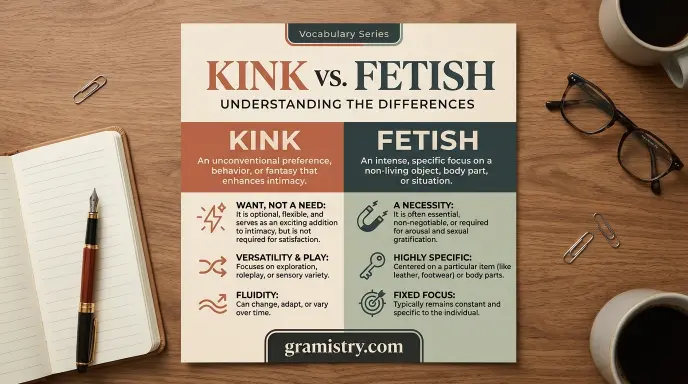
A fetish is a more specific term. In its sexual sense, it generally refers to a strong sexual focus on a particular object, material, body part, or other specific stimulus.
Merriam-Webster’s current dictionary entry describes the sexual sense as an object or bodily part whose real or imagined presence is associated with sexual gratification and fixation.
In everyday language, however, people often use fetish more loosely to mean a strong or unusual sexual preference.
That distinction matters because ordinary usage and clinical terminology are not always identical.
Pronunciation
Fetish is commonly pronounced:
/ˈfetɪʃ/
It sounds approximately like “FEH-tish.”
A second pronunciation, “FEE-tish,” is also recognized by dictionaries.
Grammar role
Fetish is primarily a noun.
Examples include:
- “The writer explained the difference between a fetish and a broader kink.”
- “A fetish can involve a particular object or body part.”
Related words include:
- Fetishism
- Fetishistic
- Fetishize
The word fetishize can also be used outside sexuality, meaning to treat something as an object of excessive or obsessive attention.
Historical origin of “fetish”
The history of fetish is especially interesting.
Merriam-Webster traces the English word through French and Portuguese, ultimately to Latin facticius. The word entered English in the early 17th century, originally referring to an object believed to possess supernatural or protective powers.
Its meaning changed over time.
By the 19th century, fetish had developed the broader sense of an object receiving irrational devotion or excessive reverence. Its sexual meaning emerged later, becoming established in the early 20th century.
So the modern sexual meaning is only one part of a much older word history.
Is a fetish automatically a mental disorder?
No.
This is one of the most important distinctions to understand.
The American Psychiatric Association explains that unusual or atypical sexual interests should not automatically be treated as mental disorders. Under the DSM framework, a paraphilic disorder involves additional clinical concerns such as significant personal distress or impairment, or sexual interests involving another person’s psychological or physical harm, or unwilling people.
The DSM-5-TR is the current text-revised edition of the Diagnostic and Statistical Manual of Mental Disorders. The APA notes that its diagnostic criteria are intended for trained professionals rather than for people to diagnose themselves.
Therefore, calling an interest a fetish does not automatically mean someone has a psychiatric disorder.
Key Differences Between Kink and Fetish
The easiest way to remember the difference is:
Kink = broad category.
Fetish = more specific focus.
Here are the main differences:
- Meaning: Kink is a broad term for unconventional sexual interests or preferences; fetish is generally more narrowly focused.
- Scope: Kink can include activities, dynamics, fantasies, or preferences.
- Focus: A fetish often centers on a particular object, material, body part, or stimulus.
- Usage: Kink is usually an informal, everyday term.
- Clinical language: Fetish has a more specific history in psychological and psychiatric terminology.
- Overlap: A fetish can also be described as a kink, but not every kink is a fetish.
- Diagnosis: Neither word automatically means that someone has a mental disorder.
- Context: Both words can be used differently in casual conversation, academic writing, and clinical discussions.
Kink vs Fetish: Comparison Table
| Feature | Kink | Fetish |
|---|---|---|
| Basic meaning | Broad unconventional sexual interest | More specific sexual fixation or focus |
| Scope | Wide | Narrower |
| May involve activities? | Yes | Sometimes, but the defining focus is more specific |
| May involve objects? | Yes | Often |
| May involve body parts? | Yes | Often |
| Is it automatically a disorder? | No | No |
| Common in casual language? | Yes | Yes |
| Clinical relevance | General informal term | Has a specific psychiatric history |
| Can the terms overlap? | Yes | Yes |
| Best memory trick | Think “umbrella” | Think “specific focus” |
Real-Life Conversation Examples
Conversation 1: Confusing the two terms
Alex: “Is a fetish just another word for kink?”
Sam: “Not exactly. A fetish is usually more specific, while kink is a broader term.”
Alex: “So a fetish can be a type of kink?”
Sam: “Yes, depending on how the terms are being used.”
🎯 Lesson: A fetish may fall under the broad umbrella of kink, but kink is not limited to fetishes.
Conversation 2: Talking about an activity
Maya: “I read that kink can include different relationship dynamics.”
Jordan: “Right. That is one reason kink is broader than fetish.”
Maya: “So the word doesn’t necessarily mean an object is involved?”
Jordan: “Correct.”
🎯 Lesson: Kink does not require a particular object or body part.
Conversation 3: Talking about terminology
Chris: “Does having a fetish mean someone has a psychological disorder?”
Taylor: “No. An interest alone does not establish a psychiatric diagnosis.”
Chris: “So context matters?”
Taylor: “Exactly. Clinical diagnosis depends on specific criteria, not simply on whether an interest is unusual.”
🎯 Lesson: A sexual interest should not automatically be confused with a mental disorder.
Conversation 4: Choosing the right word
Nina: “Which word should I use in a general article: kink or fetish?”
Omar: “If you’re discussing unconventional sexual interests generally, kink is broader. Use fetish when the specific focus is relevant.”
🎯 Lesson: Choose the word according to how broad or specific the subject is.
When to Use “Kink” vs “Fetish”
Use “kink” when the meaning is broad
Use kink when you’re talking generally about unconventional sexual preferences, activities, fantasies, or dynamics.
For example:
“The article explains how people use the word kink in modern conversations about sexuality.”
Here, the topic is broad, so kink is appropriate.
Use “fetish” when the focus is specific
Use fetish when you are specifically discussing a strong sexual interest involving a particular object, material, body part, or other narrowly defined stimulus.
For example:
“The researcher distinguished between a general kink and a specific fetish.”
The word fetish works because the sentence focuses on a narrower type of interest.
Easy memory trick
Remember:
Kink = category
Fetish = focus
Or think of it this way:
Every fetish may be discussed as a kink, but not every kink is a fetish.
This is a useful rule for everyday English, although real-world usage is not perfectly rigid.
US vs UK English
There is no major American-versus-British spelling difference between kink and fetish.
Both forms are spelled the same:
- American English: kink / fetish
- British English: kink / fetish
The bigger difference is contextual rather than regional. Informal discussions may use these words more loosely, while academic or clinical writing requires greater precision.
Formal and academic writing
In formal writing, avoid assuming that the words are interchangeable.
If the subject is a broad range of unconventional sexual interests, kink may be the more suitable general term.
If you are discussing a specific object- or body-part-focused sexual interest, fetish may be more precise.
If the article concerns mental health or diagnosis, use established clinical terminology and rely on professional diagnostic sources rather than treating everyday labels as diagnoses.
Common Mistakes People Make
Mistake 1: “Kink and fetish always mean exactly the same thing.”
Why it is incorrect:
The terms overlap, but kink is generally broader, while fetish usually refers to a more specific focus.
Better:
“A fetish can be considered a type of kink in some everyday contexts.”
Mistake 2: “Everyone with a fetish has a disorder.”
Why it is incorrect:
The presence of an unusual sexual interest alone does not establish a psychiatric disorder. The APA specifically distinguishes atypical sexual interests from paraphilic disorders.
Better:
“An interest becomes a clinical concern only when relevant diagnostic criteria are met.”
Mistake 3: Using “fetish” for every unusual preference
Why it is incorrect:
Not every unconventional preference centers on an object, material, body part, or similarly specific stimulus.
Better:
Use kink when you mean the broader category.
Mistake 4: Treating dictionary meaning and clinical terminology as identical
Why it is incorrect:
Words can have everyday meanings that differ from technical medical terminology.
Better:
Check the context before choosing the term.
Mistake 5: Assuming the words have different US and UK spellings
Why it is incorrect:
Both kink and fetish retain the same spelling in American and British English.
Better:
Focus on meaning and context rather than regional spelling.
Fun Facts and History
1. “Kink” is much older than its modern sexual meaning
The word kink has roots connected to Dutch and Middle Low German. Merriam-Webster records the noun’s first known use in 1663. Its sexual sense is only one of several meanings the word has acquired.
2. “Fetish” originally had a very different meaning
The word fetish originally referred to an object believed to have supernatural or protective power. Its sexual meaning developed much later.
3. “Fetish” is used outside sexuality
Someone can have a “fetish for” something in the figurative sense of having an excessive fixation or devotion to it. The word therefore cannot always be assumed to have a sexual meaning.
4. Modern language is more nuanced than older terminology
Contemporary clinical terminology distinguishes unusual sexual interests from disorders that involve clinically significant distress, impairment, or harm. This distinction helps avoid automatically pathologizing consensual adult behavior.
FAQs:
1. Is kink the same as fetish?
No. Kink is generally the broader term, covering a wide range of unconventional sexual interests, preferences, activities, fantasies, and dynamics. A fetish is usually more specific and involves a strong sexual focus on a particular object, material, body part, or stimulus. In casual conversation, however, people sometimes use the two terms interchangeably.
2. Can a fetish be a kink?
Yes. In everyday usage, a fetish can be described as a type of kink because kink is a broad umbrella term. However, not every kink is a fetish. A kink can involve a preference, activity, fantasy, or relationship dynamic without being centered on a particular object or body part.
3. Does having a kink mean something is wrong with you?
No. The word kink describes an interest or preference; it does not by itself diagnose a psychological condition. Clinical assessment is based on specific factors such as distress, impairment, or harm. The American Psychiatric Association specifically distinguishes atypical sexual interests from paraphilic disorders.
4. Is having a fetish a mental disorder?
Not automatically. A fetish or unusual sexual interest alone does not establish a mental disorder. Clinical terminology is more specific and considers factors such as significant distress, impairment, or harm to others. Diagnosis should be made by a qualified professional using established criteria rather than by simply applying a label.
5. Which word is more general: kink or fetish?
Kink is generally more general. It can refer to many unconventional sexual interests, including activities, fantasies, dynamics, and preferences. Fetish is typically narrower because it points toward a particular focus or fixation. When you are discussing the subject broadly, kink is usually the safer general term.
6. Are kink and fetish formal medical terms?
Not in the same way. Kink is primarily an informal everyday term. Fetish has a longer history in psychological and psychiatric terminology, but everyday use does not necessarily match clinical definitions. The DSM-5-TR uses specific diagnostic categories and criteria rather than treating every fetish or unusual sexual interest as a disorder.
7. Do kink and fetish have different spellings in American and British English?
No. Both words are normally spelled kink and fetish in American and British English. Unlike some English vocabulary differences, there is no standard US-versus-UK spelling distinction for these terms.
8. Can someone have both a kink and a fetish?
Yes. Because kink is a broad term, a person can describe a particular fetish as one of their kinks. The labels can overlap. The important distinction is that fetish generally identifies a more specific focus, whereas kink can describe a much wider range of preferences.
9. Why do people confuse kink and fetish?
People confuse them because both words can describe sexual interests outside conventional expectations, and everyday speakers do not always use technical definitions. Popular media also frequently treats them as synonyms. The simplest distinction is to remember that kink is broad, while fetish is usually more specific.
10. What is the easiest way to remember the difference?
Use this simple memory trick: “Kink is the umbrella; fetish is a specific focus.” If you’re talking about unconventional sexual interests generally, kink may be appropriate. If you’re specifically discussing a strong sexual focus on an object, body part, material, or similar stimulus, fetish is usually more precise.
Conclusion:
The difference between kink or fetish is mainly a difference in scope. Kink is a broad, informal term for unconventional sexual interests, preferences, activities, fantasies, or dynamics.
Fetish is generally more specific, referring to a strong sexual focus on a particular object, material, body part, or other stimulus.
The terms can overlap, but they are not perfect synonyms.
Most importantly, neither word automatically indicates a mental disorder.
Understanding the context helps you choose the right term and avoid unnecessary assumptions.
For clear language explanations like this, Gramistry can serve as a useful educational language resource.
Next time someone uses these two words, you’ll know exactly what they mean!

Alina Mark is the creative voice behind Gramistry.com, making word meanings, English expressions, and trending slang simple, clear, and interesting. Her mission is to make every word easier to understand, one meaning at a time.