
If you have ever written about a committee, meeting, conference, or organization, you may have wondered whether the correct word is convenor or convener.
The two spellings are close enough to cause confusion, especially because both refer to a person who brings people together for an official meeting or group activity.
Although they look or sound similar, they serve completely different purposes.
However, there is an important correction: unlike many confusing word pairs, convenor and convener do not have completely different meanings.
They are generally spelling variants of the same noun. The main difference is often one of regional preference, institutional style, or historical usage.
In this guide, we will explain what convenor and convener mean,
where each spelling is commonly found, how they are pronounced, which form you should choose, and how to use them correctly in formal, academic, workplace, and everyday writing.
What Is “Convenor”?
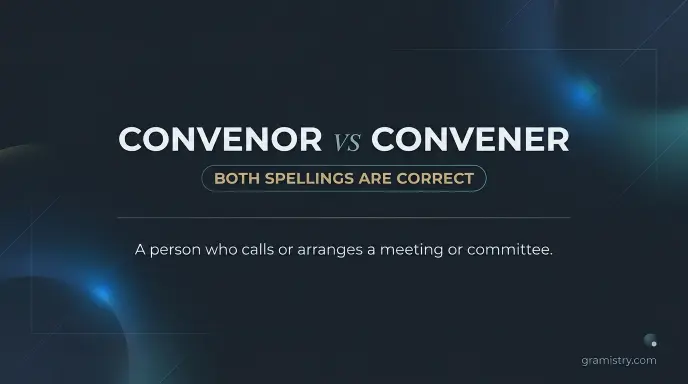
Convenor is a noun for a person who calls, organizes, or chairs a meeting, committee, panel, working group, or other organized gathering.
Cambridge Dictionary lists convenor as a noun and gives convener as an alternative spelling. It also notes uses in which a convenor arranges meetings for an official group and, in British trade-union contexts, refers to a relatively senior union official working in a particular workplace.
Quick Definition
Convenor: A person who organizes, calls, or leads a meeting, committee, or organized group.
For example:
- The convenor called an emergency meeting.
- She was appointed convenor of the university committee.
- The committee convenor welcomed the new members.
- He served as convenor of the working group.
Grammar Role
Convenor is a countable noun.
You can use it with articles and plural forms:
- a convenor
- the convenor
- several convenors
- committee convenor
- conference convenor
The plural is normally convenors.
How Is “Convenor” Pronounced?
In British English, it is commonly pronounced approximately:
kuh-VEEN-uh
Cambridge gives the pronunciation as /kənˈviː.nər/ for the UK form and /kənˈviː.nɚ/ for the US pronunciation.
The important part is the “veen” sound in the middle, which comes from the verb convene.
How Is “Convenor” Used?
The word is especially useful when someone has an official responsibility for bringing a group together.
Common contexts include:
- committees
- conferences
- academic groups
- professional organizations
- working groups
- political organizations
- trade unions
- boards
- panels
- community organizations
For example:
The convenor of the committee scheduled a meeting for Friday.
Here, convenor identifies the person responsible for bringing the committee together.
British and Commonwealth Usage
Convenor is particularly familiar in British English and related varieties of English. It is also widely encountered in formal institutional contexts in countries and organizations influenced by British English.
Cambridge labels the dictionary entry UK and gives examples involving workplace trade unions and official groups.
This does not mean that convenor is restricted to Britain. It can appear in other varieties of English when an organization or institution prefers that spelling.
A Note on the Word’s Origin
Convenor is formed from the verb convene, meaning to bring people together for a meeting or to meet formally. The verb ultimately comes from Latin convenire, meaning roughly “to come together” or “to assemble.”
The same root gives us words such as:
- convene
- convention
- convenient
- convening
The connection is easy to see: all of these words are historically related to the idea of people or things coming together.
Common Mistake With “Convenor”
A common mistake is assuming that convenor means only “chairperson.”
That is not always true.
A chairperson generally presides over a meeting or organization, while a convenor emphasizes the responsibility of bringing people together or organizing a meeting or group. In some organizations, one person may perform both roles.
So, depending on the organization’s rules, a convenor may organize meetings without necessarily being the permanent chair.
What Is “Convener”?

Convener is another spelling of the same basic word. It refers to someone who convenes a meeting, committee, group, or other organized gathering.
Quick Definition
Convener: A person who brings people together for a meeting or organized purpose.
For example:
- The convener announced the meeting date.
- She became the convener of the review panel.
- The convener invited experts to join the discussion.
- He served as convener for the annual conference.
Cambridge explicitly lists convener as an alternative to convenor, confirming that the two forms can refer to the same role.
Grammar Role
Like convenor, convener is a countable noun.
Examples include:
- a convener
- the convener
- committee convener
- conference convener
- several conveners
Its plural form is conveners.
Where Is “Convener” Used?
Convener appears in formal English in several varieties, including American English and British English.
The exact preference depends on the organization, publication, country, and house style.
For example, an American organization may naturally choose:
The convener of the committee opened the session.
A British organization may instead write:
The convenor of the committee opened the session.
Neither sentence is automatically grammatically wrong.
Why Does It Have an “-er” Ending?
The spelling convener follows a familiar English word-building pattern.
The verb is convene.
A person who performs an action can often be described with an -er ending:
- teach → teacher
- manage → manager
- organize → organizer
- convene → convener
The spelling convenor uses the -or ending instead.
Both formations are established in English.
Is “Convener” More Correct Than “Convenor”?
No.
There is no general rule saying that convener is always correct and convenor is always wrong, or vice versa.
Dictionary evidence supports treating them as alternative forms. Cambridge’s entry for convenor explicitly gives “also convener.”
The best choice is usually determined by:
- regional English
- organizational preference
- publication style
- consistency within a document
Key Differences Between Convenor and Convener
The most important point is simple:
Convenor and convener usually have the same meaning.
They are not a typical pair such as advice and advise, where one is a noun and the other is a verb.
Main differences
- Meaning: Both generally refer to a person who brings people together or organizes an official meeting or group.
- Grammar: Both are countable nouns.
- Function: Both can describe someone responsible for convening a committee, meeting, panel, or working group.
- Spelling: Convenor uses -or, while convener uses -er.
- Regional preference: Convenor is especially familiar in British usage and institutional contexts; convener is also established and may be preferred by particular organizations or varieties of English.
- Context: The preferred spelling can depend on an organization’s official title or style guide.
- Meaningful distinction: In ordinary usage, there is usually no major difference in meaning.
Convenor vs Convener: Comparison Table
| Feature | Convenor | Convener |
|---|---|---|
| Part of speech | Noun | Noun |
| Basic meaning | Person who convenes a group or meeting | Person who convenes a group or meeting |
| Spelling | -or | -er |
| Pronunciation | Essentially the same | Essentially the same |
| British English | Common | Also used |
| American English | Used, but less typical in many contexts | Commonly understandable and established |
| Formal writing | Appropriate | Appropriate |
| Academic writing | Appropriate | Appropriate |
| Committee context | Very common | Very common |
| Trade-union context | Especially established in British usage | Also possible |
| Plural | convenors | conveners |
| Main distinction | Spelling/style preference | Spelling/style preference |
Real-Life Conversation Examples
Dialogue 1: Choosing a Committee Title
Sara: Should we call her the committee convenor?
Ali: I thought it was convener.
Sara: Both spellings are used.
Ali: So which one should we put on the website?
Sara: Let’s check the organization’s official style and use that consistently.
🎯 Lesson: When both forms are accepted, follow the organization’s preferred spelling.
Dialogue 2: Academic Writing
Student: Is “convener of the research panel” grammatically correct?
Professor: Yes.
Student: Would “convenor” be wrong?
Professor: No. Both forms are established. Choose the form preferred by your institution or style guide.
🎯 Lesson: Neither spelling is automatically incorrect.
Dialogue 3: A Meeting
Manager: Who is responsible for bringing the panel together?
Nadia: The panel convener.
Manager: And what does the convener do?
Nadia: They organize or call the meetings and may have other responsibilities defined by the panel.
🎯 Lesson: A convener is someone who convenes a group; the exact responsibilities depend on the organization.
Dialogue 4: British Usage
James: The university appointed a new convenor for the committee.
Tom: Is that the same as a convener?
James: Usually, yes. Convenor is a common spelling in British institutional contexts.
🎯 Lesson: Regional and institutional spelling preferences can explain why you see convenor instead of convener.
When to Use Convenor vs Convener
There is no complicated grammar rule to memorize. The key is consistency and context.
Use “Convenor” When:
Choose convenor when:
- your organization officially uses that spelling;
- you are following British or Commonwealth institutional usage;
- the title appears in an organization’s official documents;
- the surrounding material consistently uses convenor;
- you are writing for an audience familiar with that form.
Example:
Dr. Ahmed was appointed convenor of the academic committee.
Use “Convener” When:
Choose convener when:
- your organization’s official title uses convener;
- your publication’s style guide prefers it;
- you are writing in a context where convener is the established form;
- consistency with existing American English terminology matters.
Example:
The convener invited all members to attend the meeting.
Easy Memory Trick
Think of the verb first:
convene → person who convenes → convenor / convener
Both forms point back to the same verb.
Another useful trick is:
“They convene, so they can be a convenor or convener.”
The spelling changes, but the core meaning does not.
US vs UK Usage
One of the biggest reasons people search for “convenor or convener” is regional English.
British English frequently uses convenor, particularly for formal organizational and workplace roles. Cambridge’s dictionary entry labels convenor as a UK term and provides examples involving official groups and trade unions.
Convener is also an established English form and can be found across different varieties of English.
However, it is better not to treat the distinction as an absolute “UK versus US” rule.
English usage is more flexible than that.
A university in one country may officially use convenor, while another organization in the same country may use convener.
Best Rule
If an organization has an official job title, copy its spelling.
For example, if the official title is:
Committee Convenor
do not change it to:
Committee Convener
just because you prefer the second spelling.
Official titles should normally be reproduced accurately.
Formal, Informal, and Academic Writing
Formal Writing
Both forms can work in formal writing.
Example:
The convenor requested that all members submit their reports before Friday.
Or:
The convener requested that all members submit their reports before Friday.
The important factor is consistency.
Academic Writing
Both forms can appear in academic contexts, particularly when describing committees, panels, conferences, and university organizations.
If you are referring to a named university position, use the institution’s official spelling.
Informal Writing
In casual communication, you may simply say:
She organizes the meetings.
This can be clearer than using a formal title when the title itself is not important.
Common Mistakes People Make
Mistake 1: Treating Them as Opposites
Wrong idea:
A convenor organizes meetings, while a convener chairs them.
Why it is misleading:
There is no general rule that assigns these two meanings to the two spellings. Both words can refer to someone who convenes a group.
Better:
A convenor or convener is a person who brings together or organizes a group or meeting.
Mistake 2: Saying “Convenor” Is Wrong
Incorrect claim:
“Convener is the only correct spelling.”
Why it is wrong:
Established dictionaries recognize convenor as a word and identify convener as an alternative.
Better:
Both convenor and convener are accepted forms; choose according to context and style.
Mistake 3: Switching Spellings in One Document
For example:
The committee convenor announced the meeting. Later, the committee convener asked for questions.
If both references mean the same official role, switching spellings without a reason can look careless.
Better:
The committee convenor announced the meeting. Later, the convenor asked for questions.
Consistency makes professional writing cleaner.
Mistake 4: Confusing the Noun With “Convene”
Remember:
- convene = verb
- convenor = noun
- convener = noun
Examples:
The chair will convene the meeting.
The convenor will organize the meeting.
The convener will organize the meeting.
The first sentence describes an action. The other two identify a person.
What Is the Difference Between “Convene” and “Convenor”?
This distinction is much more important than the difference between convenor and convener.
Convene is a verb. It means to bring people together for a meeting or to meet formally. Cambridge defines it as bringing together a group for a meeting or meeting as a group.
Convenor and convener are nouns referring to a person associated with that action.
Compare:
The director will convene the committee.
The director is the committee’s convenor.
The director is the committee’s convener.
This three-way distinction is useful for avoiding grammar mistakes.
Fun Facts and History
1. Both Forms Come From “Convene”
The two nouns are connected to convene, which carries the idea of coming together or bringing people together. Cambridge defines convene as formally bringing a group together or meeting as a group.
2. “Convenor” Has Strong Institutional Associations
The spelling convenor is especially visible in British institutional and workplace language. Cambridge’s examples include committee and trade-union contexts.
3. The Words Are Not a Meaning-Based Pair
Many English learners assume that different spellings must indicate different meanings. Here, that assumption does not work. Convenor and convener are primarily spelling variants.
4. Organizations Can Set Their Own Preference
A university, committee, conference, or professional organization may formally choose one spelling as part of its title. When that happens, the organization’s version should normally be retained.
FAQs:
Is “convenor” or “convener” correct?
Both are correct. Convenor and convener are established nouns for a person who brings people together or organizes a meeting, committee, or group. Cambridge lists convener as an alternative form of convenor. The best choice depends on regional usage, organizational preference, and the style guide you are following.
What is the difference between convenor and convener?
In most contexts, there is no significant difference in meaning. Both words describe a person who convenes or organizes a meeting, committee, panel, or group. The main difference is spelling: convenor ends in -or, while convener ends in -er. Usage can vary by country and organization.
Is convenor British or American?
Convenor is especially common in British English and British-influenced institutional usage. However, it is not exclusively British. It can appear in other forms of English as well. The safest approach is to check the terminology used by the organization or publication you are writing for rather than assuming that geography alone determines the correct spelling.
Is convener an American word?
Convener is an established English word and is used in American English as well as other varieties of English. It is not simply a “wrong” American spelling of convenor. Both forms are legitimate. If you are writing for an American audience, convener may feel natural, but the organization’s own terminology should take priority.
Is a convenor the same as a chairperson?
Not necessarily. A convenor is generally associated with bringing a group together or organizing its meetings. A chairperson typically presides over meetings or leads a committee. In some organizations, one person may perform both functions. The exact responsibilities of a convenor depend on the rules and structure of the organization.
What is the plural of convenor?
The standard plural is convenors.
Example:
The committee convenors met to discuss the new policy.
The plural of convener is conveners.
Example:
The conference conveners met before the event.
Can I use convenor in academic writing?
Yes. Convenor can be used in academic writing when it accurately describes an official role, such as the person responsible for a committee, panel, working group, or conference. If the university or organization officially calls the position “convener,” use that spelling instead. Accuracy and consistency matter more than choosing one spelling universally.
Which is more common: convenor or convener?
The answer depends on the region, field, and organization. Convenor is strongly established in British institutional and workplace contexts, while convener is also widely recognized and used. There is no universal rule that one spelling is always more correct. When possible, follow the terminology used by the organization itself.
Is “convenor” a noun or a verb?
Convenor is a noun. It names a person who convenes or organizes a group or meeting. The verb is convene.
For example:
The director will convene the meeting.
The director is the meeting convenor.
Convener is also a noun.
Should I use convenor or convener in a job title?
Use the spelling officially adopted by the employer or organization. If the official position is Committee Convenor, preserve that spelling in your writing. If the official title is Committee Convener, use convener. Official titles should not normally be changed simply to match a writer’s personal preference.
Conclusion:
The choice between convenor or convener is much simpler than it first appears.
Both words are established nouns that generally describe a person who brings people together for a meeting, committee, panel, or organized purpose.
The main distinction is spelling and usage preference rather than meaning.
Convenor is particularly common in British institutional contexts, while convener is also widely accepted.
When writing professionally or academically, check the organization’s preferred terminology and use it consistently.
For more clear explanations of confusing English words and language usage, resources such as Gramistry can help you make confident choices.
Next time someone uses these two words, you’ll know exactly what they mean!

Alina Mark is the creative voice behind Gramistry.com, making word meanings, English expressions, and trending slang simple, clear, and interesting. Her mission is to make every word easier to understand, one meaning at a time.