
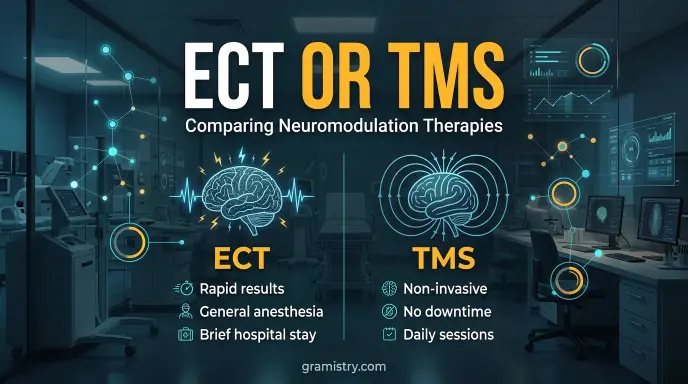
When depression becomes severe or does not improve with medication and psychotherapy, doctors may consider brain stimulation treatments such as ECT or TMS.
Both treatments affect brain activity and can help some people with difficult-to-treat depression, but they work in very different ways.
The terms can also sound intimidating because both involve stimulating the brain.
However, ECT and TMS are not interchangeable treatments.
One intentionally produces a controlled therapeutic seizure under general anesthesia, while the other uses magnetic pulses to stimulate a targeted area of the brain without anesthesia.
Although they look or sound similar, they serve completely different purposes.
In this guide, Gramistry explains what ECT and TMS mean, how they work, their major differences, side effects, treatment schedules, and situations in which doctors may consider one over the other.
The goal is to give you a clear foundation for discussing these options with a qualified healthcare professional.
Quick answer: ECT (electroconvulsive therapy) uses a controlled electrical stimulus to produce a brief seizure while the patient is under anesthesia. TMS (transcranial magnetic stimulation) uses magnetic pulses to stimulate specific brain regions without intentionally causing a seizure or requiring general anesthesia.
What Is ECT?
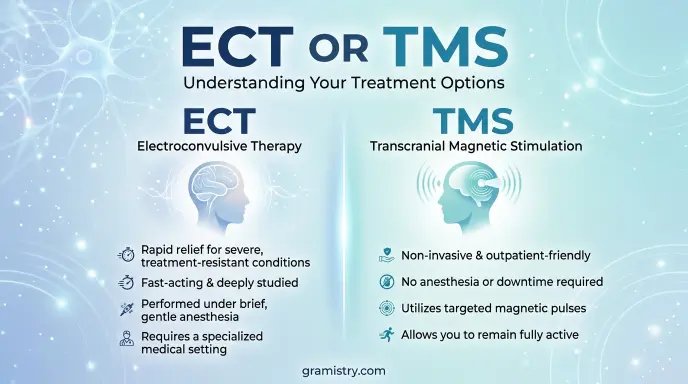
ECT stands for electroconvulsive therapy. It is a medical treatment that uses a carefully controlled electrical current to produce a brief seizure in the brain. Modern ECT is performed under general anesthesia, and a muscle relaxant is used to minimize physical movement during the seizure.
Despite its historical reputation, modern ECT is very different from the early forms of the treatment. Today, it is performed in a controlled medical environment with monitoring before, during, and after the procedure.
How Does ECT Work?
During ECT, electrodes are placed at specific locations on the patient’s head. A controlled electrical stimulus is delivered, producing seizure activity that generally lasts less than a minute.
The patient is asleep under anesthesia and does not consciously experience the electrical stimulation. After the procedure, the patient is monitored while the anesthesia wears off.
The exact biological mechanism behind ECT is complex and is still being studied. Researchers believe that the seizure produces changes in brain signaling and chemistry that can rapidly improve symptoms in some serious mental health conditions.
When Is ECT Used?
ECT is most strongly associated with severe depression, particularly when other treatments have not worked or when a rapid response is medically important.
According to the National Institute of Mental Health, ECT may be considered for severe, treatment-resistant depression and situations requiring a rapid response, such as severe suicidal risk, catatonia, or serious inability to eat or drink. It may also be used in some cases of bipolar disorder, mania, schizophrenia, and schizoaffective disorder.
ECT can sometimes begin improving symptoms faster than antidepressant medication, which is particularly important when a person’s condition is severe or potentially life-threatening.
How Long Does an ECT Session Take?
The actual ECT procedure is relatively short, often taking around 5 to 10 minutes, although preparation and recovery make the entire medical visit considerably longer.
ECT is normally given as a series of treatments rather than as a single session. The exact number and frequency depend on the person’s condition, response, and medical circumstances.
Common ECT Side Effects
ECT is generally considered a safe medical procedure when appropriately administered, but it can cause side effects.
Possible effects include:
- Temporary confusion
- Headache
- Nausea
- Muscle or jaw soreness
- Temporary fatigue
- Memory problems
- Effects related to anesthesia
- Temporary changes in blood pressure and heart rate
Memory loss is one of the most important considerations. Some people have difficulty remembering events from shortly before treatment or memories formed around the treatment period. In some cases, autobiographical memories from further in the past can also be affected. Memory problems often improve after treatment, although the extent and duration vary between individuals.
ECT: Simple Example
Imagine a person with severe depression who has tried medication and psychotherapy without sufficient improvement. If their condition becomes dangerous or requires a rapid response, a psychiatrist may discuss ECT as one possible treatment option.
The decision is individualized. ECT is not automatically the next step for everyone who has depression.
What Is TMS?
TMS stands for transcranial magnetic stimulation. The form commonly used therapeutically is called repetitive transcranial magnetic stimulation (rTMS).
Unlike ECT, TMS uses an electromagnetic coil positioned against the scalp. The device produces repeated magnetic pulses that pass through the skull and create small electrical currents in targeted areas of the brain.
TMS generally does not require general anesthesia and is performed while the patient is awake.
How Does TMS Work?
During a TMS session, a healthcare professional positions a magnetic coil near a particular area of the head.
The coil delivers a series of magnetic pulses. These pulses stimulate nerve cells in the targeted brain region.
For depression, treatment commonly targets areas of the prefrontal cortex involved in mood regulation and cognitive control. Unlike ECT, TMS is designed to provide more localized stimulation rather than intentionally producing a generalized therapeutic seizure.
When Is TMS Used?
TMS is used for certain mental health conditions, including depression. NIMH also lists FDA-cleared uses for certain TMS approaches involving conditions such as obsessive-compulsive disorder, migraine, and smoking dependence, although the exact indication depends on the specific device and protocol.
For depression, TMS may be considered when antidepressant medication has not provided adequate benefit or has not been tolerated.
Importantly, TMS is not simply a weaker version of ECT. They use different forms of stimulation and have different treatment procedures, benefits, limitations, and risk profiles.
How Long Does a TMS Session Take?
A typical rTMS session may last approximately 3 to 40 minutes, depending on the treatment protocol and device.
Treatment is usually delivered repeatedly over several weeks. A traditional course may involve sessions five days per week for roughly four to six weeks, although treatment schedules vary. Accelerated protocols can use several sessions in a single day.
This repeated schedule is one of the biggest practical differences between TMS and ECT.
Common TMS Side Effects
TMS is generally well tolerated. Common side effects can include:
- Scalp discomfort
- Mild headache
- Tingling
- Facial or jaw muscle twitching
- Lightheadedness
- Dizziness
Serious complications are uncommon, although seizures are a possible rare adverse effect. Some people may also experience other complications depending on their health and the specific treatment protocol.
Because TMS involves magnetic fields, patients should tell their healthcare provider about implanted metal or electronic devices and other relevant medical information before treatment.
Key Differences Between ECT and TMS
The easiest way to understand ECT or TMS is to compare how they stimulate the brain.
Main Differences
- ECT uses electrical stimulation; TMS uses magnetic stimulation.
- ECT intentionally induces a therapeutic seizure; standard TMS is designed to stimulate the brain without intentionally inducing a seizure.
- ECT uses general anesthesia; TMS generally does not.
- ECT can act rapidly and is often considered when severe depression requires a fast response.
- TMS is typically delivered during many outpatient sessions.
- Memory problems are a recognized concern with ECT; TMS generally has a much lower cognitive side-effect burden.
- ECT is more medically intensive, while TMS is generally less invasive in terms of procedure and recovery.
- Neither treatment is automatically better for every person.
ECT vs TMS Comparison Table
| Feature | ECT | TMS |
|---|---|---|
| Full name | Electroconvulsive therapy | Transcranial magnetic stimulation |
| Main stimulation | Electrical current | Magnetic pulses |
| Seizure intentionally produced? | Yes | No, not as part of standard treatment |
| General anesthesia | Yes | Usually no |
| Patient awake during treatment? | No | Yes |
| Treatment setting | Medical facility/hospital or outpatient setting | Usually outpatient/clinical setting |
| Typical treatment pattern | Series of treatments | Frequent sessions over several weeks |
| Memory effects | Can occur and may be significant | Generally not associated with the same type of memory loss |
| Common discomfort | Headache, nausea, muscle soreness, confusion after treatment | Scalp discomfort, headache, tingling |
| Speed of response | Can be relatively rapid | Usually requires repeated sessions |
| Main clinical consideration | Severe or treatment-resistant illness, especially when rapid improvement is important | Often considered for depression when medication has not worked adequately or was not tolerated |
The comparison is a general guide. The exact treatment protocol, indication, and expected results depend on the patient and the specific medical device or procedure.
Real-Life Conversation Examples
Conversation 1: Choosing Between Treatments
Patient: “Is TMS basically the same thing as ECT?”
Doctor: “No. Both are brain stimulation treatments, but they work differently. ECT uses controlled electrical stimulation to produce a seizure under anesthesia. TMS uses magnetic pulses while you’re awake.”
Patient: “So TMS doesn’t put me to sleep?”
Doctor: “Correct. Standard TMS usually doesn’t require general anesthesia.”
🎯 Lesson: ECT and TMS are both brain stimulation treatments, but their procedures are very different.
Conversation 2: Concern About Memory
Patient: “I’m worried about memory problems. Does TMS cause the same memory loss as ECT?”
Doctor: “Memory problems are a known concern with ECT. TMS generally has a much milder cognitive side-effect profile.”
Patient: “So does that mean TMS is always better?”
Doctor: “Not necessarily. The appropriate treatment depends on your symptoms, urgency, medical history, and previous treatment response.”
🎯 Lesson: TMS generally has fewer cognitive side effects, but that does not make it automatically appropriate for everyone.
Conversation 3: Severe Depression
Patient: “I’ve tried several treatments, and my depression is becoming dangerous. Should I wait several weeks for TMS?”
Doctor: “That depends on your immediate clinical situation. When severe depression requires a rapid response, ECT may be considered because it can work more quickly than many other treatments.”
🎯 Lesson: Treatment urgency can influence whether ECT is considered.
Conversation 4: Treatment Schedule
Patient: “Can I have one TMS session and see whether it works?”
Doctor: “TMS is normally delivered as a course of repeated sessions. One session usually isn’t the standard treatment course.”
🎯 Lesson: TMS generally requires repeated treatments rather than one procedure.
When to Use ECT vs TMS
There is no universal answer to the question “Which is better, ECT or TMS?”
A qualified psychiatrist or other appropriate medical specialist needs to consider the individual’s symptoms, diagnosis, treatment history, physical health, urgency, medications, and personal preferences.
When ECT May Be Considered
ECT may be particularly relevant when:
- Depression is severe or treatment-resistant.
- A rapid clinical response is important.
- Catatonia is present.
- Severe symptoms create immediate safety concerns.
- Other treatments have not worked or cannot be tolerated.
- A clinician believes the potential benefits outweigh the risks.
NIMH notes that ECT may be used when a rapid response is needed, including circumstances involving suicidality, catatonia, or severe inability to eat or drink.
When TMS May Be Considered
TMS may be considered when:
- Depression has not responded adequately to medication.
- Medication causes unacceptable side effects.
- The person prefers a treatment that does not require general anesthesia.
- An outpatient treatment approach is appropriate.
- The clinician believes targeted brain stimulation is suitable.
TMS is generally performed while the person remains awake and can return to normal activities relatively quickly after a session, although individual instructions may vary.
Easy Memory Trick
Think of the letters this way:
ECT = Electrical + Controlled seizure + Treatment under anesthesia
TMS = Magnetic + Targeted stimulation + Usually awake
This is only a memory aid, not a substitute for medical advice.
What About US vs UK Usage?
The names ECT and TMS are widely recognized in English-speaking medical contexts, including the United States and United Kingdom.
You may also see rTMS, which means repetitive transcranial magnetic stimulation. In medical literature, the exact terminology can vary depending on the device, protocol, and treatment being discussed.
Common Mistakes People Make
Mistake 1: “ECT and TMS are the same treatment.”
Incorrect:
“ECT and TMS are two names for the same brain stimulation treatment.”
Correct:
“ECT and TMS are different brain stimulation treatments.”
Why?
ECT uses electrical stimulation to induce a therapeutic seizure, while TMS uses magnetic pulses to stimulate targeted brain regions.
Mistake 2: “TMS is just a weaker ECT.”
Incorrect:
“TMS is simply low-powered ECT.”
Correct:
“TMS and ECT use different stimulation methods and treatment protocols.”
Why?
TMS uses magnetic pulses and is designed for targeted stimulation without intentionally producing the seizure used therapeutically in ECT.
Mistake 3: “ECT always causes permanent memory loss.”
Incorrect:
“Everyone who receives ECT permanently loses their memory.”
Correct:
“ECT can cause memory problems, but their severity and duration vary between individuals.”
Why?
Memory effects are a recognized risk of ECT, but they do not occur in exactly the same way or to the same degree for every patient.
Mistake 4: “TMS has zero risks.”
Incorrect:
“TMS is completely risk-free.”
Correct:
“TMS is generally well tolerated, but it can have side effects and rare serious complications.”
Why?
Common effects include headache and scalp discomfort, while seizures are a rare possible complication.
Mistake 5: “ECT is an outdated treatment.”
Incorrect:
“ECT is an old treatment that is no longer used in modern medicine.”
Correct:
“Modern ECT remains an established brain stimulation treatment for certain serious mental health conditions.”
Why?
ECT has a long history, but modern techniques use anesthesia, muscle relaxation, controlled stimulation, and medical monitoring.
Fun Facts and History
1. ECT Has Been Used for Decades
ECT has one of the longest histories among modern brain stimulation treatments. Its techniques have changed substantially over time, particularly with the introduction of anesthesia, muscle relaxants, and more controlled stimulation.
2. TMS Came Later
TMS is a newer approach that uses electromagnetic stimulation rather than directly delivering an electrical current to the brain. The FDA cleared the first rTMS device for depression in the United States in 2008.
3. Brain Stimulation Is a Broad Field
ECT and TMS are only two examples of brain stimulation therapies. Researchers are also studying approaches such as magnetic seizure therapy and deep brain stimulation for specific conditions and research purposes.
4. Modern ECT Is Very Different From Its Historical Image
Many popular portrayals of ECT are based on outdated practices. Modern ECT is performed with anesthesia, muscle relaxation, controlled electrical stimulation, and medical monitoring.
FAQs:
Is ECT stronger than TMS?
ECT and TMS should not simply be described as “stronger” and “weaker” versions of the same treatment. They use different technologies and treatment mechanisms. ECT intentionally produces a therapeutic seizure under anesthesia, while TMS uses magnetic pulses to stimulate targeted brain areas without intentionally inducing a seizure as part of standard treatment.
Is TMS safer than ECT?
TMS generally has a milder side-effect profile and does not require general anesthesia. ECT has additional considerations, including anesthesia-related risks and possible memory problems. However, “safer” depends on the individual and the clinical situation. ECT may be an appropriate choice when severe illness requires a rapid response.
Does ECT cause permanent memory loss?
ECT can cause memory problems, including difficulty remembering events around the treatment period and, in some cases, older autobiographical memories. The extent varies among individuals. Many memory problems improve after treatment, but some effects can persist, so memory risks should be discussed carefully with the treating clinician before ECT.
Does TMS cause memory loss?
TMS is generally not associated with the same type of memory loss that can occur with ECT. Its common side effects are usually milder and may include scalp discomfort, headache, tingling, or lightheadedness. However, TMS is not completely risk-free, and long-term effects continue to be studied.
Does TMS require anesthesia?
Usually, no. Standard TMS is generally performed while the patient is awake and does not require general anesthesia. This is one of the major practical differences between TMS and ECT. A person may feel tapping or knocking sensations on the scalp during stimulation, and mild discomfort can occur.
How quickly does ECT work compared with TMS?
ECT can produce improvement relatively quickly and may begin working within the first week in some patients. TMS usually involves repeated sessions over several weeks, although accelerated TMS protocols can deliver treatment more rapidly. The actual response varies significantly from person to person.
Can TMS replace ECT?
Not always. TMS and ECT have different roles, and the choice depends on the patient’s condition. ECT may be favored when severe symptoms require a rapid response, while TMS may be appropriate in other circumstances. A clinician should determine whether either treatment is suitable rather than assuming one can always replace the other.
Which is better for treatment-resistant depression: ECT or TMS?
There is no single answer. ECT is an established and highly effective option for severe treatment-resistant depression, while TMS can also reduce depressive symptoms and is often attractive because it does not require anesthesia. The best choice depends on severity, urgency, previous treatment response, medical history, and the patient’s circumstances.
Can ECT and TMS be used for conditions other than depression?
Yes, depending on the treatment and clinical indication. ECT may be used in some cases of bipolar disorder, mania, catatonia, schizophrenia, or schizoaffective disorder. Certain TMS approaches have also been cleared for conditions including OCD, migraine, and smoking dependence. Specific indications vary by device, country, and clinical circumstances.
Should someone choose ECT or TMS without talking to a doctor?
No. These are medical treatments that require professional assessment. A clinician needs to consider diagnosis, symptom severity, previous treatments, medications, physical health, treatment goals, and potential risks. If someone is experiencing an immediate mental health crisis or feels at risk of harming themselves, they should seek urgent local medical help rather than trying to decide between ECT and TMS on their own.
The Bottom Line:
ECT and TMS are both legitimate brain stimulation treatments, but they are not the same thing.
ECT uses controlled electrical stimulation to produce a therapeutic seizure under general anesthesia.
It can be especially important when depression is severe, treatment-resistant, or requires a rapid response. However, memory effects and anesthesia-related risks need to be considered.
TMS uses magnetic pulses to stimulate targeted areas of the brain while the patient is generally awake.
It usually requires repeated outpatient sessions and tends to have milder side effects, although it is not completely risk-free.
Neither option is universally “better.”
The right choice depends on the person’s medical situation and should be made with a qualified healthcare professional.
Important: This article is educational information, not a diagnosis or personalized medical recommendation.
Treatment decisions should be made with an appropriately qualified healthcare professional.
Conclusion:
Understanding ECT or TMS becomes much easier once you remember their basic difference.
ECT uses controlled electrical stimulation and intentionally produces a therapeutic seizure under anesthesia, while TMS uses magnetic pulses to target specific brain regions without the same procedure or anesthesia.
ECT may be particularly valuable when severe symptoms require rapid treatment, whereas TMS offers a less medically intensive option for certain patients.
Both have potential benefits and risks, so the right choice depends on the individual rather than a simple “better or worse” comparison.
Next time someone uses these two words, you’ll know exactly what they mean!

Alina Mark is the creative voice behind Gramistry.com, making word meanings, English expressions, and trending slang simple, clear, and interesting. Her mission is to make every word easier to understand, one meaning at a time.