
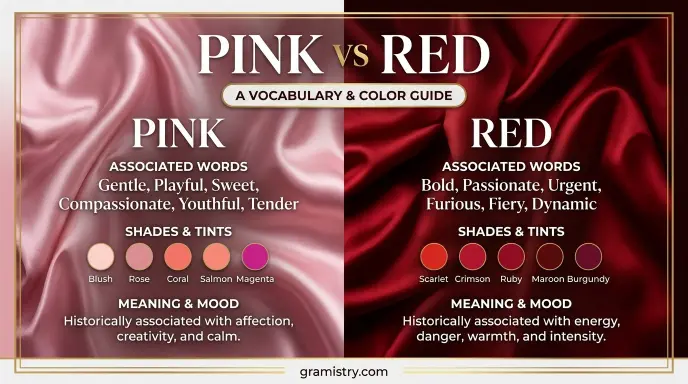
Have you ever found yourself staring at a color, completely unsure whether to call it pink or red?
It happens more often than you think. A bright lipstick, a sunset sky, a bowl of strawberry jam is it pink? Is it red?
Although they look or sound similar, they serve completely different purposes.
Learning the difference isn’t just about naming colors; it’s about understanding how we use words to describe the world around us.
In this guide, we’ll break down both colors, explore their meanings, compare their uses, and give you practical tips so you’ll never hesitate again.
We’ll also look at how these two words behave differently in English grammar and everyday conversation.
What Is “Red”?
Meaning and Definition
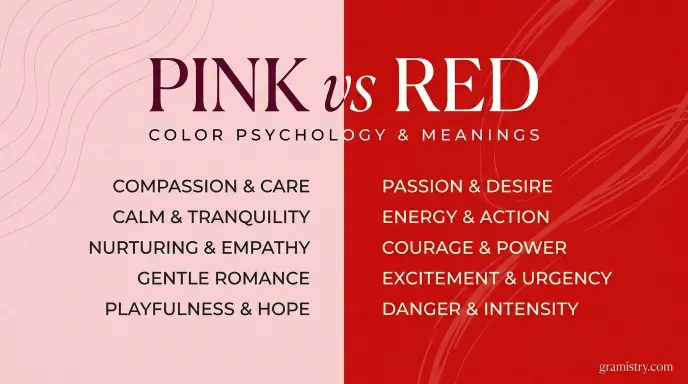
Red is one of the three primary colors in both light and traditional color theory. It sits at the long-wavelength end of the visible spectrum. In simple terms, red is the color of blood, ripe strawberries, and stop signs. It is universally recognized as a strong, intense color.
Pronunciation
Red is pronounced /rɛd/ — one syllable, rhyming with “bed” and “said.”
How It Is Used
Red is used to describe:
- Objects like apples, roses, and fire engines
- Emotions like anger (“seeing red”) and love (“red hearts”)
- Warnings and signals (stop signs, brake lights, alert buttons)
- Holidays like Christmas and Valentine’s Day
Grammar Role
Red works as both a noun and an adjective.
- As an adjective: “She wore a red dress.”
- As a noun: “Red is my favorite color.”
This flexibility makes it a very common word in English.
Country Usage
Red appears in every English-speaking country. It’s the name of a political party in the U.S., a football club in England, and a popular color for flags worldwide. Its meaning is widely consistent, though cultural associations can vary — for example, red symbolizes luck in China but can represent danger in many Western contexts.
History and Origin
The word “red” comes from Old English rēad, which traces back to the Proto-Indo-European root reudh-, meaning “red” or “ruddy.” This ancient root also gave us words like “ruby” and “rust.” Red is one of the oldest color words in the English language — it appears in the earliest written records.
Common Mistakes
- Confusing “red” with “read” (the past tense of “to read”). They sound identical but mean different things.
- Calling everything reddish “red” without specifying shades like crimson, scarlet, or maroon.
Real Examples
Here are a few sentences:
- “The warning light turned red.”
- “He painted his front door a bright red.”
- “Red is the color of passion and energy.”
- “We picked red apples from the tree.”
What Is “Pink”?
Meaning and Definition
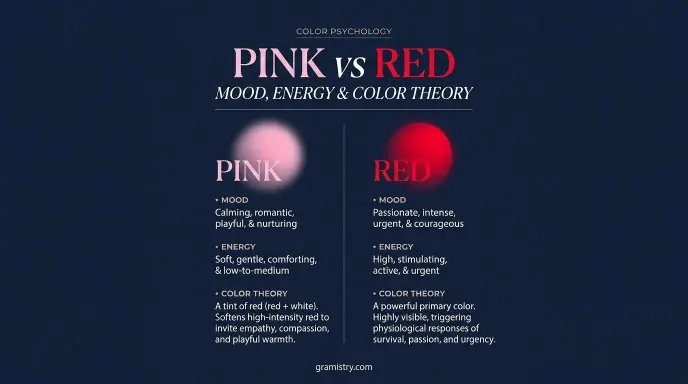
Pink is a pale red color created when red is mixed with white. It is softer, lighter, and calmer than red. Pink is commonly associated with flowers like roses and cherry blossoms, as well as with sweetness, tenderness, and springtime.
Pronunciation
Pink is pronounced /pɪŋk/ — one syllable, rhyming with “link” and “sink.”
Grammar Role
Like red, pink works as both a noun and an adjective.
- As an adjective: “She loves her pink bicycle.”
- As a noun: “Pink is a relaxing color.”
Interestingly, “pink” can also be a verb (“to pink” means to cut fabric with a zigzag edge), but this use is rare in everyday conversation.
Country Usage
Pink is used across all English-speaking nations. However, cultural meanings can differ. In Western countries, pink is often associated with baby girls and femininity — though this tradition only became common in the mid-20th century. In Japan, pink (often called sakura-iro) is tied to cherry blossoms and renewal.
Historical Note
Unlike red, “pink” is a relatively newer color word. It entered English around the 1600s. Interestingly, the name comes from the pink flower (genus Dianthus), not the other way around. The color took its name from the flower that English speakers already called “pink.”
Spelling Explanation
Pink’s spelling is straightforward and phonetic — “p-i-n-k.” The tricky part isn’t the spelling but remembering that it describes a light shade of red rather than a completely separate color family.
Common Mistakes
- Forgetting that pink is technically a shade of red, not an entirely different color.
- Using “pinkish” when you mean a faint pink, but writing “pink” when you want a specific shade like magenta or fuchsia.
Example Sentences
- “The nursery was painted a soft pink.”
- “She picked a pink rose from the garden.”
- “Pink feels warm and friendly.”
- “His cheeks turned pink with embarrassment.”
Key Differences Between Pink and Red
Let’s break down the main differences side by side.
- Meaning: Red is a primary color, full of energy and intensity. Pink is a lighter shade formed by mixing red with white.
- Usage: Red signals urgency, danger, and passion. Pink suggests softness, gentleness, and sweetness.
- Grammar: Both work as nouns and adjectives, but only “pink” has a rare verb form.
- Country: Red has consistent strong meanings worldwide. Pink’s cultural associations vary more, especially regarding gender and seasons.
- Function: Red grabs attention and demands action. Pink soothes and calms.
- Context: Red appears in warnings, sports, and celebrations. Pink shows up in fashion, nature, and branding for tenderness.
Comparison Table
| Feature | Red | Pink |
|---|---|---|
| Origin | Old English rēad | From the pink flower (1600s) |
| Color family | Primary color | Light shade of red |
| Vibe | Intense, urgent, powerful | Soft, gentle, calm |
| Grammar | Noun and adjective | Noun, adjective, rare verb |
| Common uses | Warnings, love, passion | Flowers, fashion, sweetness |
| Signals | Stop, danger, heat | Tenderness, spring, care |
Real-Life Conversation Examples
Dialogue 1
Emma: Which jacket should I buy — this one or that one?
Lily: The red one. Red is bold and goes with everything.
Emma: I was leaning toward the pink one. It’s softer and matches my scarf.
Lily: Honestly, both look great. It depends on the mood you want.
🎯 Lesson: Red and pink fill different emotional roles — choose based on the feeling you want to project.
Dialogue 2
Dad: Did you see the warning light on the dashboard?
Tom: Yeah, it turned bright red.
Dad: That means we need to stop now. Red always warns us.
Tom: But the light on the phone is pink, and that just means charging.
🎯 Lesson: Red signals urgency; pink usually signals something neutral or gentle.
Dialogue 3
Amy: The sunset is gorgeous today.
Ben: I love how it goes from deep red at the horizon to soft pink higher up.
Amy: Same colors, two completely different feelings.
Ben: Exactly. Red feels dramatic, pink feels dreamy.
🎯 Lesson: Red and pink often appear together in nature, but they create different moods.
Dialogue 4
Grace: My son wants a room color. Should we go red or pink?
Mark: I’d suggest a lighter pink. Red might be too intense for a bedroom.
Grace: True. Pink is calm and cozy.
Mark: Red can wait for the accent wall in the living room.
🎯 Lesson: In interior design, pink relaxes while red energizes — use them accordingly.
When to Use Pink vs Red
Practical Rules
Use red when you want to communicate:
- Danger or warnings
- Strong passion or anger
- Bold, attention-grabbing design
- Festive, energetic celebrations
Use pink when you want to communicate:
- Tenderness or affection
- Softness and calm
- Springtime or freshness
- Gentle, friendly design
Easy Memory Tricks
- “Red is ready, pink is pretty.” Red demands readiness and action; pink is about appearance and calm.
- Think of red = stop, pink = pause. A stop is firm; a pause is gentle.
- A simple rule: if someone might call it “light red,” it’s likely pink.
US vs UK Usage
Both countries use the words the same way. However, you’ll notice small cultural differences. In the UK, “red” might appear in phrases like “in the red” (in debt) or “red tape” (bureaucracy). In the US, “pink slip” means a dismissal notice. These fixed phrases matter more than regional pronunciation.
Formal Writing
In formal or academic writing, be specific about shades. Instead of just “red,” you might write “crimson” or “scarlet.” Instead of “pink,” try “rose” or “blush.” Precision shows care in formal contexts.
Informal Writing
In casual messages, both words are fine as-is. “Just bought a red mug” and “she painted her nails pink” are perfectly natural.
Academic Writing
In scientific or design contexts, use precise color terminology. For example, “the sample turned red” might require the exact wavelength or CMYK value in a formal report. In general prose, however, “red” and “pink” remain the standard terms.
Common Mistakes People Make
Mistake 1: Overgeneralizing Shades
- ❌ Wrong: “The apple was completely pink.” (Apples are usually more red.)
- ✅ Correct: “The apple was bright red with a pink blush.”
- Why it’s incorrect: Pink implies a much lighter color than most apples are.
Mistake 2: Mixing Up Homophones
- ❌ Wrong: “I read a book about the color red the other day.”
- ✅ Correct: “I read a book about the color red the other day.”
This example is actually correct! The confusion comes when writing “read” (past tense) vs “red.” Always check context.
Mistake 3: Confusing Emotional Weight
- ❌ Wrong: “The angry man’s face turned a soft pink.”
- ✅ Correct: “The angry man’s face turned a deep red.”
- Why it’s incorrect: Anger produces a flushed red, not a soft pink. Pink suits embarrassment, not rage.
Mistake 4: Ignoring Cultural Context
- ❌ Wrong: “In China, pink symbolizes luck and prosperity.”
- ✅ Correct: “In China, red symbolizes luck and prosperity.”
- Why it’s incorrect: Red, not pink, is the lucky color in Chinese culture. Getting this wrong can confuse readers.
Fun Facts / History
- Red was the first color humans named. Across nearly every language on Earth, “red” and “black” are among the earliest color words to appear. This reflects how important red was to survival — blood and fire demanded attention.
- Pink wasn’t always for girls. Up until the 1940s, pink was often recommended for boys in Western fashion guides because it was seen as a lighter, stronger version of red. The switch to pink-for-girls happened gradually in the mid-20th century.
- The name “pink” predates the color trend. The flower called “pink” existed in English long before the color became popular. It simply borrowed the flower’s name when people needed a word for light red.
- Red can genuinely raise your pulse. Studies suggest that viewing red can increase heart rate and alertness, which is exactly why it’s used for stop signs and danger warnings. Pink, by contrast, is associated with calmness in many environments.
FAQs:
1. Is pink considered a shade of red?
Yes. Technically, pink is a pale tint of red, created by mixing red with white. It stays within the red color family but reads as softer and lighter.
2. Which color is more attention-grabbing, pink or red?
Red is more attention-grabbing. Because it’s intense and high-energy, red naturally pulls the eye and signals urgency. Pink is gentler and less demanding of attention.
3. Does pink mean the same thing in every country?
No. Pink’s meaning varies by culture. In many Western countries it’s linked to femininity, while in Japan it connects to cherry blossoms and renewal. Always consider cultural context.
4. Can I use “red” and “pink” interchangeably?
No. They create completely different moods and convey different messages. Using them interchangeably can confuse your reader, especially in formal or descriptive writing.
5. What do red lights and pink lights mean?
Red lights almost always mean stop or warning, such as on traffic lights or appliances. Pink lights are rarely used for warnings; they typically signal something neutral, decorative, or gentle.
6. Why is red used for danger signs?
Red signals danger because it’s the most visible color to the human eye in most conditions, and it’s associated with fire and blood. This makes it the safest choice for alerts.
7. Are there any phrases with “pink” I should know?
Yes. “In the pink” means in good health, and “pink slip” means a notice of dismissal. These idioms are common and worth remembering.
8. Which color is better for a small room, red or pink?
Pink is generally better for small rooms because it feels airy and calm. Red can make a small space feel smaller and more intense when used on every wall.
9. Is blood really red, and is there pink blood?
Human blood is always some shade of red because of hemoglobin. In very rare cases it can appear pinker if heavily diluted, but healthy blood is never truly pink.
10. How can I remember the difference easily?
Use this trick: Red is the boss, pink is the baby. Red is the strong primary color, and pink is its lighter, softer child. One grabs attention; the other soothes.
Conclusion:
Red and pink may share a family tree, but they live very different lives.
Red is bold, urgent, and powerfu the color of warnings, passion, and fire.
Pink is soft, calm, and gentle the color of blossoms, tenderness, and spring.
Their grammar is nearly identical, but their meanings couldn’t be more distinct.
Whether you’re writing a sentence, painting a room, or simply describing what you see, understanding this difference helps you communicate with precision.
Next time someone uses these two words, you’ll know exactly what they mean!

Alina Mark is the creative voice behind Gramistry.com, making word meanings, English expressions, and trending slang simple, clear, and interesting. Her mission is to make every word easier to understand, one meaning at a time.
1 thought on “Pink is a light tint or shade of red created by lightening red rather”