
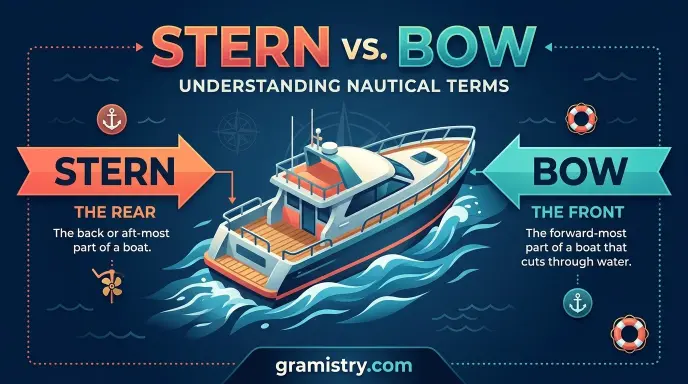
If you’ve ever been on a boat, watched a sailing competition, or read boating instructions, you’ve probably come across the terms stern and bow.
These two words are essential in the world of boating and navigation, yet many beginners often mix them up.
Knowing the difference isn’t just helpful it can also improve safety and communication on the water.
Although they look or sound similar, they serve completely different purposes.
The bow refers to the front of a boat, while the stern refers to the back. Understanding these terms makes it easier to follow directions, learn boating basics, and communicate clearly with other boaters.
In this guide, we’ll explain the meaning of each term, compare their differences, provide practical examples, and answer the most common questions about stern or bow.
What Is the Stern?
Meaning and Definition
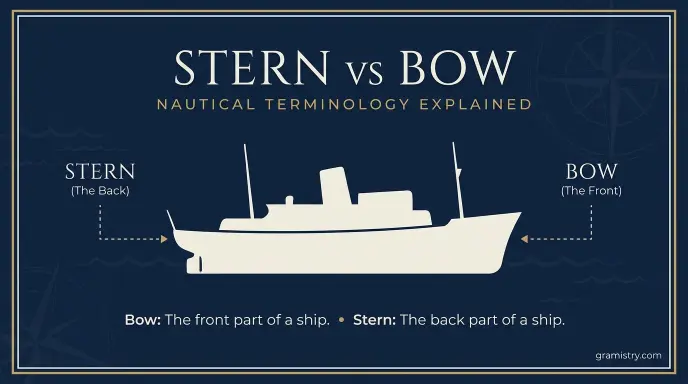
The stern is the rear or back end of a boat or ship. It is the opposite of the bow and is one of the most important reference points used in boating.
Usage
The stern is commonly mentioned when discussing:
- Boat navigation
- Docking procedures
- Marine safety
- Ship design
- Fishing boats
- Cruise ships
- Sailing
For example:
“Passengers should remain clear of the stern while the engine is running.”
Where Is It Used?
The term stern is used worldwide in:
- Recreational boating
- Commercial shipping
- Naval operations
- Sailing competitions
- Maritime education
Regional Notes
Unlike some English words, stern has the same meaning in American English, British English, Australian English, and other English-speaking countries.
Real Examples
- The fishing platform is located at the stern.
- Waves hit the stern as the boat slowed down.
- The captain walked toward the stern to inspect the engine.
- A ladder was attached to the stern for swimmers.
Short History
The word stern comes from Old Norse and Old English maritime vocabulary dating back hundreds of years. It has long referred to the rear section of a vessel and remains a standard nautical term today.
What Is the Bow?
Meaning and Definition
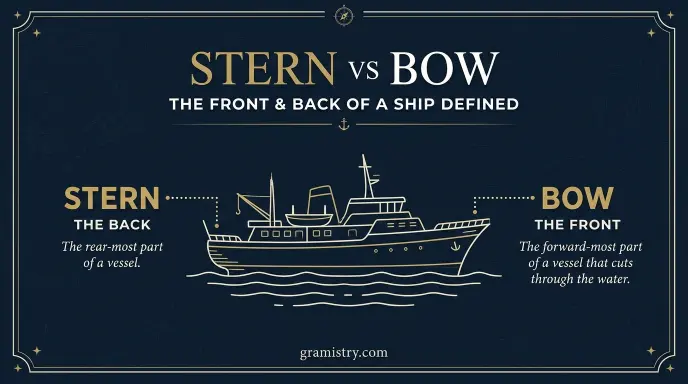
The bow is the front part of a boat or ship. It is the section designed to move through the water first.
Usage
The bow is frequently mentioned when discussing:
- Navigation
- Boat design
- Anchoring
- Mooring
- Sailing
- Marine safety
Example:
“Stand near the bow while preparing to drop the anchor.”
Where Is It Used?
The term appears in:
- Sailing manuals
- Coast Guard instructions
- Maritime training
- Recreational boating
- Yacht racing
Regional Notes
Like stern, the meaning of bow is consistent across English-speaking countries.
Real Examples
- The bow cut smoothly through the waves.
- The anchor is stored near the bow.
- Dolphins often swim beside the bow.
- The passengers gathered at the bow for photographs.
Short History
The word bow has been used in nautical language for centuries and refers to the forward-most section of a vessel designed to lead its movement through water.
Key Differences Between Stern and Bow
| Feature | Stern | Bow |
|---|---|---|
| Position | Back of the boat | Front of the boat |
| Direction | Faces behind | Faces forward |
| Main Function | Houses engine, propeller, steering equipment on many boats | Cuts through water and leads movement |
| Opposite Of | Bow | Stern |
| Common Equipment | Swim platform, motor, rudder | Anchor, navigation lights, bow rail |
| Navigation Reference | Rear | Front |
Quick Differences
- Bow is always the front.
- Stern is always the back.
- Boats move forward from the bow.
- Many engines are located near the stern.
- Anchors are often deployed from the bow.
Real-Life Examples
Conversation 1
Captain: Move toward the bow and prepare the anchor.
Crew Member: I’m heading to the front now.
🎯 Lesson: The bow means the front of the boat.
Conversation 2
Instructor: Stay away from the stern while the engine is running.
Student: Understood. I’ll remain in the middle.
🎯 Lesson: The stern is often near the engine.
Conversation 3
Friend: Where should we take photos?
Guide: The bow has the best view.
🎯 Lesson: The front of the boat usually offers better scenery.
Conversation 4
Sailor: Water is splashing over the bow.
Crew: Let’s reduce speed.
🎯 Lesson: Waves usually strike the bow first.
Conversation 5
Passenger: Where is the swim ladder?
Captain: It’s attached to the stern.
🎯 Lesson: Swim platforms are commonly located at the stern.
When Should You Use Each One?
Use bow when referring to:
- The front of a boat
- Anchoring
- Forward navigation
- Looking ahead
Use stern when referring to:
- The back of a boat
- Engines
- Propellers
- Steering equipment
- Boarding from the rear
Common Mistakes
Calling the front the stern.
Saying “back bow.”
Confusing bow with the “bow” used in archery or music.
Easy Memory Tricks
- Bow = Before (front comes before the rest of the boat.)
- Stern = Stern’s Tail (think of the tail or back.)
US vs UK Differences
There are no significant differences between American and British English regarding these nautical terms. Both use bow and stern in the same way.
Fun Facts
- The famous phrase “bow to stern” means from the very front of a boat to the very back.
- Modern cruise ships can stretch hundreds of meters from bow to stern.
- Every licensed captain learns these terms before operating a vessel professionally.
FAQs:
1. What is the bow of a boat?
The bow is the front part of the boat.
2. What is the stern?
The stern is the rear or back of a boat.
3. Which comes first when a boat moves?
The bow moves through the water first.
4. Is the engine always at the stern?
Many motorboats have engines at the stern, but not every vessel does.
5. Is the anchor kept at the bow?
Most boats store and deploy the anchor from the bow.
6. Are bow and stern universal boating terms?
Yes. They are standard nautical terms used worldwide.
7. Can passengers stand on the bow?
Yes, when it’s safe and permitted by the captain.
8. Why is the stern important?
It often contains steering and propulsion equipment.
9. What’s the easiest way to remember them?
Think Bow = Front and Stern = Back.
Conclusion:
Understanding the difference between stern and bow is one of the first steps toward learning boating terminology.
While the bow refers to the front of a boat and leads the vessel through the water, the stern is the back and often contains important equipment such as the engine and steering components.
Whether you’re taking a boating course, enjoying a sailing trip, or simply reading about ships, using these terms correctly helps you communicate more clearly and confidently.
Next time someone uses these two words, you’ll know exactly what they mean!

Alina Mark is the creative voice behind Gramistry.com, making word meanings, English expressions, and trending slang simple, clear, and interesting. Her mission is to make every word easier to understand, one meaning at a time.