
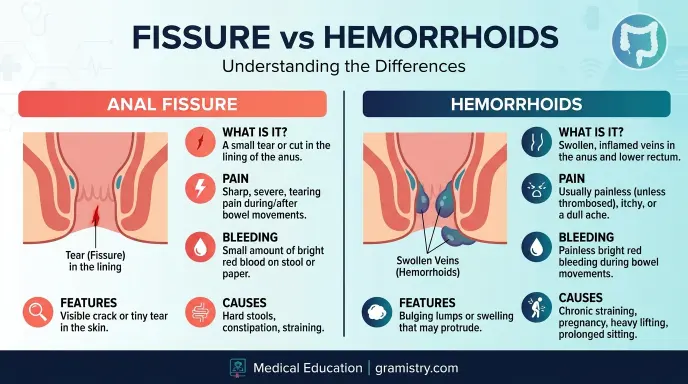
Have you ever felt pain, itching, or noticed blood after using the toilet? You may wonder whether you have an anal fissure or hemorrhoids. These two problems affect the same area, so it’s easy to confuse them.
However, they are not the same condition. A fissure is a small tear in the skin around the anus. Hemorrhoids are swollen blood vessels in or around the anus and lower rectum.
Although they can cause similar symptoms, they have different causes, signs, and treatments. Knowing the difference can help you understand what may be happening and when you should seek medical care.
What Is an Anal Fissure?
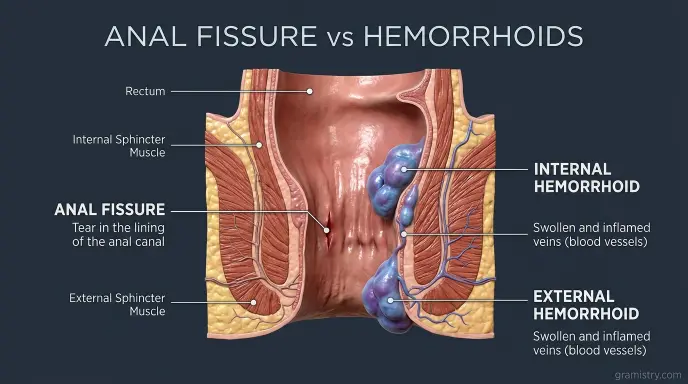
An anal fissure is a small cut or tear in the thin skin around the opening of the anus.
Think of it like a small crack in dry skin. It can hurt a lot, especially when you pass stool (poop).
An anal fissure often develops when hard stool stretches and tears the skin. Frequent diarrhea can also cause one.
Common signs of an anal fissure
You may notice:
- Sharp pain when passing stool.
- Burning pain that continues after using the toilet.
- A small amount of bright red blood on toilet paper.
- Pain that lasts for minutes or even hours after a bowel movement.
- A small skin tag near the tear in some long-lasting cases.
One important sign is the pain. People with an anal fissure often describe it as a sharp, cutting, or burning feeling.
What causes an anal fissure?
Common causes include:
- Constipation: Hard stool can stretch and tear the anal skin.
- Straining: Pushing too hard during a bowel movement can cause injury.
- Frequent diarrhea: Repeated bowel movements can irritate the skin.
- Childbirth: The pressure during childbirth can contribute to a tear.
- Certain bowel conditions: Conditions such as Crohn’s disease can sometimes cause fissures.
Simple example
Imagine someone has constipation for several days. When they finally pass a hard stool, they feel a sharp pain near the anus.
They also notice a little bright red blood on the toilet paper.
These signs may point to an anal fissure, although a medical examination is needed to confirm the cause.
Can an anal fissure heal on its own?
Yes. Many new anal fissures heal without surgery.
Doctors often recommend:
- Eating more fiber-rich foods.
- Drinking enough water.
- Avoiding straining.
- Keeping stools soft.
- Taking warm baths for 10–20 minutes.
- Using prescribed creams when needed.
If the tear does not heal, a doctor may prescribe medicine to relax the muscles around the anus. Some long-lasting fissures need a medical procedure or surgery. nhs.uk+3
What Are Hemorrhoids?
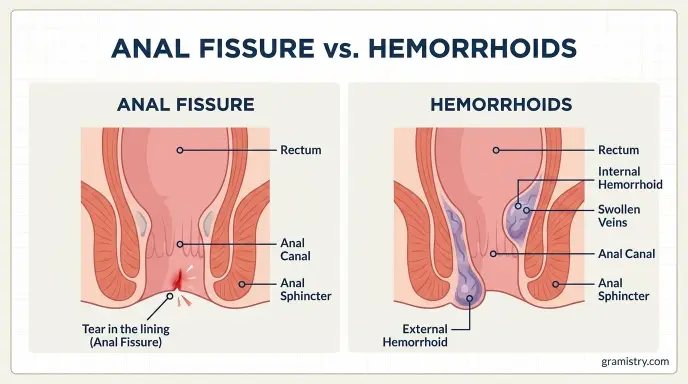
Hemorrhoids are swollen blood vessels in or around the anus and lower rectum.
They are also commonly called piles.
These swollen blood vessels can cause bleeding, itching, discomfort, and sometimes painful lumps.
Unlike an anal fissure, hemorrhoids do not involve a tear in the skin.
Two main types of hemorrhoids
There are two common types:
1. Internal hemorrhoids
These develop inside the rectum.
Common signs include:
- Bright red blood after a bowel movement.
- Blood on toilet paper or in the toilet bowl.
- Tissue that sometimes comes out through the anus during a bowel movement.
Internal hemorrhoids usually do not cause pain unless they come out through the anus or develop certain complications.
2. External hemorrhoids
These develop under the skin around the anus.
Common signs include:
- Itching around the anus.
- Swelling near the anal opening.
- A small or large lump.
- Pain or discomfort when sitting.
- Tenderness when touching the affected area.
Sometimes, a blood clot forms inside an external hemorrhoid. This is called a thrombosed hemorrhoid. It can cause sudden and severe pain.
What causes hemorrhoids?
Several things can increase the chance of developing hemorrhoids:
- Constipation and hard stools.
- Straining during bowel movements.
- Sitting on the toilet for too long.
- Frequent diarrhea.
- Pregnancy.
- A diet low in fiber.
- Aging and weakening of the supporting tissues.
Simple example
Imagine someone spends a long time sitting on the toilet and often strains to pass stool.
After some time, they notice a swollen lump near the anus. The area feels itchy and uncomfortable.
These symptoms may suggest external hemorrhoids.
However, a doctor must check the area to confirm the diagnosis.
Can hemorrhoids go away?
Yes. Mild hemorrhoids often improve with simple care.
Doctors may recommend:
- Eating more fruits, vegetables, and whole grains.
- Drinking enough water.
- Avoiding straining.
- Spending less time on the toilet.
- Taking warm baths.
- Using suitable creams or medicines for a short time.
If home treatment does not help, doctors may suggest other treatments. These can include rubber band ligation, other office procedures, or surgery for severe cases. NIDDK+2
Key Differences Between Fissure and Hemorrhoids
Both conditions affect the anal area. Both can cause bright red bleeding. However, their causes and symptoms are different.
Here is a simple comparison:
| Feature | Anal Fissure | Hemorrhoids |
|---|---|---|
| Meaning | A small tear in the anal skin | Swollen blood vessels |
| Main problem | A cut or crack | Swollen veins and supporting tissue |
| Common pain | Sharp or cutting pain | Itching, aching, or tenderness |
| Pain during stool | Very common | Not always present |
| Pain after stool | Can last for hours | Depends on the type |
| Bleeding | Often small amounts of bright red blood | Bright red blood may appear |
| Lump | Sometimes a small skin tag | External lumps may appear |
| Main causes | Hard stool, straining, diarrhea | Straining, constipation, pregnancy |
| Main treatment | Soft stools and medicines to help the tear heal | Soft stools and treatment for swelling |
The easiest way to remember
- Fissure = Tear: A small cut that can cause sharp pain during and after a bowel movement.
- Hemorrhoids = Swelling: Enlarged blood vessels that can cause itching, lumps, discomfort, or bleeding.
Important distinction
Internal hemorrhoids can bleed without causing pain. An anal fissure more often causes sharp pain when passing stool.
However, these are common patterns, not rules that can confirm a diagnosis. fascrs.org+2
Real-Life Conversation Examples
These short conversations show how people may talk about the two conditions in everyday life.
Example 1: Pain after using the toilet
Ali: I feel a sharp pain every time I pass stool.
Ahmed: Does the pain continue after you finish?
Ali: Yes, sometimes for a few hours.
Ahmed: An anal fissure can cause that kind of pain. You should get it checked.
🎯 Lesson: Sharp pain during and after a bowel movement can be a sign of an anal fissure.
Example 2: A lump near the anus
Sara: I noticed a small lump near my anus.
Mina: Does it itch or hurt?
Sara: Yes, especially when I sit for a long time.
Mina: External hemorrhoids can cause those symptoms. A doctor can check it.
🎯 Lesson: A tender or itchy lump may be a sign of external hemorrhoids.
Example 3: Bright red blood
John: I saw bright red blood on the toilet paper.
Mike: Did you feel pain when passing stool?
John: Yes, it felt like a small cut.
Mike: A fissure is one possible cause, but bleeding should be checked.
🎯 Lesson: Bright red blood can occur with both conditions. Never assume the cause.
Example 4: No pain but bleeding
David: I noticed blood after using the toilet, but I don’t feel pain.
Peter: Internal hemorrhoids can sometimes cause painless bleeding.
David: So, does that mean I have hemorrhoids?
Peter: Not necessarily. You need a proper medical check.
🎯 Lesson: Painless bleeding may occur with internal hemorrhoids, but other conditions can also cause it.
When to Use Fissure vs Hemorrhoids
When talking about these medical conditions, choose the correct term based on what you mean.
Use “anal fissure” when:
- You are talking about a small tear near the anus.
- Someone experiences sharp pain during bowel movements.
- The skin around the anal opening has a crack.
- A doctor diagnoses a tear in the anal lining.
Example sentences:
- The doctor diagnosed an anal fissure.
- Constipation can lead to an anal fissure.
- She experienced burning pain after passing stool because of a fissure.
Use “hemorrhoids” when:
- You are talking about swollen blood vessels around or inside the anus.
- Someone has external hemorrhoid lumps.
- A person experiences itching or swelling around the anal opening.
- A doctor diagnoses internal or external hemorrhoids.
Example sentences:
- He has internal hemorrhoids.
- Sitting on the toilet for too long may increase the risk of hemorrhoids.
- The doctor recommended treatment for external hemorrhoids.
What about the word “piles”?
Piles is another common name for hemorrhoids.
For example:
- “I think I have piles.”
- “The doctor said I have hemorrhoids.”
Both sentences refer to the same condition.
However, anal fissure and piles are not interchangeable terms.
Common Mistakes People Make
People often confuse fissures and hemorrhoids because both can cause bleeding and discomfort.
Here are some common mistakes to avoid.
– Mistake 1: Calling every anal problem hemorrhoids.
Not every lump, pain, or bleeding problem is caused by hemorrhoids. An anal fissure, infection, or another condition may cause similar symptoms.
– Mistake 2: Thinking a fissure and hemorrhoids are the same.
They are different conditions. A fissure is a tear, while hemorrhoids involve swollen blood vessels.
– Mistake 3: Assuming all bleeding is caused by hemorrhoids.
Bright red blood can come from either condition. Other bowel problems can also cause bleeding.
– Mistake 4: Thinking internal hemorrhoids always hurt.
Internal hemorrhoids often cause painless bleeding. Pain is more common with external hemorrhoids or complications.
– Mistake 5: Ignoring symptoms for too long.
Pain, bleeding, or swelling that continues or gets worse needs medical attention.
Helpful tip: Don’t diagnose yourself based on one symptom. A doctor can examine the area and find the actual cause. NIDDK+2
When Should You See a Doctor?
This is an important point.
Both conditions are common, but rectal bleeding should never be ignored.
Arrange a medical check if:
- You notice blood after passing stool.
- You have repeated pain around the anus.
- A lump or swelling does not improve.
- Your symptoms keep returning.
- Home treatment does not help.
- You notice a change in your usual bowel habits.
Get urgent medical help if you have heavy or continuous bleeding, black or dark red stools, severe abdominal pain, dizziness, fainting, or signs of shock.
Fever, feeling very unwell, or pus around the anus also needs urgent medical assessment.
Remember, rectal bleeding can sometimes point to a more serious bowel problem. It is safer to find the cause than to assume you have piles or a fissure. NHS+2
Fun Facts About Fissures and Hemorrhoids
Here are two useful facts that many people don’t know.
1. A fissure can cause a small skin tag.
A long-lasting anal fissure can sometimes develop a small piece of extra skin near the tear. This is called a sentinel skin tag. People may mistake it for an external hemorrhoid.
2. Internal hemorrhoids are often painless.
Many people expect hemorrhoids to cause pain. However, internal hemorrhoids often cause painless bleeding instead. This is one reason why a proper diagnosis matters. fascrs.org+1
Conclusion:
Fissures and hemorrhoids affect the same area, but they are different conditions. An anal fissure is a small tear that often causes sharp pain during and after bowel movements.
Hemorrhoids are swollen blood vessels that may cause itching, lumps, discomfort, or bleeding.
Both conditions can improve with proper care, but the right treatment depends on the cause. Never ignore repeated bleeding or severe pain.
Next time someone mentions a fissure or hemorrhoids, you’ll understand exactly what each condition means.

Alina Mark is the creative voice behind Gramistry.com, making word meanings, English expressions, and trending slang simple, clear, and interesting. Her mission is to make every word easier to understand, one meaning at a time.