
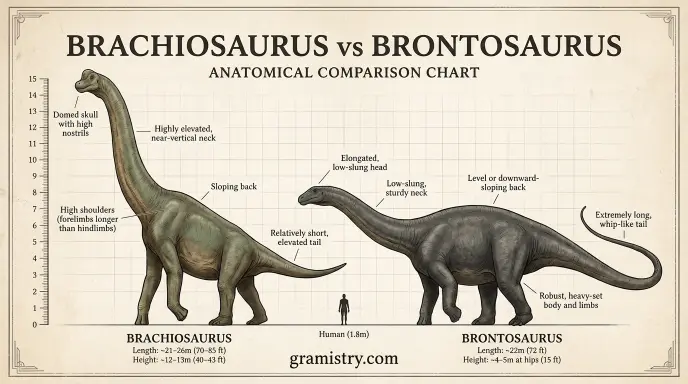
Imagine visiting a dinosaur museum and seeing two huge dinosaurs with long necks. One has a very long neck and tall front legs.
The other has a large body and a long tail. You might wonder: Are they the same dinosaur, or are they different?
This is where Brachiosaurus or Brontosaurus can become confusing. Both were giant plant-eating dinosaurs. Both had long necks, huge bodies, and long tails. However, they belonged to different dinosaur groups and had different body shapes.
Although their names may sound similar, they refer to two completely different dinosaurs. Once you learn a few simple features, you can tell them apart with confidence.
What Is Brachiosaurus?
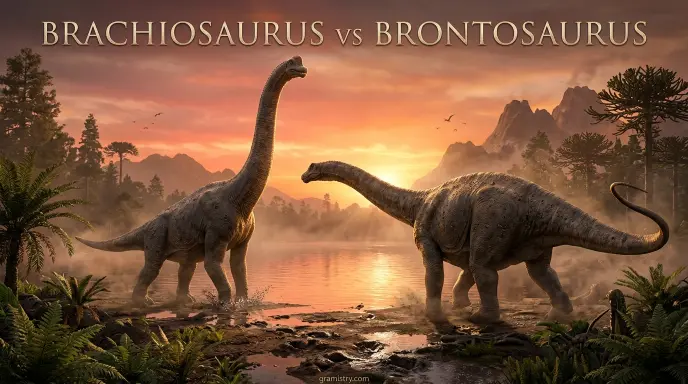
Brachiosaurus was a very tall, plant-eating dinosaur that lived during the Late Jurassic Period. Its name means “arm lizard.”
It was famous for its long neck and unusually long front legs. These features made its body slope upward toward its shoulders.
What Did Brachiosaurus Look Like?
Brachiosaurus had several special features:
- Long front legs: Its front legs were longer than its back legs.
- Long neck: It could reach leaves high in trees.
- Huge body: It was one of the largest land animals of its time.
- Long tail: Its tail helped balance its large body.
- Small head: It had a small head compared with its enormous body.
Brachiosaurus could grow to around 22 metres long. However, scientists still study its size because complete skeletons are rare.
Where Did Brachiosaurus Live?
Brachiosaurus lived in what is now North America, especially the area that is now the United States.
It lived around 152–145 million years ago, during the Late Jurassic Period.
What Did Brachiosaurus Eat?
Brachiosaurus was a herbivore, which means it ate plants.
Its long neck helped it reach leaves from tall trees. It likely fed on plants such as conifers and tree ferns.
It swallowed its food rather than chewing it.
Example Sentences
Here are some simple ways to use the word Brachiosaurus:
- The Brachiosaurus had a very long neck.
- My favourite dinosaur is the Brachiosaurus.
- The Brachiosaurus could reach leaves high in trees.
- We saw a huge Brachiosaurus skeleton at the museum.
- The Brachiosaurus was a giant plant-eating dinosaur.
Easy way to remember: Brachiosaurus had long front legs and a tall body. Think of a dinosaur that could reach high branches!
What Is Brontosaurus?
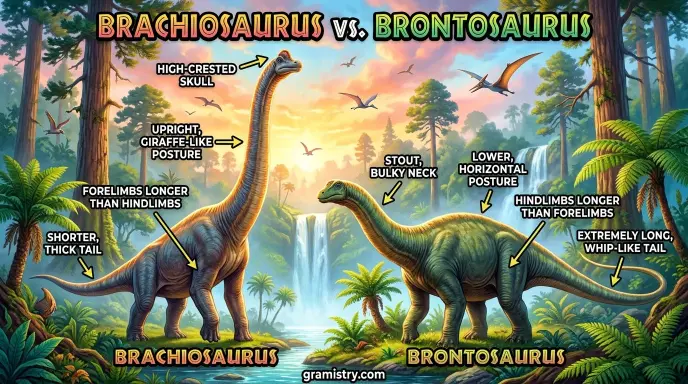
Brontosaurus was a large, long-necked, plant-eating dinosaur that lived during the Late Jurassic Period.
Its name means “thunder lizard.” It had a huge body, four strong legs, a long neck, and a very long tail.
Unlike Brachiosaurus, Brontosaurus had shorter front legs than back legs. Its body was lower and more heavily built.
What Did Brontosaurus Look Like?
Brontosaurus had some interesting physical features:
- Long neck: It used its neck to reach plants.
- Strong legs: All four legs supported its heavy body.
- Long tail: Its tail extended far behind its body.
- Large body: It was a massive dinosaur with a strong build.
- Shorter front legs: Its front legs were shorter than its back legs.
Unlike Brachiosaurus, Brontosaurus had a more level body shape.
Where Did Brontosaurus Live?
Brontosaurus lived in what is now North America.
It lived during the Late Jurassic Period, roughly 156–145 million years ago.
Its fossils have been found in the western United States, including areas of Wyoming and Colorado.
What Did Brontosaurus Eat?
Brontosaurus was also a herbivore.
It ate plants and low-growing vegetation. Its neck helped it reach food close to the ground and at different heights.
It did not hunt other dinosaurs because it ate plants rather than meat.
Example Sentences
Here are some simple examples:
- The Brontosaurus had a very long tail.
- Brontosaurus was a giant plant-eating dinosaur.
- The children saw a Brontosaurus model at school.
- The Brontosaurus walked on four strong legs.
- My dinosaur book has a picture of a Brontosaurus.
Easy way to remember: Brontosaurus had a large body, a long tail, and shorter front legs. Think of a giant dinosaur with a lower body.
Key Differences Between Brachiosaurus and Brontosaurus
Brachiosaurus and Brontosaurus may look alike at first. Both had long necks, huge bodies, four legs, and long tails.
However, their body shapes and feeding habits were different.
Here is a simple comparison:
| Feature | Brachiosaurus | Brontosaurus |
|---|---|---|
| Name meaning | Arm lizard | Thunder lizard |
| Dinosaur group | Sauropod | Sauropod |
| Diet | Plants | Plants |
| Front legs | Longer than back legs | Shorter than back legs |
| Body shape | Tall and upward-sloping | Lower and more level |
| Neck | Very long | Long |
| Tail | Long | Very long |
| Feeding style | Reached higher vegetation | Fed at lower heights |
| Walking style | On four legs | On four legs |
| Period | Late Jurassic | Late Jurassic |
| Main location | North America | North America |
The Biggest Difference
The easiest way to tell these dinosaurs apart is to look at their legs.
- Brachiosaurus: Its front legs were longer than its back legs. This made its shoulders higher than its hips.
- Brontosaurus: Its front legs were shorter than its back legs. Its body had a more level shape.
Another important difference was their feeding style. Brachiosaurus could reach higher branches, while Brontosaurus was better suited to feeding on vegetation at lower heights.
Remember, both dinosaurs were plant eaters. Neither was a meat-eating predator.
Real-Life Conversation Examples
Let’s look at how people might use these dinosaur names in everyday conversations.
Example 1: At School
Ali: Which dinosaur had longer front legs, Brachiosaurus or Brontosaurus?
Sara: Brachiosaurus had longer front legs.
Ali: So, it could reach higher trees?
Sara: Yes! That’s one of its special features.
🎯 Lesson: Brachiosaurus had longer front legs and could reach higher vegetation.
Example 2: At a Museum
Teacher: Can anyone tell me the name of this dinosaur?
Student: Is that a Brontosaurus?
Teacher: Yes! Look at its large body and long tail.
🎯 Lesson: Brontosaurus was a large, long-necked dinosaur with a strong body.
Example 3: During a Dinosaur Quiz
Hamza: Are Brachiosaurus and Brontosaurus the same dinosaur?
Ahmed: No, they are different dinosaurs.
Hamza: How can I tell them apart?
Ahmed: Look at their front legs. Brachiosaurus had longer front legs.
🎯 Lesson: Both dinosaurs were sauropods, but their body shapes were different.
Example 4: Talking About Food
Mina: Did Brontosaurus eat other dinosaurs?
Ayesha: No! It ate plants.
Mina: What about Brachiosaurus?
Ayesha: It ate plants too, but it could reach higher leaves.
🎯 Lesson: Both dinosaurs were herbivores, meaning they ate plants.
When to Use Brachiosaurus vs Brontosaurus
Choosing between these names is easy once you know what each one describes.
Use Brachiosaurus when:
- You are talking about the dinosaur with longer front legs.
- You mean the tall dinosaur with an upward-sloping body.
- You are describing a dinosaur that could reach high tree branches.
- You are discussing this particular sauropod in a book, museum, or science lesson.
Use Brontosaurus when:
- You are talking about the dinosaur known as the thunder lizard.
- You mean the dinosaur with a large, lower-set body.
- You are describing a long-necked dinosaur with a long tail and shorter front legs.
- You are discussing its fossils, history, or place in dinosaur science.
Quick memory trick:
- Brachiosaurus = Long front legs = Taller shoulders.
- Brontosaurus = Shorter front legs = Lower body.
This simple trick can help you remember the difference without learning difficult scientific terms.
Common Mistakes People Make
Many people mix up these dinosaur names because they share several features. Here are some mistakes to avoid.
– Mistake 1: Thinking they are the same dinosaur.
Brachiosaurus and Brontosaurus were different dinosaurs. They belonged to the same broad group but had different body shapes.
– Mistake 2: Thinking both had the same leg length.
Brachiosaurus had longer front legs. Brontosaurus had shorter front legs.
– Mistake 3: Thinking Brontosaurus was a meat eater.
This is incorrect. Brontosaurus ate plants, just like Brachiosaurus.
– Mistake 4: Thinking Brachiosaurus had a lower body.
Its front legs were longer than its back legs, which gave it a raised shoulder area.
– Mistake 5: Thinking Brontosaurus was never a real dinosaur.
This is an old misunderstanding. Scientists once stopped using its name, but research published in 2015 supported recognizing Brontosaurus as a separate dinosaur genus again.
– Mistake 6: Using the two names interchangeably.
They are not two names for the same dinosaur. Each name refers to a different animal.
Fun Facts and History
Here are two interesting facts about these famous dinosaurs.
1. Brontosaurus Once Lost Its Scientific Name
In 1879, American palaeontologist Othniel Charles Marsh named Brontosaurus.
However, in 1903, another palaeontologist, Elmer Riggs, argued that Brontosaurus and Apatosaurus were the same dinosaur. Scientists then used the older name, Apatosaurus, instead.
In 2015, a new scientific study found enough differences to support bringing Brontosaurus back as a separate genus. Some scientific debate about its classification has continued.
2. Brachiosaurus Had a Special Body Shape
Brachiosaurus had longer front legs than back legs.
This unusual feature made its body slope upward toward its shoulders. It also helped the dinosaur reach vegetation high above the ground.
These features made Brachiosaurus quite different from many other long-necked dinosaurs.
Conclusion:
Brachiosaurus and Brontosaurus were both giant, plant-eating dinosaurs, but they were not the same animal. Brachiosaurus had longer front legs, a taller body, and could reach higher branches.
Brontosaurus had shorter front legs, a lower body, and a very long tail. Both lived during the Jurassic Period and walked on four legs.
The easiest way to remember the difference is to look at their front legs. Next time someone hears Brachiosaurus or Brontosaurus, they’ll know exactly what each name means!

Alina Mark is the creative voice behind Gramistry.com, making word meanings, English expressions, and trending slang simple, clear, and interesting. Her mission is to make every word easier to understand, one meaning at a time.