
If you have sudden or persistent abdominal pain, you may wonder: hernia or appendicitis which one is causing it?
The two conditions can both cause abdominal discomfort, but they are very different medical problems.
A hernia happens when an organ or tissue pushes through a weak area in muscle or surrounding tissue, while appendicitis occurs when the appendix becomes inflamed.
Although they look or sound similar, they serve completely different purposes.
In this guide, you’ll learn how hernia and appendicitis differ, what symptoms to watch for, how doctors diagnose them,
what treatments may be used, and which warning signs require urgent medical attention.
This article is educational and cannot replace an examination by a qualified healthcare professional.
Quick Answer: Hernia or Appendicitis?
A hernia is a structural problem in which tissue or an organ pushes through a weak spot, often producing a visible or noticeable lump. Appendicitis is inflammation of the appendix and commonly causes worsening abdominal pain, often beginning around the belly button and moving toward the lower-right abdomen.
A simple way to remember the difference:
- Hernia = tissue pushes through a weak spot.
- Appendicitis = appendix becomes inflamed.
- Hernia often causes a bulge or lump.
- Appendicitis often causes worsening abdominal pain and may cause fever, nausea, or vomiting.
- Suspected appendicitis needs prompt medical assessment because an untreated appendix can rupture.
What Is a Hernia?

A hernia occurs when part of an internal organ or tissue pushes through a weak area in the muscle or tissue that normally keeps it in place. Hernias commonly develop in the abdomen or groin, although they can occur in other locations.
How Do You Pronounce “Hernia”?
Hernia is commonly pronounced approximately as HER-nee-uh.
It is a noun, because it names a medical condition.
For example:
“The doctor diagnosed him with an inguinal hernia.”
Common Types of Hernia
There are several types of hernia. Common examples include:
- Inguinal hernia: develops in the groin.
- Femoral hernia: develops in the upper thigh near the groin.
- Umbilical hernia: develops around the belly button.
- Hiatus hernia: occurs when part of the stomach moves upward through an opening in the diaphragm.
- Incisional hernia: can develop at the site of a previous abdominal surgical incision.
The NHS also identifies lumbar and stoma hernias among other types.
What Does a Hernia Feel Like?
The symptoms depend on the type and size of the hernia. A common sign is a bulge or lump in the abdomen, groin, or upper thigh.
The lump may become more noticeable when you:
- Cough
- Sneeze
- Strain
- Lift something
- Stand for a long time
Some hernias cause pain or discomfort, while others may produce little or no pain.
A hernia can sometimes become trapped or strangulated. This can interfere with blood supply and may become an emergency.
What Causes a Hernia?
A hernia develops when there is a weakness or opening in tissue combined with pressure that pushes tissue through that area.
Factors that may contribute include:
- Heavy lifting or repeated straining
- Chronic coughing
- Excess body weight
- Pregnancy
- Previous abdominal surgery
- Constipation and repeated straining
- Natural weaknesses in the abdominal wall
Not every hernia has one obvious cause.
Hernia Example Sentences
- “The doctor found an inguinal hernia during the examination.”
- “He noticed a small lump near his belly button.”
- “The hernia became more uncomfortable after lifting a heavy object.”
- “Some hernias may require surgical repair.”
- “She was advised to have her abdominal pain evaluated.”
What Is Appendicitis?
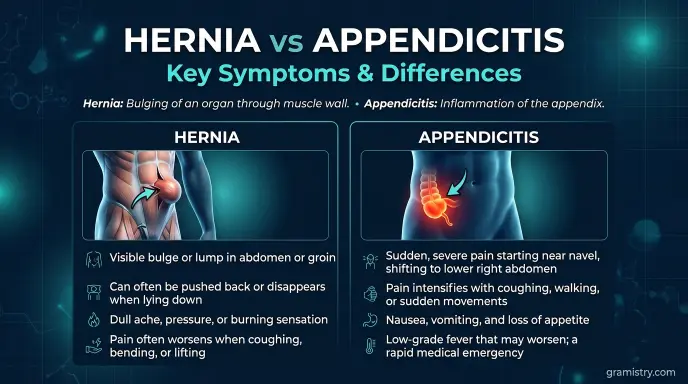
Appendicitis means inflammation of the appendix, a small finger-shaped pouch attached to the large intestine. The appendix is located in the lower-right area of the abdomen.
Unlike a hernia, appendicitis is not simply a weak spot in the abdominal wall. It is an inflammatory condition involving the appendix.
How Do You Pronounce “Appendicitis”?
Appendicitis is commonly pronounced approximately as uh-PEN-di-SY-tis.
It is also a noun.
Example:
“The patient was taken to the hospital because doctors suspected appendicitis.”
What Are the Symptoms of Appendicitis?
The classic symptom is abdominal pain.
In many people, the pain starts near the belly button and then moves toward the lower-right side of the abdomen. The pain can become increasingly severe and may worsen with movement, coughing, or sneezing.
Other symptoms can include:
- Loss of appetite
- Nausea
- Vomiting
- Fever
- Abdominal swelling or bloating
- Constipation
- Diarrhea
- Difficulty passing gas
Not everyone experiences the classic pattern. Symptoms can vary, particularly in children and older adults.
What Causes Appendicitis?
Appendicitis can have several possible causes. In some cases, the opening of the appendix becomes blocked. Hardened stool, enlarged tissue, or other processes may contribute to the blockage. Inflammation and infection can then develop.
If appendicitis is not treated promptly, the appendix can rupture. A rupture may spread infection inside the abdomen and cause serious complications such as peritonitis or an abscess.
Appendicitis Example Sentences
- “The doctor suspected appendicitis after examining his abdominal pain.”
- “Her pain moved from around the belly button to the lower-right abdomen.”
- “Appendicitis can require urgent medical treatment.”
- “The patient had nausea, fever, and worsening abdominal pain.”
- “Doctors used imaging to help confirm the diagnosis.”
Key Differences Between Hernia and Appendicitis
Although both conditions can involve abdominal pain, their causes and typical symptoms are different.
Main Differences
- Cause: A hernia results from tissue pushing through a weak area; appendicitis involves inflammation of the appendix.
- Typical visible sign: A hernia may cause a noticeable lump or bulge.
- Typical pain pattern: Appendicitis often causes progressively worsening abdominal pain, commonly moving toward the lower-right abdomen.
- Location: Hernias can occur in the groin, belly button, abdomen, diaphragm area, or other sites. Appendicitis involves the appendix.
- Emergency risk: Both can become serious, but untreated appendicitis can lead to a ruptured appendix and infection.
- Treatment: Hernia treatment depends on its type and severity and may involve monitoring or surgery. Appendicitis is commonly treated with an appendectomy, although selected mild cases may sometimes be treated with antibiotics alone.
- Diagnosis: Doctors use physical examination and, when necessary, imaging and laboratory tests to determine the cause.
Hernia vs Appendicitis Comparison Table
| Feature | Hernia | Appendicitis |
|---|---|---|
| Basic definition | Tissue or an organ pushes through a weak area | Inflammation of the appendix |
| Common location | Groin, abdomen, belly button, diaphragm area | Usually associated with the lower-right abdomen |
| Common symptom | Lump, bulge, pressure, or localized pain | Worsening abdominal pain |
| Visible lump | Often possible | Usually not the typical feature |
| Nausea/vomiting | Can occur with complications | Common possible symptoms |
| Fever | May occur with complications | Can occur |
| Diagnosis | Examination and sometimes imaging | Examination, blood/urine tests, and imaging when needed |
| Treatment | Depends on type and symptoms; surgery may be needed | Usually appendectomy; antibiotics may be appropriate in selected cases |
| Major concern | Incarceration or strangulation | Rupture, abscess, or peritonitis |
| Urgency | Varies by symptoms and type | Suspected appendicitis requires prompt medical evaluation |
Real-Life Conversation Examples
Conversation 1: A New Lump
Sam: “I noticed a lump near my groin when I stood up.”
Alex: “Does it become more noticeable when you cough or strain?”
Sam: “Yes, actually.”
Alex: “That can happen with a hernia. You should have it checked by a healthcare professional.”
🎯 Lesson: A bulge that changes with coughing, straining, or position can be a sign of a hernia, but only an examination can establish the diagnosis.
Conversation 2: Worsening Abdominal Pain
Ali: “My stomach started hurting around my belly button, and now the pain is mostly on the lower right.”
Sara: “Is the pain getting worse?”
Ali: “Yes, and I feel sick.”
Sara: “You should get medical attention promptly.”
🎯 Lesson: Worsening abdominal pain that moves toward the lower-right abdomen can occur with appendicitis and deserves urgent assessment.
Conversation 3: Assuming Every Abdominal Pain Is a Hernia
John: “I have pain near my abdomen, so I think I have a hernia.”
Doctor: “Abdominal pain can have many causes. Do you have a lump?”
John: “No.”
Doctor: “Then we need to examine you rather than assume the cause.”
🎯 Lesson: Abdominal pain alone does not prove that you have a hernia or appendicitis.
Conversation 4: Appendicitis Warning Signs
Mia: “My abdominal pain is becoming severe, and now I have a fever.”
Tom: “Have you been evaluated?”
Mia: “Not yet.”
Tom: “Please seek medical care rather than waiting for it to disappear.”
🎯 Lesson: Severe or worsening abdominal pain, particularly with symptoms such as fever, nausea, or vomiting, should not be ignored.
When to Use “Hernia” vs “Appendicitis”
There is an important distinction here: hernia and appendicitis are medical conditions, not interchangeable vocabulary choices.
You should use hernia when you are referring to tissue or an organ pushing through a weak area.
Example:
“The patient has an inguinal hernia.”
Use appendicitis when you are referring to inflammation of the appendix.
Example:
“The patient was evaluated for possible appendicitis.”
Easy Memory Trick
Think of it this way:
Hernia = “something pushes through.”
Appendicitis = “the appendix becomes inflamed.”
This simple distinction can help you remember the basic difference.
US vs UK Usage
The terms hernia and appendicitis are standard medical English terms in both American and British English. The underlying medical meanings do not change based on whether the reader is in the United States, United Kingdom, Canada, Australia, or another English-speaking region.
What can differ is the healthcare system, terminology for services, and spelling of some related words—not the basic definition of these two conditions.
Formal and Academic Writing
In medical, academic, or educational writing, avoid using the terms loosely.
Instead of:
“He probably has appendicitis because his stomach hurts.”
A more accurate sentence is:
“His symptoms may be consistent with appendicitis, but a healthcare professional must evaluate the cause.”
That wording avoids presenting an unconfirmed diagnosis as fact.
How Doctors Tell a Hernia From Appendicitis
Because abdominal pain can have many causes, doctors do not rely on one symptom alone.
1. Medical History
A healthcare professional may ask:
- When did the pain begin?
- Where did it start?
- Has it moved?
- Is it getting worse?
- Is there a lump?
- Does coughing or straining change the pain?
- Do you have fever, nausea, vomiting, constipation, or diarrhea?
- Have you had previous surgery?
These details can help narrow down possible causes.
2. Physical Examination
For a suspected hernia, a clinician may examine areas such as the abdomen and groin for a bulge or tenderness.
For suspected appendicitis, the doctor may examine the abdomen and assess tenderness, particularly around the lower-right side.
3. Blood and Urine Tests
Blood tests may provide evidence of inflammation or infection. A urine test can also help doctors consider other causes of abdominal pain, such as a urinary infection or kidney stone.
4. Imaging
Depending on the situation, doctors may use ultrasound, CT, or MRI.
Imaging can help identify appendicitis or reveal another cause of abdominal pain. Ultrasound is particularly useful in certain groups, including children and pregnant patients, while the appropriate imaging method depends on the individual situation.
Treatment: Hernia vs Appendicitis
Hernia Treatment
Treatment depends on the type of hernia, its symptoms, its size, and whether complications are present.
Some hernias may initially be monitored, while symptomatic or problematic hernias may require surgical repair. The NHS notes that treatment can include surgery, depending on the circumstances.
Inguinal hernia repair can be performed through open surgery or keyhole, also called laparoscopic, surgery. In some repairs, surgeons use mesh to strengthen the affected area.
A hernia should not be diagnosed or treated based only on information from an online article.
Appendicitis Treatment
Appendicitis commonly requires treatment in a hospital. The standard treatment has traditionally been appendectomy, which means surgical removal of the appendix. Antibiotics are also commonly given, particularly around surgery.
Some selected mild cases may be treated with antibiotics alone, but this approach is not appropriate for everyone. Doctors consider the person’s symptoms, test results, overall health, and other factors.
If an appendix ruptures, treatment may involve surgery, antibiotics, and management of complications such as an abscess or peritonitis.
Common Mistakes People Make
Mistake 1: “Every abdominal lump is appendicitis.”
Incorrect:
“There’s a lump, so it must be appendicitis.”
Better:
“A lump may have several possible causes, including a hernia, and needs medical assessment.”
Why: Appendicitis typically involves inflammation of the appendix rather than a visible abdominal-wall bulge.
Mistake 2: “Every lower-right abdominal pain is appendicitis.”
Incorrect:
“Pain on the lower right automatically means appendicitis.”
Better:
“Lower-right abdominal pain can occur with appendicitis, but other conditions can cause similar symptoms.”
Why: Abdominal pain has many possible causes, so diagnosis requires clinical evaluation.
Mistake 3: “A hernia always hurts.”
Incorrect:
“If it doesn’t hurt, it can’t be a hernia.”
Correct:
“Some hernias cause little or no pain.”
The NHS notes that some hernias may produce a lump without significant pain.
Mistake 4: “Appendicitis always starts in the lower-right abdomen.”
Incorrect:
“Appendicitis always begins on the lower right.”
Correct:
“In many people, appendicitis pain starts around the belly button and later moves toward the lower-right abdomen.”
The classic pattern does not occur in every patient.
When Should You Seek Urgent Medical Care?
Do not try to determine hernia or appendicitis from symptoms alone if you have significant abdominal pain.
Seek urgent medical evaluation if you experience:
- Severe or rapidly worsening abdominal pain
- Persistent vomiting
- Fever with significant abdominal pain
- A painful or increasingly tender hernia
- Abdominal swelling or bloating with severe symptoms
- Fainting, confusion, or feeling extremely unwell
- Symptoms that make you concerned about appendicitis
Suspected appendicitis deserves prompt assessment because untreated inflammation can progress to a ruptured appendix, peritonitis, or an abscess.
Similarly, a hernia accompanied by significant pain, vomiting, bloating, fever, or other concerning symptoms needs urgent medical attention.
If you currently have severe or worsening abdominal pain, do not wait for an online article to tell you which condition you have. Seek urgent medical care.
Fun Facts and History
1. Appendicitis Is Relatively Common
NIDDK estimates that approximately 5 to 9 out of every 100 people develop appendicitis at some point.
2. The Appendix Is Attached to the Large Intestine
The appendix is a small, finger-shaped pouch connected to the large intestine in the lower-right area of the abdomen.
3. Hernias Can Occur in Several Locations
People often associate hernias only with the groin, but hernias can occur in areas including the belly button, diaphragm, upper thigh, abdominal wall, and sites of previous surgery.
4. Appendicitis Does Not Always Look the Same
Although the classic pain pattern is well known, symptoms can vary. Some people, particularly children, may not experience every typical symptom.
FAQs:
1. How can I tell if I have a hernia or appendicitis?
A hernia often causes a noticeable lump or bulge that may become more obvious with coughing or straining. Appendicitis more commonly causes worsening abdominal pain, often beginning near the belly button and moving toward the lower-right abdomen, sometimes with nausea, vomiting, fever, or appetite loss. However, symptoms overlap with many other conditions, so a doctor should make the diagnosis.
2. Can a hernia cause lower-right abdominal pain?
Yes. A hernia can cause pain or discomfort depending on its location and whether complications develop. However, lower-right abdominal pain can also have many other causes, including appendicitis. The location of pain alone cannot reliably distinguish the two conditions. If pain is severe, persistent, or worsening, seek medical evaluation rather than trying to diagnose the cause yourself.
3. Is appendicitis more dangerous than a hernia?
Neither condition should automatically be considered harmless. An untreated appendicitis can cause the appendix to rupture and lead to serious infection, including peritonitis. Hernias can also develop complications, particularly when tissue becomes trapped or its blood supply is compromised. The urgency depends on the individual symptoms and findings, so concerning abdominal symptoms should be assessed promptly.
4. Does a hernia always cause a lump?
No. Some hernias may not produce an obvious external lump, depending on their type and location. Other hernias create a bulge that becomes more noticeable when standing, coughing, sneezing, or straining. Because not every hernia looks the same, a healthcare professional may need to examine the area to determine whether a hernia is present.
5. Can appendicitis go away on its own?
You should not assume that suspected appendicitis will simply go away. Appendicitis can progress and may cause a ruptured appendix and serious infection if untreated. Some carefully selected mild cases can be managed with antibiotics, but that decision belongs to a healthcare professional after evaluation. If you think you may have appendicitis, seek medical care promptly.
6. What does appendicitis pain usually feel like?
Appendicitis commonly causes abdominal pain that may begin near the belly button and then move toward the lower-right abdomen. The pain often becomes stronger over time and may worsen with movement, coughing, or sneezing. However, not every person experiences this classic pattern, so unusual abdominal pain should not automatically rule out appendicitis.
7. Can a hernia cause nausea and vomiting?
It can, particularly when a hernia becomes complicated. Nausea, vomiting, abdominal bloating, significant pain, constipation, or fever in someone with a hernia can be warning signs requiring urgent medical attention. These symptoms should not be dismissed as a routine part of having a hernia.
8. What tests are used to diagnose appendicitis?
Doctors may use a medical history, physical examination, blood tests, urine testing, and imaging. Depending on the patient, imaging may include ultrasound, CT, or MRI. The choice depends on factors such as age, pregnancy status, symptoms, and what other conditions need to be ruled out.
9. Does every hernia need surgery?
Not necessarily. Treatment depends on the type of hernia, symptoms, size, overall health, and risk of complications. Some people may be monitored, while others may benefit from surgical repair. A healthcare professional can explain whether observation or repair is appropriate for an individual case.
10. Can I diagnose hernia or appendicitis at home?
No. You can recognize warning signs, but you cannot reliably diagnose either condition at home. Abdominal pain can result from many problems that have similar symptoms. A healthcare professional may need to perform an examination and, for suspected appendicitis, order laboratory or imaging tests.
Final Takeaway:
A hernia and appendicitis are completely different medical conditions.
A hernia occurs when tissue or an organ pushes through a weak area, often producing a lump or localized discomfort.
Appendicitis involves inflammation of the appendix and commonly causes worsening abdominal pain, sometimes accompanied by nausea, vomiting, fever, or appetite loss.
The most important point is not to rely on a symptom checklist to diagnose yourself.
Severe or worsening abdominal pain deserves medical attention, especially when appendicitis or a complicated hernia is possible.
For readers using Gramistry as an educational language resource, the key distinction is simple:
hernia describes a structural problem, while appendicitis describes inflammation of the appendix.
Next time someone uses these two words, you’ll know exactly what they mean!

Alina Mark is the creative voice behind Gramistry.com, making word meanings, English expressions, and trending slang simple, clear, and interesting. Her mission is to make every word easier to understand, one meaning at a time.