

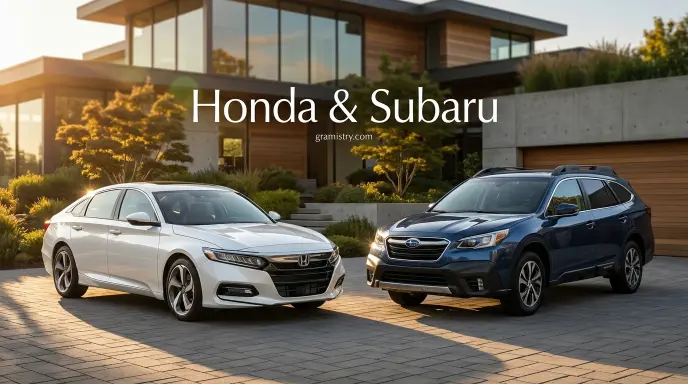
Choosing between Honda or Subaru can be surprisingly difficult. Both are Japanese automakers with strong reputations, practical vehicles, and loyal owners.
However, they take different approaches to designing cars.
Honda is widely known for efficient powertrains, practical packaging, broad vehicle choices, and a long history of engineering innovation.
Subaru, meanwhile, has built its identity around all-wheel drive, safety, rugged capability, and adventure-focused vehicles.
So, which one should you choose?
The answer depends on what you need from your next vehicle. Although they look or sound similar, they serve completely different purposes.
In this guide, we’ll compare Honda and Subaru in terms of reliability, AWD, fuel economy, SUVs, hybrids, safety, driving experience, maintenance, price, and everyday practicality.
Whether you’re shopping for a commuter car, family SUV, or adventure vehicle, this Honda vs. Subaru comparison will help you make a more informed decision.
What Is Honda?
Honda is a Japanese automotive company officially established in September 1948 by Soichiro Honda and his business partner Takeo Fujisawa. The company began with motorcycles and engines before expanding into automobiles and other products. Honda’s first original product was the A-Type auxiliary bicycle engine, introduced in 1947, and its first full-fledged motorcycle, the Dream D-Type, followed in 1949.
Today, Honda produces motorcycles, automobiles, and power products. Its automotive lineup has included well-known models such as the Civic, Accord, CR-V, Pilot, and Odyssey.
What Is Honda Known For?
Honda has traditionally focused on vehicles that balance:
- Fuel efficiency
- Practicality
- Everyday comfort
- Responsive handling
- Efficient engines and powertrains
- Useful interior space
- Broad model availability
- Long-term ownership value
Honda also has a long engineering history. The company entered the four-wheel vehicle business in the early 1960s and continued developing its automotive technology alongside its motorcycle operations.
Honda’s Vehicle Personality
A typical Honda tends to feel like an all-purpose vehicle. It is often designed for people who want a practical car that can handle commuting, errands, road trips, and family use without emphasizing extreme off-road capability.
For example, a Honda Civic can make sense for a daily commuter, while a CR-V can serve as a family crossover. Larger Honda models offer additional passenger and cargo capacity.
Honda Example
Example: “I chose a Honda CR-V because I wanted a comfortable SUV with good everyday practicality and available hybrid technology.”
The important point is that Honda is a brand name, not a grammar term or a word with a special language rule. When someone searches for “Honda or Subaru,” they are normally asking which automotive brand or vehicle is the better choice.
What Is Subaru?
Subaru is another Japanese automotive brand, but its history is somewhat different from Honda’s. Subaru’s corporate roots can be traced to the Aircraft Research Laboratory established in 1917. Fuji Heavy Industries was established in 1953, and the Subaru 360 became the company’s first Subaru automobile in 1958. Fuji Heavy Industries was renamed Subaru Corporation in 2017.
Subaru’s aviation heritage has influenced its engineering philosophy. The company says safety has been a central priority because of its roots in aircraft development.
What Is Subaru Known For?
Subaru is particularly associated with:
- Symmetrical all-wheel drive
- Boxer engines
- SUV and crossover vehicles
- Outdoor-oriented driving
- Safety technology
- Practical cargo areas
- All-weather confidence
- Distinctive engineering
Subaru identifies the horizontally opposed engine and Symmetrical AWD as core automotive technologies.
Subaru’s Vehicle Personality
A Subaru often appeals to drivers who spend time outdoors or regularly deal with rain, snow, gravel roads, steep driveways, or other challenging conditions.
Models such as the Forester and Outback have helped define Subaru’s reputation as an adventure-oriented crossover and SUV brand.
Subaru Example
Example: “I chose a Subaru Forester because standard all-wheel drive and its outdoor-friendly design were important to me.”
Subaru is therefore not simply another name for Honda. The two companies have different product philosophies and different strengths.
Honda vs Subaru: Key Differences

The easiest way to understand Honda or Subaru is to compare what each brand emphasizes.
Honda generally stands out for:
- Fuel-efficient daily driving
- Hybrid options
- Broad vehicle selection
- Comfortable urban commuting
- Practical interior design
- Sedans and family vehicles
- Balanced handling
- Strong all-around versatility
Subaru generally stands out for:
- Standard AWD on many models
- Outdoor-oriented vehicles
- All-weather traction
- Boxer-engine architecture
- SUV and crossover focus
- Adventure-oriented practicality
- Safety-focused engineering
- Gravel, snow, and rough-weather confidence
Quick Answer
Choose Honda if you prioritize efficiency, everyday versatility, hybrid choices, and a broad range of vehicles. Choose Subaru if standard all-wheel drive, outdoor capability, and all-weather confidence are major priorities.
Neither brand is automatically better for everyone.
Honda vs Subaru Comparison Table
| Feature | Honda | Subaru |
|---|---|---|
| Brand origin | Japan | Japan |
| Automotive history | Entered automobile business in the 1960s | First Subaru automobile launched in 1958 |
| Main reputation | Efficiency and practicality | AWD, safety, and adventure |
| AWD availability | Available on selected models | A major part of Subaru’s lineup |
| Hybrid options | Strong and growing presence | Hybrid options are also expanding |
| Sedans | Strong selection | More limited |
| SUVs/Crossovers | Strong selection | Major focus |
| Outdoor driving | Good, depending on model | Particularly strong |
| Snow and poor-weather traction | Model-dependent | AWD is a major strength |
| Best for | Daily driving and broad needs | All-weather and outdoor lifestyles |
Subaru itself describes Symmetrical AWD and its boxer engine as core technologies, while Honda’s product history reflects a broader approach across motorcycles, automobiles, and power products.
Real-Life Conversation Examples
Conversation 1: The Daily Commuter
Alex: “Should I buy a Honda or Subaru?”
Sam: “How much do you drive every day?”
Alex: “Mostly city roads and highways.”
Sam: “Then I’d compare Honda’s efficient models first. You may not need AWD.”
🎯 Lesson: If your driving is mainly urban and highway commuting, Honda may offer the broader selection of practical choices.
Conversation 2: The Snowy Climate
Mia: “I live somewhere with heavy winter weather. Honda or Subaru?”
Jake: “I’d look closely at Subaru’s AWD-equipped models.”
Mia: “Why?”
Jake: “AWD is one of Subaru’s defining strengths, especially for drivers who regularly deal with difficult road conditions.”
🎯 Lesson: Subaru deserves serious consideration when all-weather traction is a high priority.
Conversation 3: The Outdoor Driver
Chris: “I go camping and hiking almost every weekend.”
Taylor: “Then Subaru could be a better match.”
Chris: “Because of the SUVs?”
Taylor: “Yes. Its lineup and engineering philosophy are strongly connected to outdoor and all-weather driving.”
🎯 Lesson: Your lifestyle can matter more than brand reputation when choosing a vehicle.
Conversation 4: The Hybrid Shopper
Nina: “I want a hybrid SUV. Honda or Subaru?”
David: “Compare the specific models rather than choosing the brand first.”
Nina: “Why?”
David: “Hybrid systems, pricing, fuel economy, AWD, cargo space, and features can vary significantly by model.”
🎯 Lesson: For hybrid shopping, compare individual vehicles instead of assuming one brand always wins.
When to Choose Honda vs Subaru
There is no single answer to “Honda or Subaru?” The better choice depends on your priorities.
Choose Honda If You Want:
1. A Practical Daily Driver
Honda is worth considering if most of your driving involves commuting, errands, school runs, and highway trips.
2. Strong Hybrid Choices
Honda has invested heavily in hybrid powertrains, making its hybrid models important options for shoppers who want better fuel efficiency without moving directly to a fully electric vehicle.
3. A Sedan
If you specifically want a traditional sedan, Honda deserves a close look because sedans have historically been an important part of its lineup.
4. Broad Vehicle Choice
Honda’s automotive range covers multiple vehicle types, giving buyers more ways to stay within the same brand as their needs change.
Choose Subaru If You Want:
1. Standard AWD on Many Models
Subaru’s Symmetrical AWD system is one of the brand’s defining features. Its current lineup continues to emphasize AWD as a core part of its identity.
2. Outdoor Capability
If hiking, camping, skiing, fishing, or driving on unpaved roads is part of your lifestyle, Subaru’s crossover-focused lineup may fit your needs particularly well.
3. All-Weather Confidence
Drivers who regularly encounter snow, rain, or slippery roads may place a higher value on Subaru’s AWD-focused approach.
4. SUV/Crossover Practicality
Subaru has concentrated its U.S. strategy heavily around SUVs and sports-oriented vehicles.
Honda vs Subaru: What About Hybrid Models?
Hybrid technology makes the Honda vs Subaru decision more interesting.
The right comparison should be model versus model, not simply brand versus brand.
For example, Subaru currently markets the 2026 Forester Hybrid, which has standard Symmetrical AWD. Subaru’s own comparison with the Honda CR-V Hybrid highlights AWD as one of the major differences between the two vehicles.
This does not mean every Honda hybrid is inferior or every Subaru hybrid is superior. Instead, it shows why shoppers should compare:
- Starting price
- Fuel economy
- AWD availability
- Cargo space
- Passenger room
- Powertrain performance
- Warranty
- Maintenance costs
- Safety features
- Local dealer support
Tip: Never choose a hybrid simply because it has the word “hybrid” in the name. Look at the complete ownership picture.
Honda or Subaru for Reliability?
This is one of the most common questions, but it needs a careful answer.
It is too simplistic to say “Honda is always more reliable” or “Subaru is always more reliable.” Reliability depends on the specific model, model year, powertrain, maintenance history, driving conditions, and previous ownership.
A well-maintained vehicle can provide years of useful service, regardless of brand.
When evaluating reliability, look beyond internet stereotypes and check:
- Specific model-year reliability data
- Recalls
- Technical service information
- Maintenance requirements
- Repair history
- Warranty coverage
- Owner reviews
- Independent inspection results
For a used vehicle, condition and maintenance records can be more important than the badge on the hood.
Quick rule: Compare Honda Civic vs. Subaru Impreza, Honda CR-V vs. Subaru Forester, or another genuinely comparable pair rather than comparing the brands in isolation.
Honda or Subaru for Snow?
If snow is your biggest concern, Subaru has a natural advantage because AWD is central to its product philosophy.
Subaru describes its Symmetrical AWD system as a core technology and connects it with its horizontally opposed engine architecture.
However, AWD is not a substitute for good tires or careful driving.
A vehicle’s winter performance can also depend on:
- Tire quality
- Winter tires
- Ground clearance
- Vehicle weight
- Electronic stability systems
- Driver behavior
- Road conditions
A Honda equipped with suitable tires can still perform well in many winter conditions. The question is whether you need Subaru’s AWD-focused approach enough to make it a deciding factor.
Honda or Subaru for Everyday Driving?
For ordinary commuting, both can work well.
Honda may appeal more to someone who wants a conventional, efficient, versatile vehicle. Subaru may appeal more to someone who wants the additional confidence and capability associated with AWD.
Think about your actual week.
If your routine looks like:
Home → office → grocery store → school → highway → home
Honda may be an excellent fit.
If it looks like:
Home → mountain road → trailhead → ski resort → gravel road → home
Subaru may make more sense.
The best car is not necessarily the one with the most impressive specifications. It is the one that matches your real driving conditions.
Common Mistakes People Make
Mistake 1: Assuming AWD Means Better in Every Situation
Wrong idea: “Subaru has AWD, so it is automatically better.”
Better approach: AWD can provide advantages in certain conditions, but it does not make a vehicle universally superior.
Mistake 2: Comparing Brands Instead of Models
Wrong idea: “Honda is better than Subaru.”
Better approach: Compare similar vehicles from each brand based on price, equipment, powertrain, space, and intended use.
Mistake 3: Ignoring Tires
Wrong idea: “I have AWD, so I don’t need winter tires.”
Better approach: AWD helps a vehicle put power down, but tires remain critical for braking and traction.
Mistake 4: Choosing Based Only on Reliability Reputation
Wrong idea: “This brand is Japanese, so it must never break.”
Better approach: Research the exact model year and maintain the vehicle properly.
Mistake 5: Looking Only at the Purchase Price
The cheapest vehicle to buy is not necessarily the cheapest vehicle to own. Consider insurance, fuel, maintenance, depreciation, tires, financing, and expected repairs.
Fun Facts and History
1. Honda Started With Engines and Motorcycles
Honda was officially established in 1948 after beginning with auxiliary bicycle engines. Its first full-fledged motorcycle, the Dream D-Type, arrived in 1949.
2. Subaru Has Aviation Roots
Subaru’s corporate history traces back to the Aircraft Research Laboratory established in 1917. The company later evolved through several reorganizations before Fuji Heavy Industries was established in 1953.
3. Subaru Is Named After a Star Cluster
The name symbolizes the unity of the companies that came together to form Fuji Heavy Industries.
4. Subaru’s Automotive Story Began With the 360
The Subaru 360 launched in 1958 and became the company’s first automobile.
FAQs:
1. Is Honda or Subaru better?
Neither brand is universally better. Honda may be a better fit for buyers who prioritize efficiency, everyday practicality, and a broad range of vehicles. Subaru may be preferable for drivers who value AWD, all-weather confidence, and outdoor-oriented vehicles.
2. Is Honda more reliable than Subaru?
You should not assume that one brand is always more reliable. Reliability varies by model year, engine, transmission, maintenance history, and driving conditions. When shopping used, investigate the exact vehicle rather than relying only on a brand-wide reputation.
3. Is Subaru better than Honda in snow?
Subaru can be particularly attractive in snowy regions because AWD is a major part of its lineup. However, winter tires, road conditions, driving technique, and ground clearance also matter. AWD alone does not guarantee better braking or safe driving on ice.
4. Which is cheaper to maintain, Honda or Subaru?
Maintenance costs depend on the specific model and how you use it. Routine service, tires, brakes, fluids, insurance, and repairs should all be considered. Before buying, compare maintenance schedules and local service costs for the exact Honda and Subaru models you are considering.
5. Which has better SUVs, Honda or Subaru?
It depends on what you expect from an SUV. Honda offers versatile family-oriented SUVs and crossovers, while Subaru places greater emphasis on AWD and outdoor-oriented vehicles. Compare models such as the CR-V and Forester based on your priorities instead of choosing by brand alone.
6. Is Honda or Subaru better for families?
Both can be good family choices. Honda may appeal to families seeking broad practicality, efficient powertrains, and flexible vehicle choices. Subaru can be especially attractive to families who regularly drive in challenging weather or enjoy outdoor activities. Passenger space, cargo capacity, safety equipment, and child-seat compatibility should all be checked.
7. Which is better for highway driving, Honda or Subaru?
Both brands offer vehicles suitable for highway travel. Honda may appeal to drivers focused on efficiency and comfortable long-distance commuting, while Subaru may be attractive to drivers who want AWD and all-weather confidence. Compare seat comfort, road noise, fuel economy, driver assistance, and cargo needs.
8. Does every Subaru have AWD?
Subaru has made AWD a central part of its automotive identity, and many current Subaru vehicles feature standard Symmetrical AWD. However, equipment can vary by model and market, so always verify the specifications for the exact vehicle you are buying.
9. Which is better for outdoor adventures, Honda or Subaru?
Subaru is often the more natural choice for buyers who frequently camp, hike, ski, or travel on gravel roads because of its AWD-focused lineup and outdoor-oriented vehicle designs. However, the right Honda can also handle many recreational activities, especially when equipped appropriately.
10. Should I buy a Honda or Subaru in 2026?
Start with your driving needs rather than the brand name. Compare the exact models you are considering for price, fuel economy, AWD, hybrid availability, cargo space, safety features, warranty, maintenance, and local service support. A careful model-to-model comparison will give you a more useful answer than choosing a winner for the entire brand.
Conclusion:
So, Honda or Subaru which one should you choose?
Choose Honda if your priorities are efficient everyday driving, practical design, hybrid options, broad model choice, and general versatility.
Choose Subaru if AWD, all-weather confidence, outdoor activities, and SUV/crossover capability are more important to you.
The biggest mistake is looking for one universal winner.
There isn’t one. A commuter in a warm climate may have very different needs from a family living in a snowy mountain region.
The smartest approach is to identify your driving conditions first and then compare the specific models that fit your budget.
Resources such as Gramistry can help readers understand confusing comparisons and terminology, but the final vehicle decision should always be based on current specifications, ownership costs, and your personal needs.
Next time someone uses these two words, you’ll know exactly what they mean!

Alina Mark is the creative voice behind Gramistry.com, making word meanings, English expressions, and trending slang simple, clear, and interesting. Her mission is to make every word easier to understand, one meaning at a time.