
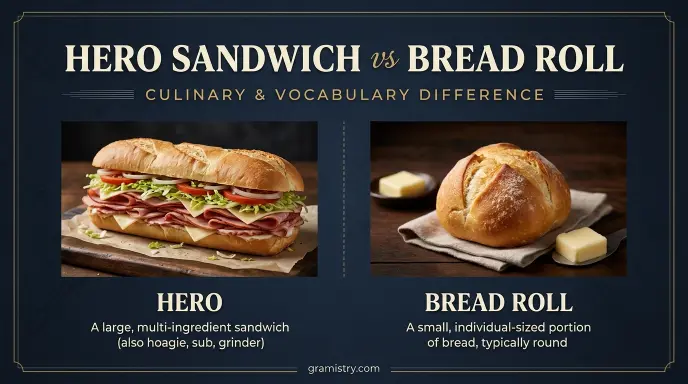
If you have ever ordered a sandwich and wondered whether to call the bread a hero or a roll, you are not alone.
English has many regional food words, and sandwich terminology is a perfect example.
The same basic type of bread can have different names depending on where you live, what kind of sandwich you are describing, and how the bread is prepared.
The confusion becomes even greater because hero can refer to the entire sandwich, while roll usually describes the bread itself.
So, are hero and roll interchangeable? Not always.
Although they look or sound similar, they serve completely different purposes.
In this guide, we will explain what hero and roll mean, how they are used, where the terms are common, and how to choose the right word in everyday, informal, and formal writing.
If you enjoy learning practical English distinctions, Gramistry can be a useful educational language resource for understanding these subtle differences.
What Is a Hero?
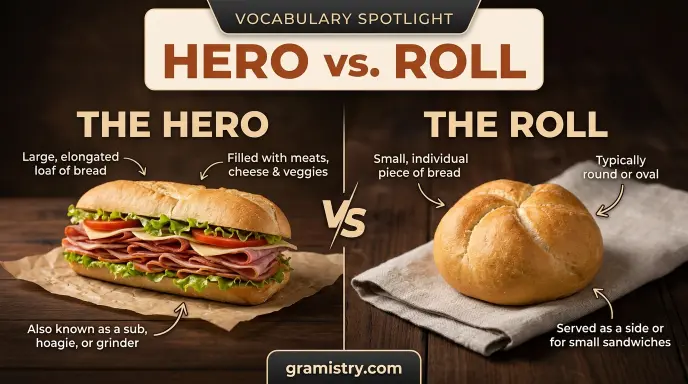
A hero is a type of long sandwich, especially a sandwich associated with Italian-American food traditions. The word is particularly common in New York City and parts of the northeastern United States.
Quick Definition
Hero: A long sandwich, usually made with a long, crusty bread roll and filled with ingredients such as meat, cheese, vegetables, or sauces.
A hero can contain many different fillings. For example, a hero might include sliced turkey and cheese, Italian meats, meatballs, chicken cutlets, or grilled vegetables.
The important point is that hero generally refers to the sandwich as a whole, not simply the piece of bread.
Examples
- I ordered an Italian hero for lunch.
- She made a chicken cutlet hero with mozzarella.
- That deli is famous for its meatball heroes.
- He picked up a turkey hero on his way home.
In these sentences, hero describes the finished sandwich.
Is “Hero” a Grammar Term?
No. In this context, hero is a noun used as a food term.
The word has another, much more familiar meaning: a person admired for courage or exceptional actions. For example:
The firefighter was called a hero after rescuing the family.
The food meaning is completely different from this general meaning.
Where Is “Hero” Used?
The sandwich meaning of hero is strongly associated with New York and the northeastern United States.
Other parts of the United States may use different names for a similar sandwich. Depending on the region, you may hear:
- sub
- hoagie
- grinder
- Italian sandwich
- po’ boy, for a different regional sandwich style
- roll, when referring specifically to the bread
This is an important lesson in English: regional vocabulary can describe the same or closely related foods in different ways.
Where Did the Word “Hero” Come From?
The exact origin of hero as a sandwich term is not completely settled. It is generally treated as a regional American food term, especially associated with New York.
Several explanations for the word’s origin have circulated over the years, but they should not be presented as established fact without strong historical evidence. This is a good example of why popular word-origin stories should be treated carefully.
Common Mistake With “Hero”
One common mistake is using hero when you mean only the bread.
For example:
Less precise: I bought a hero to put cheese in.
If you mean the bread itself, roll is usually more appropriate.
Better: I bought a long roll to make a sandwich.
The distinction is simple:
Hero = the sandwich.
Roll = the bread.
However, regional usage can blur this distinction in everyday speech.
What Is a Roll?

A roll is a small or relatively compact piece of bread, often served individually or used to make a sandwich.
Quick Definition
Roll: A portion of bread, usually smaller than a loaf and often shaped as an individual serving or a long piece suitable for a sandwich.
The word roll is much broader than hero. A roll can be round, oval, oblong, or elongated.
For example:
- dinner roll
- bread roll
- sandwich roll
- kaiser roll
- hoagie roll
- sub roll
- hard roll
So, when someone says roll, they may be talking about the bread rather than a complete sandwich.
Examples
- I bought six dinner rolls for the meal.
- Put the chicken inside the sandwich roll.
- The bakery sells fresh crusty rolls every morning.
- We need a few rolls for the sandwiches.
Notice that none of these sentences necessarily describes a complete sandwich.
Is “Roll” a Grammar Term?
In this context, roll is a noun.
It can also be a verb with completely different meanings:
Please roll the dough into a circle.
It can also describe movement:
The ball began to roll down the hill.
Because roll has several meanings, context determines what the speaker means.
What Does “Roll” Mean in Sandwich Vocabulary?
When discussing sandwiches, roll usually refers to the bread used to hold the filling.
For example:
I bought a fresh roll for my sandwich.
This does not necessarily mean the sandwich already exists. You may simply have purchased the bread.
Compare that with:
I bought a chicken hero.
Here, the sentence normally refers to the completed sandwich.
Long Rolls and Sandwiches
A long roll can be used to make many kinds of sandwiches. Depending on the region and sandwich style, it might be called a:
- sub roll
- sandwich roll
- hero roll
- hoagie roll
- Italian roll
- long roll
The exact terminology varies by region, bakery, restaurant, and local tradition.
Common Mistake With “Roll”
Another common mistake is assuming that every roll is a hero.
That is not correct.
A roll can simply be bread. A dinner roll served beside soup is still a roll, but it is not a hero.
Correct: We served warm rolls with dinner.
Calling those rolls “heroes” would change the meaning and sound unnatural in most varieties of English.
Key Differences Between Hero and Roll
The easiest way to understand the difference is to ask whether you are talking about the sandwich or the bread.
Main Differences
- Hero generally refers to a complete long sandwich.
- Roll generally refers to a piece or type of bread.
- Hero is strongly associated with regional American sandwich vocabulary.
- Roll is a much broader English word used in many countries.
- A hero can be made using a long roll.
- A roll does not automatically contain sandwich fillings.
- Hero has a separate everyday meaning referring to a courageous or admired person.
- Roll has several meanings as both a noun and a verb.
- Regional vocabulary can affect which sandwich term sounds most natural.
Hero vs Roll Comparison Table
| Feature | Hero | Roll |
|---|---|---|
| Basic meaning | A type of long sandwich | A piece or type of bread |
| Usually refers to | The complete sandwich | The bread |
| Grammar | Noun | Noun; also a verb |
| Regional use | Especially associated with New York/Northeast U.S. | Widely used in English |
| Can contain fillings? | Yes, by definition as a sandwich | It may or may not |
| Can be used to make a sandwich? | No, it is already the sandwich | Yes |
| Example | “I ordered a meatball hero.” | “I bought a fresh roll.” |
| Main context | Food and regional sandwich vocabulary | Bread, food, movement, and other contexts |
Hero or Roll: Which One Should You Use?
Use hero when you are talking about the finished sandwich.
Use roll when you are talking about the bread itself.
A simple memory trick is:
Hero = sandwich. Roll = bread.
For example:
If you are buying bread:
I need a long roll for the sandwiches.
If you are ordering lunch:
I’ll have a chicken hero.
This rule works well in most situations, but regional vocabulary matters. Someone in New York may naturally say hero, while someone elsewhere may prefer sub, hoagie, grinder, or another local term.
What About “Hero Roll”?
You may also encounter the expression hero roll.
In that phrase, hero modifies roll to identify the type of bread intended for a hero-style sandwich.
For example:
The bakery sells fresh hero rolls.
Here, the speaker is talking about bread, not a completed sandwich.
This is why context matters.
Real-Life Conversation Examples
Conversation 1: Ordering Lunch
Sam: What are you getting for lunch?
Mike: A meatball hero.
Sam: Is that the one with the long roll?
Mike: Exactly. The roll is filled with meatballs, sauce, and cheese.
🎯 Lesson: Hero normally describes the completed sandwich, while roll describes the bread.
Conversation 2: Buying Bread
Emma: Can you pick up some bread for tonight?
Daniel: Sure. Do you want regular bread or rolls?
Emma: Get a few long rolls. We’re making sandwiches.
🎯 Lesson: When the bread is being purchased separately, roll is the natural word.
Conversation 3: Regional Vocabulary
Alex: What do you call this sandwich?
Jordan: Around here, I’d call it a hero.
Alex: I usually call it a sub.
Jordan: That’s common in other parts of the country.
🎯 Lesson: Different regions may use different words for similar sandwiches.
Conversation 4: Avoiding Confusion
Nina: Is the hero the bread?
Chris: Not exactly. The hero is the sandwich. The roll is the bread.
Nina: Got it. So I need a roll to make a hero.
Chris: Right.
🎯 Lesson: Thinking of roll as the container and hero as the finished sandwich makes the distinction easier.
When to Use Hero vs Roll
Use “Hero” When You Mean the Sandwich
Choose hero when the sentence describes the completed food item.
Examples:
- I ordered an Italian hero.
- She made a turkey hero.
- The deli sells excellent chicken heroes.
- We shared a meatball hero.
Use “Roll” When You Mean the Bread
Choose roll when you are talking about the bread itself.
Examples:
- The rolls are fresh.
- Buy four sandwich rolls.
- Slice the roll before adding the filling.
- The bakery makes crusty rolls.
Use “Hero Roll” When You Need to Specify the Bread for a Hero
If you want to make the relationship especially clear, you can say hero roll.
Example:
The restaurant bakes its own hero rolls.
This means the long bread used for that type of sandwich.
US vs UK Usage
The term hero as a sandwich name is primarily associated with American regional English, especially New York and nearby areas.
Roll, however, is common in both American and British English, although the precise types of bread referred to by the word can vary.
British speakers may also use roll for many everyday bread products that Americans might describe with more specific terms.
Therefore, if you are writing for an international audience, roll may be easier to understand when you mean the bread. If you are specifically discussing New York sandwich culture, hero may be the more appropriate regional term.
Formal vs Informal Writing
In formal or educational writing, make your meaning explicit.
Instead of writing:
Get a hero.
You could write:
Get a hero sandwich.
Instead of:
Put it in a hero.
You could write:
Put it in a long sandwich roll.
This is especially helpful when your readers come from different English-speaking regions.
Common Mistakes People Make
Mistake 1: Treating Every Roll as a Hero
Wrong:
I had a hero with my soup.
If you mean a small piece of bread served with soup, roll is the appropriate word.
Correct:
I had a warm roll with my soup.
Why? A roll does not automatically mean a sandwich.
Mistake 2: Calling the Bread a Hero
Less precise:
I bought a hero from the bakery.
If you purchased only the bread, roll is clearer.
Better:
I bought a long roll from the bakery.
Why? Hero generally refers to the sandwich rather than the empty bread.
Mistake 3: Assuming “Hero” Is Used Everywhere
Incorrect assumption:
Everyone in America calls this a hero.
Better understanding:
Hero is a regional American term for a type of long sandwich.
Why? American English contains many regional food terms.
Mistake 4: Confusing the Food Meaning of “Hero” With the General Meaning
Example:
My brother is a hero.
Here, hero means a person admired for courage or noble actions.
Example:
I ordered a hero.
Here, hero can refer to a sandwich in the appropriate regional context.
Why? English words can have multiple unrelated meanings.
Fun Facts and History
1. “Hero” Is a Regional Sandwich Word
The sandwich meaning of hero is especially connected with New York and the northeastern United States. It is one example of how American English develops regional food vocabulary.
2. Sandwich Names Differ Across the United States
A long sandwich may be called a hero, sub, hoagie, or grinder, depending partly on regional tradition. These terms are not always perfectly interchangeable because particular sandwich styles can differ.
3. “Roll” Is Much Broader Than “Hero”
A roll can be used for breakfast, dinner, burgers, sandwiches, or simply served as bread. Hero has a much narrower food-related meaning.
4. Context Controls Meaning
The word hero can refer to a person or a sandwich, while roll can refer to bread, movement, or several other concepts. English speakers rely heavily on context to identify the intended meaning.
FAQs:
Is a hero the same as a roll?
No. In sandwich vocabulary, a hero generally refers to the completed long sandwich, while a roll refers to the bread used to make a sandwich. A hero may be served on a long roll, but not every roll is a hero.
Is a hero a type of sandwich?
Yes. In regional American English, particularly around New York, hero is a term for a long sandwich. It can contain meat, cheese, vegetables, sauces, or other fillings. Similar sandwiches may have different names in other regions, such as sub or hoagie.
Is a hero roll the same as a hero?
Not exactly. A hero roll generally refers to the bread used to make a hero sandwich. A hero normally refers to the completed sandwich. The phrase hero roll therefore focuses on the bread rather than the finished meal.
What is another word for a hero sandwich?
Depending on the region, similar long sandwiches may be called subs, hoagies, grinders, or other regional names. These terms are related but can have different local meanings and traditions. If you are writing for a broad audience, long sandwich or submarine sandwich may be clearer.
Is “hero” American English?
The sandwich meaning of hero is American English and is strongly associated with New York and the northeastern United States. The ordinary meaning of hero, referring to a courageous or admired person, is much broader and is used throughout English-speaking communities.
Can a roll be a sandwich?
A roll itself is not necessarily a sandwich. A roll is bread. However, once you cut or split a roll and fill it with ingredients, it can become part of a sandwich. The exact name of the finished sandwich depends on its style and regional vocabulary.
Which word should I use in general English: hero or roll?
If you mean the bread, use roll. If you mean a finished New York-style long sandwich, hero may be appropriate. For an international audience, explain the term because hero as a sandwich word is regional and may not be immediately understood everywhere.
Do British people call sandwiches heroes?
Generally, hero is not a standard British term for a sandwich. British English has its own common sandwich vocabulary, and roll is widely used for certain types of bread. Regional American sandwich terms such as hero may be understood through American media but are not normally the default British term.
Is a hero the same as a sub?
They can refer to similar types of long sandwiches, but the terms are regional and are not always exact synonyms. Hero is particularly associated with New York and the Northeast, while sub is widely used in American English. Specific ingredients and preparation can also affect the name.
How can I remember the difference between hero and roll?
Use this simple memory trick: a roll is the bread; a hero is the sandwich. Imagine building the sandwich. First, you have a roll. Then you add meat, cheese, vegetables, sauce, or other fillings. The finished food can be called a hero in regions where that term is used.
Conclusion:
The difference between hero and roll becomes simple once you separate the sandwich from the bread.
A hero is generally the finished long sandwich, while a roll is the bread that can be used to make that sandwich.
The word hero is especially common in New York and northeastern American English, while roll is much broader and widely understood.
Regional vocabulary can make sandwich terminology confusing, but context usually tells you what someone means.
When in doubt, remember the basic rule: the roll is the bread, and the hero is the sandwich.
Next time someone uses these two words, you’ll know exactly what they mean!

Alina Mark is the creative voice behind Gramistry.com, making word meanings, English expressions, and trending slang simple, clear, and interesting. Her mission is to make every word easier to understand, one meaning at a time.