
When filling out school forms, signing medical documents, or dealing with legal matters, you’ve probably come across the terms guardian and parent.
Many people use these words interchangeably because both are responsible for caring for a child. However, they don’t always mean the same thing.
If you’ve ever wondered whether a guardian has the same rights as a parent or whether a parent automatically becomes a guardian you’re not alone.
These questions are common because the legal and everyday meanings of these terms often overlap.
Although they look or sound similar, they serve completely different purposes.
In this guide, you’ll learn exactly what guardian and parent mean, how they differ, when each term applies, and why understanding the distinction matters in schools, healthcare, and the legal system.
What Is a Parent?
A parent is a person who gives birth to a child or legally adopts one. Parents have the primary responsibility for raising, protecting, and supporting their children.
In most countries, parents automatically receive legal rights and responsibilities once a child is born or adopted.
Definition
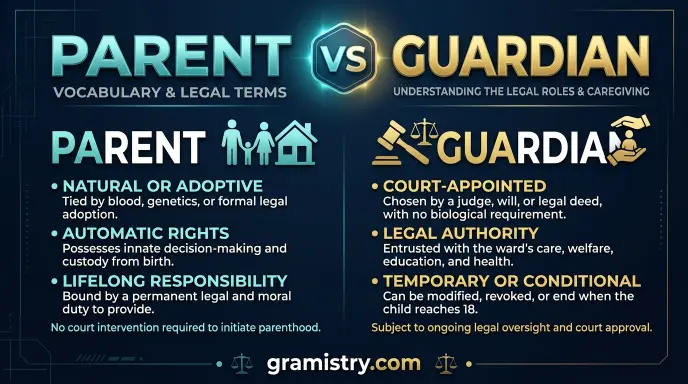
A parent is an individual’s biological or adoptive mother or father who has legal authority and responsibility for the child’s care.
Main Responsibilities
Parents typically are responsible for:
- Providing food and shelter
- Ensuring education
- Making healthcare decisions
- Offering emotional support
- Teaching values and life skills
- Protecting the child’s welfare
Where the Term Is Used
The word parent is commonly used in:
- Schools
- Hospitals
- Government documents
- Family law
- Everyday conversations
Legal Notes
Although laws differ by country and state, biological and adoptive parents generally have automatic parental rights unless those rights are limited or removed by a court.
Real-Life Examples
- Sarah is the parent of two children.
- Both parents attended the teacher conference.
- Every parent wants their child to succeed.
- Parents must approve the school trip.
- The doctor spoke with the child’s parent before treatment.
Short History
The word parent comes from the Latin word parens, meaning “one who brings forth or gives birth.” Over time, it expanded to include adoptive parents as well as biological ones.
What Is a Guardian?
A guardian is someone who has the legal authority to care for another person, usually a child, when the parents cannot or should not fulfill that role.
Unlike parents, guardians are usually appointed by a court, named in a legal document, or designated under specific laws.
Definition
A guardian is an individual legally authorized to make decisions and care for another person.
Main Responsibilities
A guardian may:
- Make educational decisions
- Consent to medical treatment
- Provide daily care
- Manage finances (if appointed)
- Ensure the child’s safety
- Represent the child legally
Where the Term Is Used
You’ll often see guardian used in:
- Courts
- Schools
- Hospitals
- Foster care systems
- Estate planning
- Legal documents
Legal Notes
Guardianship does not automatically make someone a parent. Instead, it grants specific legal authority defined by the court or governing law.
A grandparent, aunt, uncle, older sibling, family friend, or another trusted adult can become a guardian if legally appointed.
Real-Life Examples
- His grandmother became his legal guardian.
- The guardian signed the school enrollment form.
- The court appointed a guardian after the accident.
- Medical consent was provided by the child’s guardian.
- Every guardian must act in the child’s best interests.
Short History
The word guardian comes from Old French and Medieval Latin, referring to someone who protects or watches over another person.
Key Differences Between Guardian and Parent
| Feature | Parent | Guardian |
|---|---|---|
| Relationship | Biological or adoptive | Legally appointed |
| Automatically assigned | Usually yes | Usually no |
| Legal appointment needed | No | Yes, in most cases |
| Primary responsibility | Raising their own child | Caring for someone else’s child or dependent |
| Biological connection | Often yes | Not required |
| Can make legal decisions | Yes | Yes, within legal authority |
| Temporary or permanent | Usually permanent | May be temporary or permanent |
| Court involvement | Not usually | Often required |
Quick Comparison
- Parents are usually biological or adoptive family members.
- Guardians receive legal authority through appointment.
- Every guardian is not necessarily a parent.
- Every parent is not always the child’s legal guardian in every circumstance.
- Guardianship may end when the child becomes an adult or when the court orders it.
Real-Life Examples
Conversation 1
Teacher: Who should sign this permission slip?
Student: My grandmother is my legal guardian, so she’ll sign it.
🎯 Lesson: Guardians can legally sign school documents.
Conversation 2
Doctor: Is the child’s parent available?
Uncle: I’m not the parent, but I’m the court-appointed guardian.
🎯 Lesson: Guardians often make healthcare decisions.
Conversation 3
Friend: Are you his mother?
Woman: No, I’m his legal guardian.
🎯 Lesson: Guardians don’t have to be biological relatives.
Conversation 4
Principal: We’d like to meet with the parents.
Father: We’ll be there tomorrow afternoon.
🎯 Lesson: Parents usually handle school matters.
Conversation 5
Lawyer: Who has legal custody?
Client: The child’s guardian was appointed last year.
🎯 Lesson: Legal guardianship comes through formal authority.
When Should You Use Each One?
Choose parent when referring to:
- A biological mother or father
- An adoptive mother or father
- Everyday family relationships
- General discussions about raising children
Choose guardian when referring to:
- Someone legally appointed to care for a child
- Court documents
- Medical authorization
- School enrollment
- Legal responsibility without parenthood
Common Mistakes
❌ Calling every caregiver a parent.
✔ A caregiver may actually be a guardian.
❌ Assuming guardians are biological relatives.
✔ Guardians can be unrelated adults.
❌ Believing parents always need court approval.
✔ Parents usually receive legal authority automatically.
Easy Memory Tricks
- Parent = Birth or Adoption
- Guardian = Granted Legal Authority
Think of it this way:
Parents begin the relationship.
Guardians receive legal responsibility.
US vs UK Differences
Both the United States and the United Kingdom distinguish between parents and guardians, although the legal rules and terminology vary.
- In the US, guardianship is generally established through state courts.
- In the UK, parental responsibility and guardianship are governed by family law, with some differences in terminology and legal procedures.
Regardless of the country, a guardian is typically someone with legal authority to care for a child who is not acting solely as the child’s parent.
Fun Facts
- Some children have both living parents and a legal guardian in special legal situations.
- A guardian doesn’t always live with the child.
- Adults with disabilities may also have legal guardians to help manage important decisions.
FAQs:
1. Is a guardian the same as a parent?
No. A parent is usually biological or adoptive, while a guardian receives legal authority through appointment.
2. Can a grandparent become a guardian?
Yes. Courts often appoint grandparents when appropriate.
3. Does a guardian have legal rights?
Yes. Their rights depend on the guardianship order and applicable laws.
4. Can a child have both a parent and a guardian?
Yes. Certain legal situations allow both to exist at the same time.
5. Can guardians make medical decisions?
Usually yes, if their legal authority includes healthcare decisions.
6. Do guardians have financial responsibilities?
Often they do, depending on the guardianship arrangement.
7. Is a foster parent automatically a guardian?
Not always. Foster care and legal guardianship are different legal arrangements.
8. Can guardianship end?
Yes. It may end when the child reaches adulthood or when a court changes the arrangement.
9. Are adoptive parents considered parents?
Yes. Adoptive parents have the same legal status as biological parents in most jurisdictions.
10. Why is knowing the difference important?
Understanding the distinction helps avoid confusion in schools, healthcare, legal matters, and official paperwork.
Conclusion:
Understanding the difference between a guardian and a parent is important because these terms describe different legal and family relationships.
A parent is typically a biological or adoptive mother or father with inherent responsibilities for raising a child.
A guardian, on the other hand, is someone legally authorized to care for a child or dependent when circumstances require it.
Knowing which term applies can help you complete official documents correctly, understand legal rights, and communicate more accurately in everyday life.
Next time someone uses these two words, you’ll know exactly what they mean!

Alina Mark is the creative voice behind Gramistry.com, making word meanings, English expressions, and trending slang simple, clear, and interesting. Her mission is to make every word easier to understand, one meaning at a time.